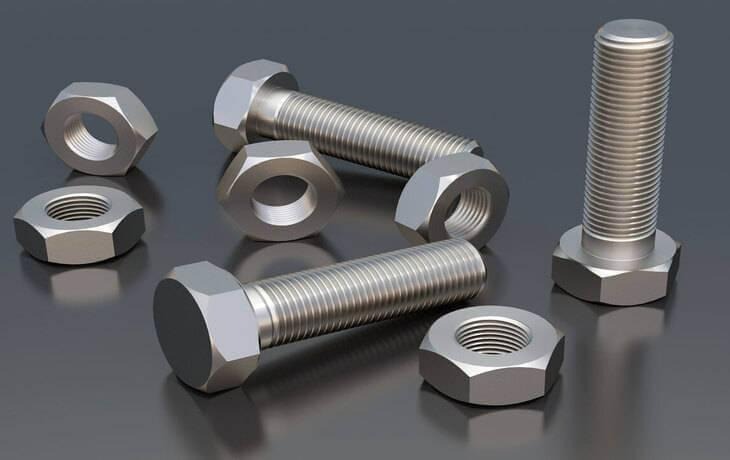
In chemical plants, Hastelloy B2 Fasteners are often specified when something goes wrong. Most engineers underestimate the rate of corrosion of bolts and nuts when exposed to concentrated hydrochloric, sulfuric or acetic acid. This results in leaks, downtime, and unplanned maintenance cycles that are far more expensive than the fasteners themselves. Hastelloy B2 Fasteners can overcome this problem, unlike standard stainless steel grades. These fasteners are made from a nickel-molybdenum alloy with about 65% nickel and 26–30% molybdenum. It provides excellent corrosion resistance in highly reducing chemical environments where most other alloys fail in months.
The alloy’s composition drives performance directly. Molybdenum at that concentration stabilises the nickel matrix against reducing acids, preventing the uniform corrosion and pitting that destroy standard fasteners in HCl service. Chemical plants working with Types Of Hastelloy B2 Fasteners typically specify bolts, nuts, washers, stud bolts, threaded rods, screws, and hex bolts across reactor flanges, heat exchanger heads, and pump housings. Each product type handles the same aggressive media while maintaining full mechanical integrity under load.
Hastelloy B2 Chemical Composition and Its Importance
The Hastelloy B2 chemical composition centres on two primary elements. Nickel forms the base matrix and provides inherent resistance to reducing environments; molybdenum, held between 26% and 30%, dramatically raises resistance to hydrochloric acid at virtually all concentrations and temperatures up to approximately 120°C. Together, they create an alloy that maintains corrosion rates below 0.5 mm per year in boiling HCl solutions where carbon steel corrodes at rates exceeding 10 mm per year.
Low carbon content, capped at 0.02%, prevents carbide precipitation at grain boundaries during welding or elevated-temperature service. Without carbon control at this level, sensitisation occurs, creating intergranular attack pathways that accelerate failure. Silicon content stays below 0.1%, which further reduces susceptibility to oxidising media contamination that would otherwise compromise the alloy’s reducing-environment performance.
Why Chemical Plants Prefer Hastelloy B2 Fasteners
Resistance to hydrochloric acid is where Hastelloy B2 Fasteners separate from every competing option. At concentrations from 1% to 37% HCl and temperatures up to 100°C, the alloy holds corrosion rates that make multi-year service life achievable without fastener replacement. Plants processing formic acid, phosphoric acid, and acetic acid report similar durability.
Pitting and stress corrosion cracking represent the two failure modes that terminate fastener life prematurely in chloride-rich environments. Hastelloy B2’s molybdenum content resists both. The stress corrosion crack propagation in chloride media in austenitic stainless steel grades takes place at temperatures higher than 60°C, while here this alloy does not show such behavior. Mechanical strength remains constant up to service temperature of 150°C, which is within the range of most operating conditions of chemical reactors and distillation columns.
Reduced maintenance costs follow directly from extended service life. A chemical plant replacing 316L stainless fasteners annually on a hydrochloric acid reactor saves the cost differential within the first replacement cycle when switching to Hastelloy B2 Fasteners.
Industries That Rely on Hastelloy B2 Fasteners
Several process industries depend on this alloy for critical bolted connections across a range of demanding service conditions.
Chemical processing plants use Hastelloy B2 hex bolts and stud bolts on reactor vessels, acid storage tanks, and pipeline flanges where HCl concentrations exceed 20% at elevated temperatures.
Petrochemical facilities apply these fasteners in units handling hydrocarbon streams contaminated with hydrogen sulfide and organic chlorides, where reducing conditions accelerate standard alloy degradation.
Pharmaceutical manufacturers specify Hastelloy B2 nuts and washers on reactors producing intermediates via acid-catalysed synthesis routes, where contamination from corroding fasteners would compromise product purity.
Fertilizer plants operating phosphoric acid and ammonium systems use these fasteners on scrubbers and absorber columns, where acid concentrations and temperatures fluctuate continuously across operating cycles.
Pollution control systems, including wet scrubbers and flue gas desulfurisation units, rely on Hastelloy B2 threaded rods and bolts to hold equipment integrity in highly acidic, chloride-laden gas streams.
Choosing a Reliable Hastelloy B2 Fasteners Manufacturer
It is critical to select the right Hastelloy B2 Fasteners Manufacturer to ensure the product meets specification, or fails to meet the lab-grade alloy properties in real service conditions. Buyers evaluating suppliers should verify a number of critical variables before placing orders.
Request mill test reports and material certifications to verify the exact chemical composition to UNS N10665 or ASTM B574 specifications for each lot supplied. Confirm that the manufacturer is making the fasteners to ASTM A193, ASME B18.2 or equivalent dimensional and mechanical property specifications suitable for your flange class and bolt grade.
Manufacturing quality shows in heat treatment records. Ask whether the supplier solution anneals at 1065°C after hot working to dissolve carbides and restore corrosion resistance. Skipping that step produces fasteners that corrode prematurely in HCl service.
Confirm global supply capability before committing to a source, since lead-time gaps during plant commissioning carry costs exceeding fastener savings. For existing equipment, verify custom sizing includes non-standard thread pitches, lengths and hex dimensions. For each critical order, obtain 3rd party test certificates from accredited laboratories for mechanical properties, hardness values and corrosion test results.
Conclusion
Hastelloy B2 fasteners provide significant advantages in chemical plants where reducing acids are used, especially hydrochloric acid at high concentrations. Due to their nickel-molybdenum content, controlled carbon levels and resistance to pitting and stress corrosion cracking, they are a technically sound choice where stainless steel grades consistently underperform. Get in touch with a reliable manufacturer or supplier today to source certified Hastelloy B2 fasteners for your upcoming project.