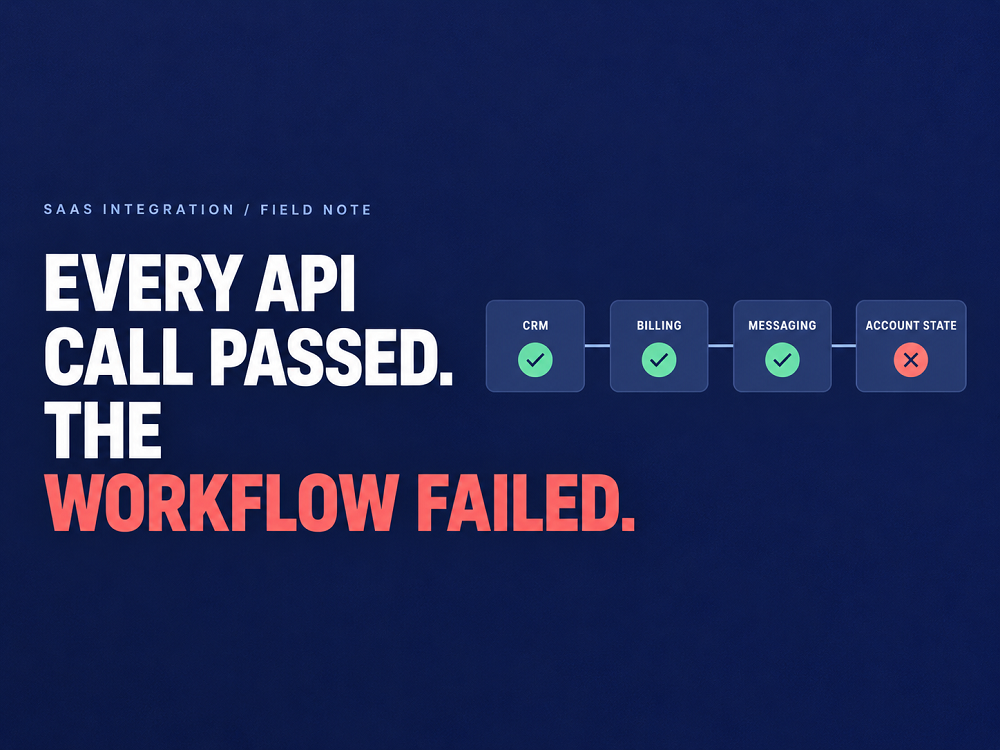
The CRM returned a successful response.
The billing platform accepted the subscription update. The support system received the customer record. Every API dashboard was green, and no exception appeared in the application logs.
The customer still received the wrong plan.
From a technical perspective, every request had worked. From the customer’s perspective, the integration had failed.
This situation is common because an API connection and a working business integration are not the same thing. An API proves that two systems can exchange requests. An integration must ensure that the correct data reaches the correct account, in the correct sequence, exactly once, with a reliable recovery path when something goes wrong.
A successful HTTP response confirms only a small part of that responsibility.
The Green Dashboard Can Be Misleading
Teams often monitor integrations through API uptime, latency, and error rates. These signals matter, but they mainly describe the transport layer.
A 200 OK response means that a server understood and accepted a request. It does not confirm that:
- The request contained the correct business data.
- Both systems interpreted the fields in the same way.
- The update reached the intended customer or tenant.
- A newer event did not arrive before an older one.
- A retry did not create a duplicate transaction.
- Another system did not overwrite the update later.
- The workflow can recover if a downstream step fails.
The integration may remain technically available while its business state quietly becomes inaccurate.
To understand why this happens, it helps to treat every SaaS integration as five separate contracts.
Contract One: Can the Systems Communicate?
The transport contract covers the visible API layer.
It includes authentication, endpoints, request methods, response codes, timeouts, rate limits, and network availability. Most integration testing begins here because these failures are easy to reproduce.
If an access token expires, the API returns 401. If the provider is unavailable, it may return 503. If too many requests arrive, the application receives 429.
These failures are clear. They create logs, alerts, and exceptions.
Transport problems are rarely the most difficult integration failures. The harder failures occur when communication succeeds but the meaning of the transaction changes between systems.
Contract Two: Do the Fields Mean the Same Thing?
Two platforms may use similar field names while assigning them different meanings.
Consider a field called amount.
One API expects dollars as a decimal. Another expects the smallest currency unit as an integer. Sending 100 could mean $100 in one system and $1 in another.
Dates create similar problems. One platform may store a subscription end date in UTC. Another may interpret it in the customer’s local timezone. A technically valid timestamp can still cancel access several hours too early.
Status fields are even more dangerous.
A CRM may use inactive for a lead who has stopped responding. A billing platform may use the same word for a cancelled subscription. Mapping one directly to the other can remove access from a paying customer.
Reliable integrations therefore need an explicit translation layer. External fields should be converted into the application’s own stable data model before they affect business logic.
Without that boundary, vendor-specific meanings spread throughout the product.
Contract Three: Does the Action Belong to the Right Identity?
SaaS integrations rarely operate for only one user.
They work across customers, workspaces, organizations, roles, and connected accounts. A technically successful request can still cross one of those boundaries.
This often happens when an external account ID is stored without the internal tenant ID that owns it. A background job retrieves the correct external record but attaches it to the wrong workspace.
Shared credentials create another risk. If one integration token can access several customer accounts, application code must enforce tenant boundaries on every request. The external provider may not understand the SaaS product’s internal authorization model.
OAuth scopes also change over time. An integration that originally required read-only access may later gain permission to create records. Unless permissions are reviewed, a small feature update can quietly expand the application’s authority.
Every integration action should answer three questions:
- Which internal tenant initiated the operation?
- Which external account is connected to that tenant?
- Is this user authorized to perform this specific action?
Authentication proves who connected the service. Authorization decides what each request is allowed to change.
Contract Four: Did Events Happen in the Correct Order?
APIs are synchronous, but real integrations are often event-driven.
Webhooks can arrive late, more than once, or in a different order from the events that created them. A network timeout can also leave the sender uncertain about whether the receiver completed an operation.
Imagine a customer upgrading a subscription and cancelling it a few seconds later.
The cancellation webhook may arrive first. The delayed upgrade event then arrives and restores the higher plan. Both webhooks are authentic. Both are processed successfully. The final account state is wrong.
Retries create another version of this problem.
If an application sends a payment request and times out before receiving the response, it may retry. The first request might already have succeeded. Without an idempotency key, the second attempt can create another payment.
Reliable integration design assumes that events will be duplicated and reordered. It does not treat those conditions as unusual edge cases.
Useful controls include:
- Unique event IDs for duplicate detection.
- Idempotency keys for operations with side effects.
- Event timestamps and version numbers.
- Durable queues instead of direct webhook processing.
- Rules that reject stale state transitions.
- Dead-letter queues for events that cannot be processed safely.
The goal is not to prevent every delivery problem. It is to make repeated and delayed events predictable.
Contract Five: Can the Integration Recover?
Many integrations are built around the happy path.
A customer is created in the CRM, added to the email platform, assigned a billing account, and granted product access. The workflow appears complete.
But what happens if the fourth step fails after the first three succeed?
The customer now exists in several systems without product access. Retrying the entire workflow could create duplicates. Reversing the earlier actions may remove data that another process has already used.
This is not an API availability problem. It is a distributed workflow problem.
Each step needs a defined recovery strategy. Depending on the action, the system may retry, compensate, pause for human review, or continue with a reduced level of service.
A reliable workflow should record:
- The operation that was attempted.
- The external system involved.
- The request’s idempotency key.
- The state before and after the operation.
- The response or failure received.
- The next permitted recovery action.
Logs help engineers investigate a failure. A durable workflow record helps the application recover from it.
Integration Health Is More Than Uptime
An API can maintain excellent uptime while the connected data slowly drifts.
That is why integration monitoring should measure business outcomes alongside technical responses.
Useful operational signals include:
Freshness: How long does it take for a change in one platform to appear in another?
Completeness: Did every expected record or event arrive?
Correctness: Do important fields match across systems?
Duplication: Was the same transaction or event processed more than once?
Recoverability: Can failed operations be retried without creating additional damage?
A reconciliation job is often as important as real-time processing. It periodically compares records across systems and identifies missing, stale, or contradictory states.
Real-time webhooks make an integration fast. Reconciliation makes it trustworthy.
Build Around the Workflow, Not the Endpoint
Teams sometimes begin integration planning by listing available endpoints.
A better starting point is the business workflow.
For example, “create a customer” is not a complete workflow. The real process may include verifying the account, selecting a plan, creating a billing profile, assigning permissions, sending an onboarding message, and notifying an internal team.
Once the workflow is clear, each API call can be assigned a role within it.
Before implementation begins, define:
- Which system owns each piece of data.
- Which state transitions are valid.
- Which operations must be idempotent.
- Which failures can be retried automatically.
- Which actions require human review.
- How conflicting records will be reconciled.
- Who owns the integration after deployment.
These decisions are more important than writing the first API request.
The Source of Truth Must Be Explicit
An integration becomes fragile when two systems can update the same field without a clear owner.
If the CRM and billing platform can both change the customer’s plan, which value wins? If a support representative edits an address while an automated sync is running, should the integration overwrite the manual correction?
The answer should not depend on whichever update arrives last.
Each important field needs a defined source of truth. Other systems may display or cache the value, but they should not silently compete to control it.
When bidirectional synchronization is necessary, conflict-resolution rules should be written as application logic rather than buried inside individual webhook handlers.
Reliable Integrations Need Product Ownership
An integration is not finished when the connection goes live.
External APIs change. Permissions expire. Customers disconnect accounts. Data volumes grow. New workflows reuse fields in ways the original developers did not expect.
Someone must own provider updates, operational alerts, failed-event queues, reconciliation reports, and recovery procedures.
For teams selecting a SaaS application development company, integration experience should be evaluated beyond the ability to connect endpoints. Spaculus Software approaches SaaS integrations as long-running business workflows with explicit data ownership, tenant isolation, idempotency, monitoring, and recovery.
A Working API Is Only the Beginning
APIs make communication possible. They do not guarantee shared meaning, correct identity, reliable ordering, or recoverable execution.
That is why SaaS integrations can fail while every endpoint remains available and every request returns successfully.
The better question is not, “Did the API call work?”
It is, “Did the complete business workflow reach the correct state, and can the system prove it?”