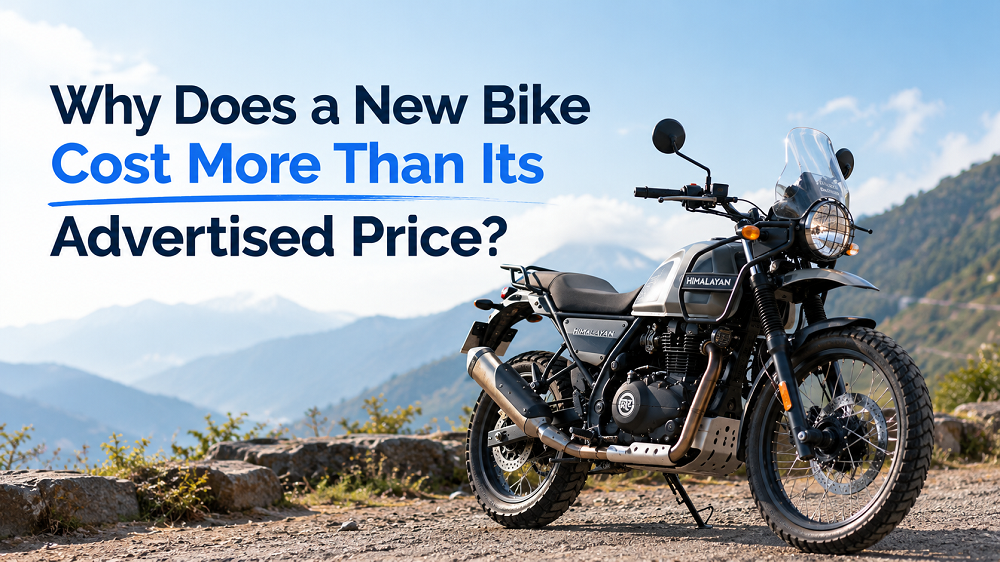
A bike advertised at ₹1 lakh may look affordable until you receive the dealer’s final quotation. Suddenly, the amount is higher than expected, and you are left wondering where the extra money is going.
The difference is usually explained by expenses that aren’t included in the advertised price. Registration, road tax and insurance can add to the bill, while accessories and additional packages may increase it further.
Before booking a motorcycle, it helps to understand what you are paying for. Knowing how the final price is calculated makes it easier to compare models, question unclear charges and choose a bike that fits your budget.
What Does the Showroom Price Actually Include?
The price displayed in a manufacturer’s advertisement or on a dealership website is usually the ex-showroom price. It represents the listed price of the motorcycle before certain additional purchase expenses are added.
The ex-showroom price generally includes the applicable taxes incorporated into the vehicle’s listed price and the dealer’s margin. However, it typically excludes registration-related charges, separately payable road tax and insurance.
This is why the price you see online may not match the amount you need to pay to take the bike home.
Imagine you have shortlisted two motorcycles. One is advertised at ₹95,000, while the other costs ₹98,000. The first appears to be the cheaper option, but the difference in their final prices may change once insurance and registration expenses are included.
When comparing models, use the ex-showroom price to understand their listed vehicle prices. For budgeting, however, ask for the on-road price, which provides a more complete picture of the initial purchase expense.
Six Things That Can Increase Your Bike’s Final Price
1. Registration and road tax
A new motorcycle must be registered according to the applicable motor vehicle rules before it can be used legally on public roads. Registration-related fees and road tax are therefore important parts of the purchase calculation.
Road tax varies by state and may depend on factors such as the vehicle category and applicable local rules. As a result, the same motorcycle can have different on-road prices in different locations.
Your quotation may also include charges for required registration-related items, such as a high-security registration plate where applicable.
Ask the dealer to show these expenses separately. A clear breakdown will help you understand which amounts relate to registration and which represent other services.
2. Insurance
Insurance is another expense buyers need to consider before collecting their new bike. Third-party liability insurance is mandatory for motorcycles used on public roads in India, while additional coverage can provide protection for damage to your own vehicle, subject to the policy terms.
The premium depends on the motorcycle, the type and duration of coverage, and other applicable pricing factors.
Dealers often offer insurance as part of the purchase process, which can save time. Still, it is worth checking the policy details before accepting the quotation.
Look at the premium, coverage, deductibles, exclusions and available add-ons. You can also compare eligible policies from different insurers. The cheapest option may not provide the protection you actually need.
3. Accessories you may not need
A dealer may offer a package containing a crash guard, seat cover, phone holder, protective coating or other accessories. Some can be useful, but not every buyer needs all of them.
Extended warranties and maintenance packages may also be offered during the sale.
Ask which items are optional and whether the quotation can be revised without them. If you want an accessory, compare its price and quality before agreeing to buy it through the dealership.
The difference may seem small when each item is considered separately. Together, however, optional extras can push the total beyond your planned budget.
4. Handling and other dealership charges
Charges described as handling, logistics, preparation or similar services can sometimes cause confusion.
If one appears on your quotation, ask the dealer to explain what it covers and why you are being charged for it. Do not assume a fee is compulsory simply because it appears on a printed estimate.
The validity of individual charges depends on the applicable rules and circumstances. If something seems questionable, seek clarification and check the relevant requirements before paying.
A useful approach is to separate statutory charges, insurance, optional purchases and dealership fees. That makes it easier to identify what you need to pay and what deserves further discussion.
5. Model-specific differences
Even motorcycles in a similar price range can have different registration expenses, insurance premiums and other applicable costs.
Engine capacity, vehicle category, the state of registration and the selected policy can all affect the final amount. Accessories or special editions may also change the price.
For this reason, comparing two motorcycles based only on their advertised prices can be misleading. Request an on-road quotation for each model using the same registration location, and check what is included in both.
6. Discounts and dealership offers
The final quotation can also change because of an available discount or promotional offer.
A dealership might offer a reduction on the vehicle price or include selected accessories as part of a promotion. However, not every offer reduces the amount you ultimately pay by the same amount advertised.
Check whether the discount applies to the ex-showroom price, optional products or another component. Then compare the final payable amount rather than relying on the headline offer.
A Simple Example: What Will You Actually Pay?
Suppose your budget is ₹1.10 lakh and the motorcycle you want has an ex-showroom price of ₹1 lakh.
Here is an illustrative calculation showing how the additional expenses could affect your decision. These figures are examples, not actual rates for a specific motorcycle or state.
| Cost component | Illustrative amount |
|---|---|
| Ex-showroom price | ₹1,00,000 |
| Registration and road tax | ₹10,000 |
| Insurance | ₹3,000 |
| Other applicable charges | ₹1,000 |
| Total on-road price | ₹1,14,000 |
The final amount is ₹4,000 above your budget, even before purchasing optional accessories.
At this point, you have a practical decision to make. You could ask whether an applicable dealership discount is available, compare another motorcycle, or reconsider your budget. You could also review optional expenses, although required taxes and fees cannot simply be removed.
This is the value of checking the on-road price early. It helps you make a realistic decision before paying a booking amount or committing to the purchase.
How to Check a Bike Quotation Before Booking
You do not need to become an expert in vehicle pricing to understand a dealership’s estimate. A few checks can make the process much clearer.
Request an itemized quotation. It should separate the vehicle price, registration-related expenses, road tax, insurance and additional charges.
Ask about compulsory fees. If the dealer says a charge is mandatory, ask for an explanation and verify the applicable requirements where necessary.
Review insurance separately. Compare suitable policies and coverage rather than choosing based on the premium alone.
Remove unwanted extras. Ask for a revised quotation without optional accessories or packages you do not intend to purchase.
Compare the final amounts. If several dealerships sell the same model, compare their complete quotations and check whether the included items are equivalent.
Check the invoice before payment. Make sure the amount matches the agreed quotation and that you understand any changes.
These checks are particularly useful when you have a fixed budget. They also make it easier to distinguish legitimate expenses from products or services you can choose not to buy.
Don’t Forget the Cost of Owning the Bike
The on-road price covers the initial purchase, but your expenses do not end when the motorcycle leaves the showroom.
Fuel, regular servicing, tyres, replacement parts and insurance renewals will affect your budget over time. How much you spend depends on your daily distance, riding conditions, the bike’s fuel efficiency and its maintenance requirements.
For someone commuting long distances every day, fuel and servicing may be more significant than they are for an occasional rider.
Before deciding on a model, consider both the upfront payment and the running costs you expect to face. A motorcycle that is affordable to buy may not be the most economical choice for your particular needs.
Final Thoughts
The price displayed in a bike advertisement is a useful starting point, but it does not always tell you how much you will need to spend. Registration, road tax and insurance contribute to the final amount, while optional accessories and additional services can increase it further.
Before booking, get the complete on-road quotation, question charges you do not understand and compare the final prices of your shortlisted models. Most importantly, leave enough room in your budget for fuel and maintenance after the purchase.
Planning to buy a new bike? Start by requesting an itemized on-road quotation from your dealership. Knowing the full amount upfront can help you choose a motorcycle that fits your budget without unpleasant financial surprises. For more practical insights, explore our guide to motorcycle pricing and buying tips.
Frequently Asked Questions
1. Can I buy a bike at its advertised price?
Usually, the advertised ex-showroom price does not cover all the expenses required to complete the purchase. You should budget for applicable registration charges, road tax and insurance as well.
2. Can I choose my own bike insurance?
You can compare eligible insurance policies and ask the dealer about your options. Review the coverage, premium, exclusions and policy duration before deciding.
3. Why does the same bike cost more in another state?
Road tax and registration-related expenses can vary by state. Insurance and dealership offers may also differ, which affects the final on-road price.