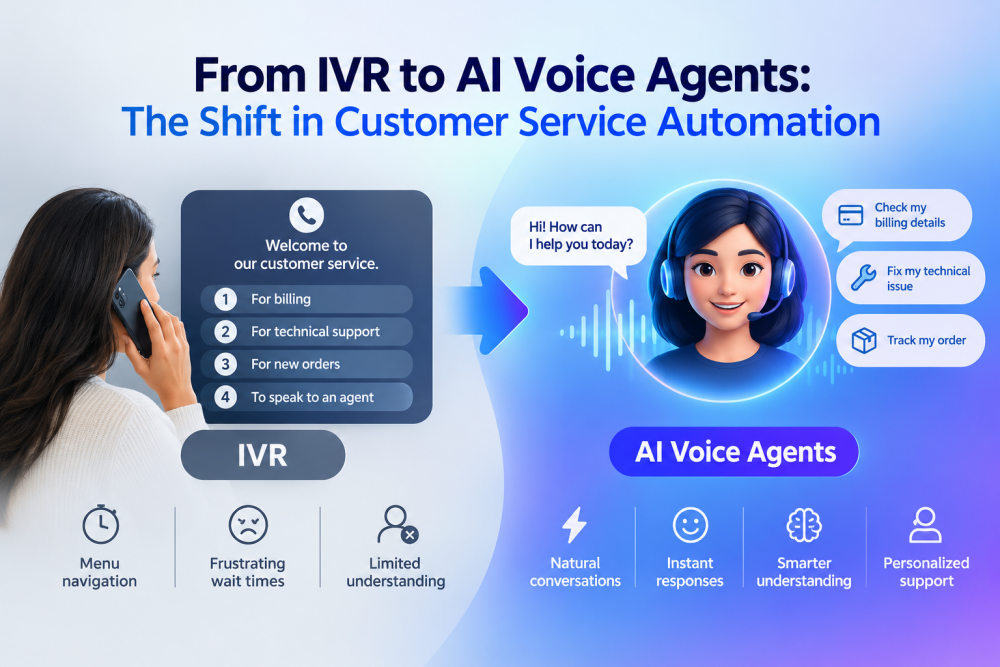
Customer service teams are under pressure from rising call volumes, multilingual demands, compliance obligations, and shrinking budgets. Traditional IVR systems struggle under these pressures because they’re menu‑driven paths designed for predictable transactions. When requests require context, flexibility, or cross‑department input, they’re insufficient. Considering how customers now-a-days expect faster, more accurate responses, enterprises need intelligent systems to fix the issue. AI Voice Agents are emerging as the next stage in service delivery. Instead of routing calls, modern voice agents interpret intent, access authorized data, and manage complete interactions.
This shift is not about replacing human agents but about redesigning workflows in a way; automation handles routine requests while human agents focus on exceptions and judgment‑based tasks. So, let’s explore how IVR evolved, the reasons businesses are moving beyond it, and the role of Agentforce voice AI in enhancing customer service.
Moving Beyond IVR: The Rise of Voice Automation
IVR runs on fixed paths: press 1, say “billing,” get routed. It’s better for simple, repetitive tasks. However, each new use case adds another branch to test and maintain. As those branches multiply, the menu tree is difficult to maintain and runs smoothly.
An AI voice agent skips the tree entirely. It picks up intent, keeps context as the call continues, asks for clarification when needed, and follows the workflow. That may mean checking an account, updating a record, booking an appointment, or handing the call to a human when required. Customers can explain their requirements directly instead of searching through menu options.
So, the distinction is simple: IVR routes calls, and AI voice agents handle requests.
Why Are Businesses Moving Beyond Traditional IVR?
Every added product line, language, channel, or backend system makes an IVR menu harder to maintain and quick to breakdowns. A team needs to configure each path, test it, and keep it updated. And when a caller can’t find an option that matches what they actually need, they hit zero, or hang up frustrated, which shows later as a transfer-rate issue.
Intent-based workflows sidestep a lot of that. AI voice agent services can handle appointment scheduling, order tracking, account inquiries, lead qualifications, and service updates. Basic troubleshooting without needing a menu option pre-built for every scenario.
There’s a resourcing shift here, too. When routine calls run on automated rules, human agents get to spend their time on the interactions that actually need a person, negotiation, exceptions, anything requiring judgment. You can set escalation parameters based on how sensitive or complicated each workflow is.
7 Practical Benefits of Voice Agents in Customer Care
1. Enable Natural-Language Interactions
Customers describe what they need in their own words instead of working through a menu tree. An AI voice agent reads intent, asks a clarifying question when something’s unclear, and responds using whatever business context it has access to. This matters most for the requests that never mapped cleanly onto an IVR category to begin with, and there are more of those than most businesses assume.
2. Support Multilingual Customer Service
IVR systems typically need a separate build for each new language, a parallel menu tree, and parallel maintenance. Multilingual voice agents avoid that duplication. The business rules and escalation logic stay constant across languages; only the language layer shifts underneath them. That lets an enterprise serve multiple markets on one standardized set of service logic rather than several disconnected ones.
3. Apply Consistent Service Workflows
Manual handling drifts. Two agents, two shifts, two slightly different answers to the same question; it happens even with good training. An automated workflow doesn’t work the same way. AI voice agent services for businesses apply the same response policy and data-access rule to every eligible interaction, which in turn gives quality-assurance teams a cleaner baseline to monitor against.
4. Integrate With Enterprise Applications
A voice agent with no system access can hold a conversation, but it can’t really resolve anything. Value comes from the integration layer, CRM records, ticketing queues, scheduling tools, and knowledge bases. Once those are connected, the agent can look something up mid-call and act on it, rather than just talking around the customer’s actual problem.
5. Preserve Context During Human Handoffs
Repeating details after a transfer frustrates customers. Handoffs don’t have to work that way. Subject to the enterprise’s data and privacy controls, Agentforce voice AI carries forward whatever it already gathered during the call, and the human representative picks up with that context intact. The customer explains less. The receiving agent starts further along.
6. Extend Inbound Call Coverage
Customer demand cannot be fitted into business hours, and it’s difficult for the staff to be available around the clock. An AI call answering service fills that gap. It can answer FAQs, collect caller details, schedule appointments, and route intent whenever call volume spikes, or off‑hours. It extends coverage without replacing the human team.
7. Establish Controls for Sensitive Workflows
Automating everything by default is a mistake. Some transactions need authentication, added verification, or a human reviewer before they proceed, regulated processes and high-risk requests, in particular. Setting boundaries is part of workflow design, not a compliance afterthought. Enterprises define where automation stops, and human judgment begins.
What Should Enterprises Consider Before Replacing IVR?
When you consider replacing IVR with AI voice agents, follow these important factors:
- Intent recognition and handling of ambiguous requests
- CRM, ticketing, scheduling, and operational-system integrations
- Authentication and authorization requirements
- Data privacy, call recording, and retention policies
- Supported languages and voice quality
- Human handoff procedures and context transfer
- Monitoring, analytics, testing, and quality assurance
- Cost per interaction and expected automation rate
In addition, a lot of enterprises opt for a hybrid approach: IVR for predictable, clearly routed transactions, AI voice agents for anything needing intent recognition or system access or a multi-step workflow. One doesn’t have to fully replace the other.
AI Voice Agents and Automated Customer Service: Future Outlook
IVR systems were built to route calls, not to understand them with intent. Voice automation has brought in the ability to interpret intent, using authorized data, running tasks, and escalating to humans when required. But for optimal results, effective deployment is required based on accurate recognition, secure integrations, and clear escalation paths.
Moreover, voice AI agents are becoming a part of the wider customer service framework, connected to CRM platforms, operational systems, and human teams. The challenge for enterprises is not how to run these intelligent systems but determining which interactions can be automated reliably, which require human judgment, and how to keep balance between two without friction.
Moreover, voice AI agents are becoming a part of the wider customer service framework, connected to CRM platforms, operational systems, and human teams. An AI voice agent platform can help enterprises manage these intelligent systems more effectively, but the real challenge is determining which interactions can be automated reliably, which require human judgment, and how to keep the balance between the two without friction.