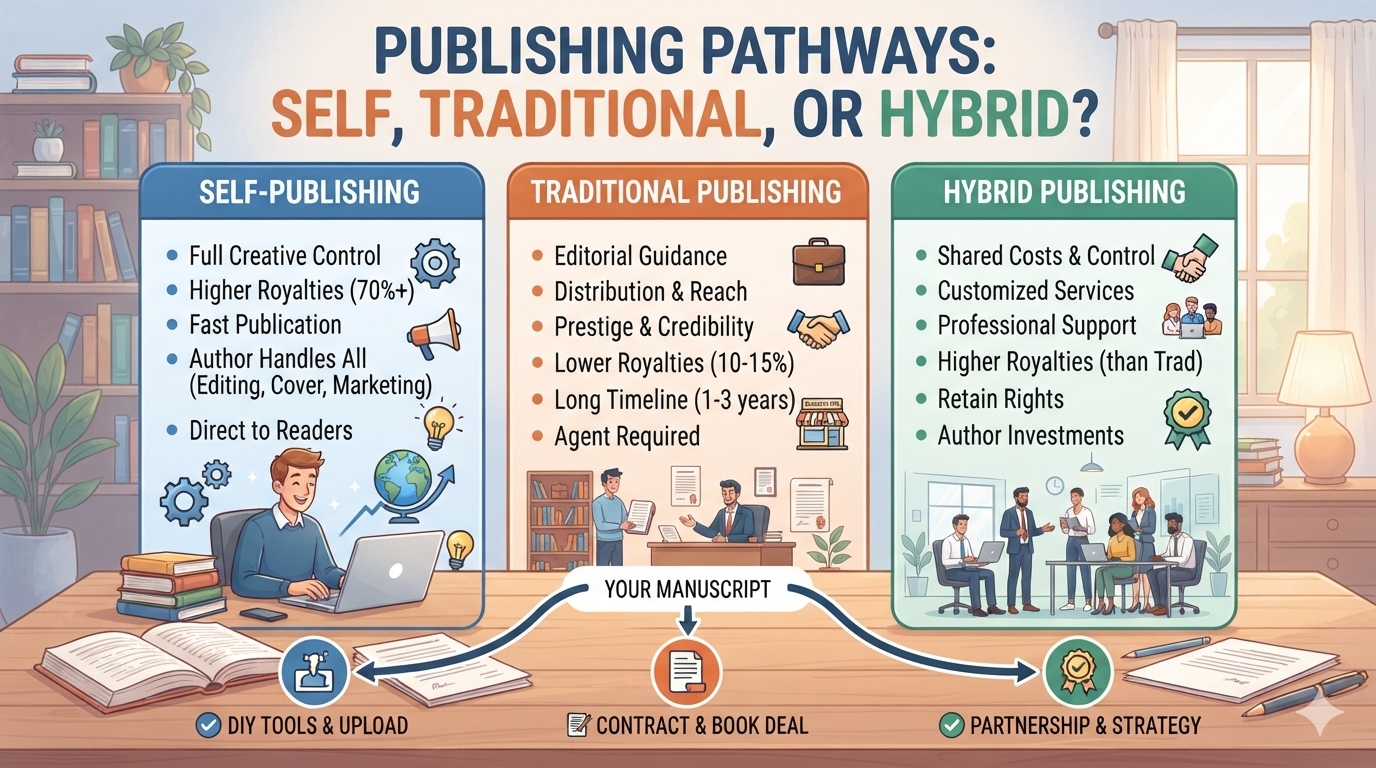
If you are a new author still determining self-publishing vs traditional vs hybrid publishing, you just need the right direction. The choice of publishing route depends on who you are and what you appreciate most. Authors need to make the right decision, as the publishing path is one of the key factors in how your book will be marketed in the industry.
Another factor that demands close attention is how certain elements shape your decision about the right publishing path. It could include industry support, creative control, time, or financial responsibility. Each route has its own standout qualities. It is about finding the path that best matches your book, your audience and your work style.
What Are the Differences Between the Three Publishing Routes?
| Factor | Traditional | Self-Publishing | Hybrid |
| Upfront cost | Usually low | Author-funded | Author-funded |
| Creative control | Lower | Highest | Shared |
| Speed | Usually slower | Usually faster | Moderate |
| Professional support | Publisher-led | Author hires services | Publisher provides services |
| Distribution | Established channels | Author builds channels | Depends on agreement |
| Financial risk | Mainly publisher | Mainly author | Mainly author |
| Best for | Commercially positioned books | Direct-to-reader books | Authors wanting support and input |
This comparison table between self-publishing vs traditional vs hybrid publishing shows how different factors influence the variance in each publishing path. Authors must make the decision with each element in mind. Ask questions of the publishing house or the consultant helping you decide. If they answer confidently and genuinely try to resolve your query, you can trust them. This method helps you judge the credibility of service providers like bookpublishingsg, etc.
When is the Established Traditional Publishing Route Appropriate?
Traditional publishing suits authors who prefer a more established publishing process and network. Publishers choose the articles and pay for their publication, and they can also determine where they are placed.
Which Genre Works Best in This Route?
The conventional publishing method can work well for commercial fiction, romance, crime, fantasy, or narrative nonfiction. But genre alone is not enough to be successful. Even a good manuscript needs an audience, the right time, place, and commercial interest.
A new author might prefer a professional editor and bookstore distribution rather than having sole control. In this case, the choices are self-publishing vs traditional vs hybrid publishing, and it comes down to priorities. Traditional publishing can involve submissions, agents, revisions, negotiations, and a long wait.
Potential Advantages
➔ Committed editorial and production teams.
➔ Having access to distribution relationships.
➔ Reduces production cost responsibility.
➔ Industry credibility.
Possible Drawbacks
➔ Longer timelines
➔ Decreased leverage in cover, pricing, and positioning
➔ Competitive selection
➔ Rights and royalties may be impacted by the terms of the contracts.
Who Can Benefit from Self-Publishing?
The author can control the release through self-publishing. In this path, they can choose editors, designers, formats, pricing, launch dates, and even marketing strategies. This flexibility can come in handy if the author already knows their audience.
Being an author, ask yourself, when choosing between self-publishing vs traditional vs hybrid publishing, whether you are prepared to run the book like a small business. Be sure to do your research. And a simple self-publishing companies in Singapore search will show you various business models, so take note of exactly what each package includes.
Coming down to genre choice, independent publishing can suit romance, science fiction, fantasy, poetry, practical guides or niche nonfiction. A specialised guide can work if the author knows how to communicate with their audience.
Where Could Things Go Right or Wrong?
The self-publishing route shifts the burden of the whole process of writing and publishing the work to the author.
Strengths
● Full creative decision-making
● Faster release control
● More options for pricing and format
Challenges
︕ The author must plan editing, design, printing, and promotion.
︕ Outsourcing multiple services can increase costs.
︕ The author retains all rights and is responsible for selling the book.
What about Going for a Middle Hybrid Publishing Route?
For authors who want professional help without surrendering creative control, hybrid publishing may be the answer. But it is not the standard business model. The fees, rights, royalties, distribution and marketing may vary.
– Prior to signing, authors should ask for a detailed breakdown of services, ownership, revision, change limits, cancellation terms, and distribution.
This might be an option for an author who desires editing, design, formatting, and distribution without losing approval. When support and control are important, comparing self-publishing vs traditional vs hybrid publishing comes into play. When looking for a book publisher Singapore, authors must not only look at package prices but contracts as well. A lower-cost package may not include some of the services.
What Might Be Bad or Good in This Publishing Path?
Benefits
✔ Professional assistance without giving up all decisions.
✔ A well-defined manufacturing process.
✔ May be faster than traditional avenues.
✔ A single service package can address various requirements.
Risks
⨯ Initial fees may be high.
⨯ Not all providers are created equal.
⨯ It will be hard to compare royalty arrangements.
⨯ Marketing promises should be in writing.
Which Self-Publishing vs Traditional vs Hybrid Publishing Route Belongs to Which Author?
| Priority | Considered Route |
| Industry-led production | Traditional |
| Maximum creative control | Self-publishing |
| Hands-on professional support | Hybrid |
| A targeted audience that you can reach directly | Self-publishing |
| Reduced production responsibility | Traditional |
FAQs
Can an author change the publication route later on?
In the self-publishing vs traditional vs hybrid publishing comparison, keep in mind that it is not too late to change your path. But contracts, rights and distribution will all play a part in what is available.
Can a publisher be trusted because they have an ISBN?
No. An ISBN does not by itself demonstrate the quality of service or fair commercial terms of a publishing house. It should not be the major point of determination for authors when selecting the publishing routes.
Which publishing path allows an author to have more control?
In general, self-publishing gives authors the most control over the manuscript, cover, pricing, release date, and marketing decisions. Traditional publishing includes more publisher involvement, and hybrid publishing usually has both the publishing company and the author in decision-making.
Is it possible to publish the same book in different ways?
Usually, you should not release the same book under the same rights and in the same format through different publishing routes. Before changing paths, authors should review the current contract.
What Does This Comparison Imply?
There is no guarantee that book marketing will be successful. The best decision aligns publishing with your resources, audience, and expectations. Self-publishing vs traditional vs hybrid publishing is a planning decision and not the choice between the labels. Authors should read the contract, work out the expenses, and understand what is involved, then choose a model they can afford. Consider what you will do after launch, too, since promotion, reader engagement, and future editions can be yours after publishing.