Have you ever thought that your APIs could become one of the biggest revenue engines? For some companies, they already are, and even data backs this up.
According to Postman’s 2025 State of the API Report, 42% of companies that skip an API-first approach earn less than 10% of their revenue from APIs. Meanwhile, their API-first rivals build major revenue on the same technology.
This gap has grown over the years because software moved from single, locked-down applications to interconnected systems. Companies that treated APIs as a last-minute add-on struggled with every new connection. And companies that built on API-first architecture from day one moved faster. Their products can now easily plug into partners’ systems, platforms, and even AI agents.
But how did this approach rise, and why are modern applications now being built around connected ecosystems? Let’s explore the evolution.
How Application Development Moved From Monoliths to APIs
Earlier, user interface, business logic and data access were all in a single monolithic codebase. However, this setup became hard to scale when features and users grew. Even a small change to one feature could affect the entire system.
Thus, businesses started adopting modular architectures with microservices. Applications became easier to maintain and scale, as each service performed specific functions on its own. APIs emerged as the bridge between these services and other systems.
This also changed application integration. Teams no longer rebuilt the same feature for every platform. They built it once and let other apps use it through an API.
The need for flexibility kept growing. Businesses now integrate payment options with CRMs, mobile apps, analytics, and AI services. This has changed the function of APIs. They are no longer a tool for connecting, but the beginning of application design.
What API-First Development Actually Means
The short answer is that it is an approach where the API is designed before any application is built.
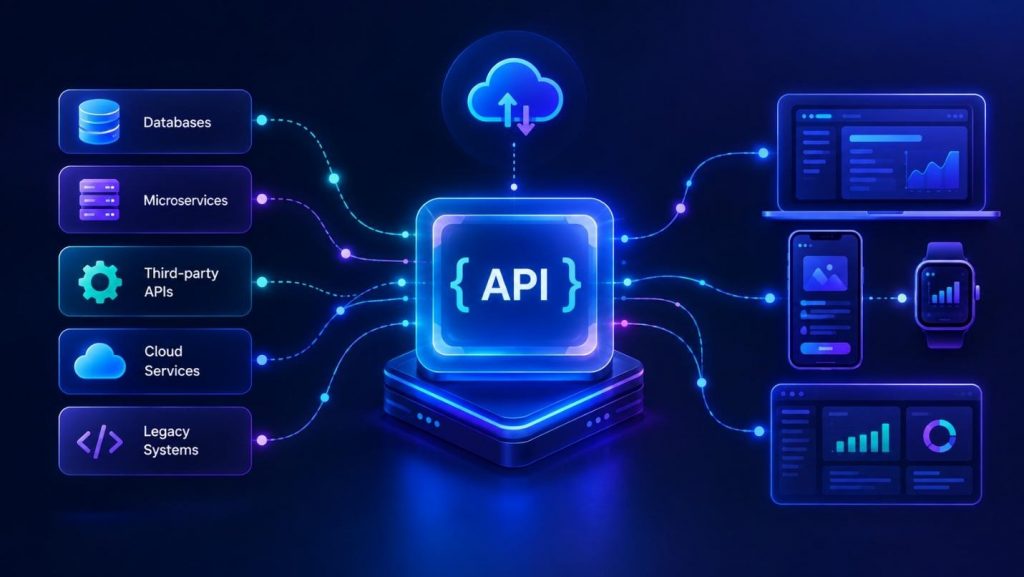
For example, a retailer wants to have their product catalog on a website, app and partner marketplace. If the team followed a code-first approach, they would have to create three separate connections. API-first architecture, on the other hand, sets up one standard rule to access the product catalog.
Every team can then build its part using those same rules. This is API-driven development in action. Each service becomes a reusable building block, and that is the core of API-first architecture. Once those blocks exist, the business benefits start to show.
Why Businesses Are Building Modern Applications Around Connected API Ecosystems
Businesses build around connected API ecosystems because it helps them grow faster, stay safer, and earn more. Here are the reasons businesses keep making this move.
Faster Growth Through Scalable Design
Begin with growth. Reusable services mean teams do not have to reconstruct the same feature, which results in an earlier product launch. That’s also a good indication of how API-first development can enhance scalability. Services are independent and won’t crash when a traffic surge occurs in one area. Web, mobile, IoT and AI agents can also be fed from the same backend with a scalable API architecture.
Safer Connections From Day One
More connections bring more risk. All open endpoints are doors, and therefore security for an API needs to be built into its design. Build authentication, rate limiting and gateway rules into the contract itself. In that case, each new connection will get the same protection.
New Markets and the Next Chapter
Safe connections then open new markets. Once your business exposes its services through secure APIs, your partners can build on top of them. Your customers get better experiences, and every new partner grows the ecosystem further. Few teams can design all this alone, so many turn to API development services for contracts, governance, and application integration.
This is just the initial phase of the growth. Today, AI tools and agents communicate directly with APIs and require clean, well-documented APIs to function. That’s a glimpse into the future of API-driven software ecosystems, where the businesses with the best APIs are first to plug in.
Preparing Applications for a More Connected Future
Applications have evolved from stand-alone code to services that integrate with platform and AI services and partners. But it is not going to slow down any time soon. In the future, users will be interacting with software that looks for and calls APIs for them, sometimes in real time.
Hence, the shift from API-first architecture becomes more than just a technical decision. It’s how businesses stay ready for whatever connects next. In a world built on connections, the businesses that are easiest to connect with will be the ones that lead.