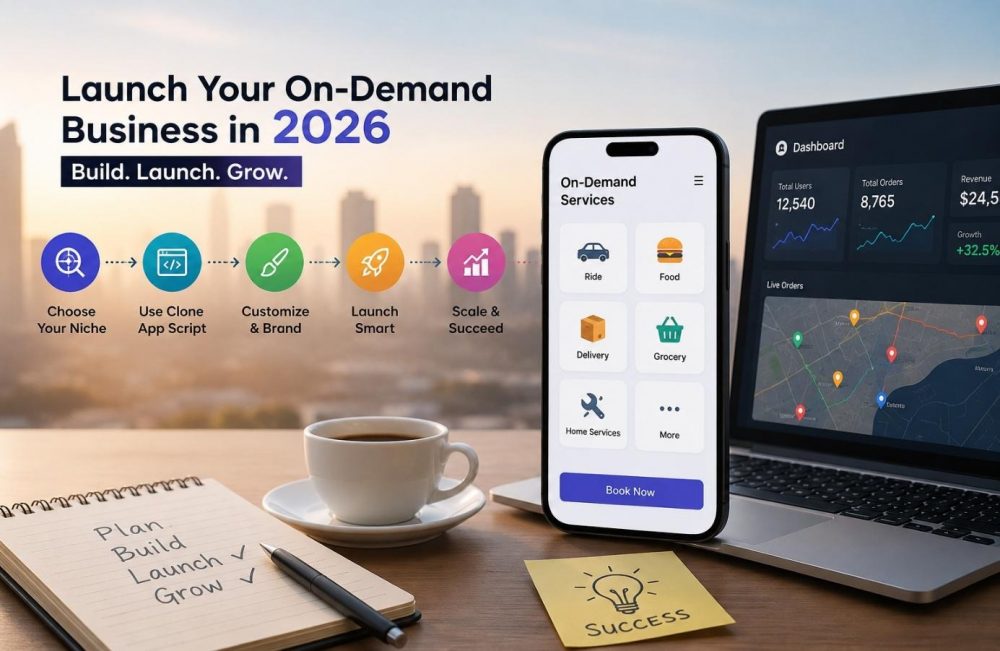
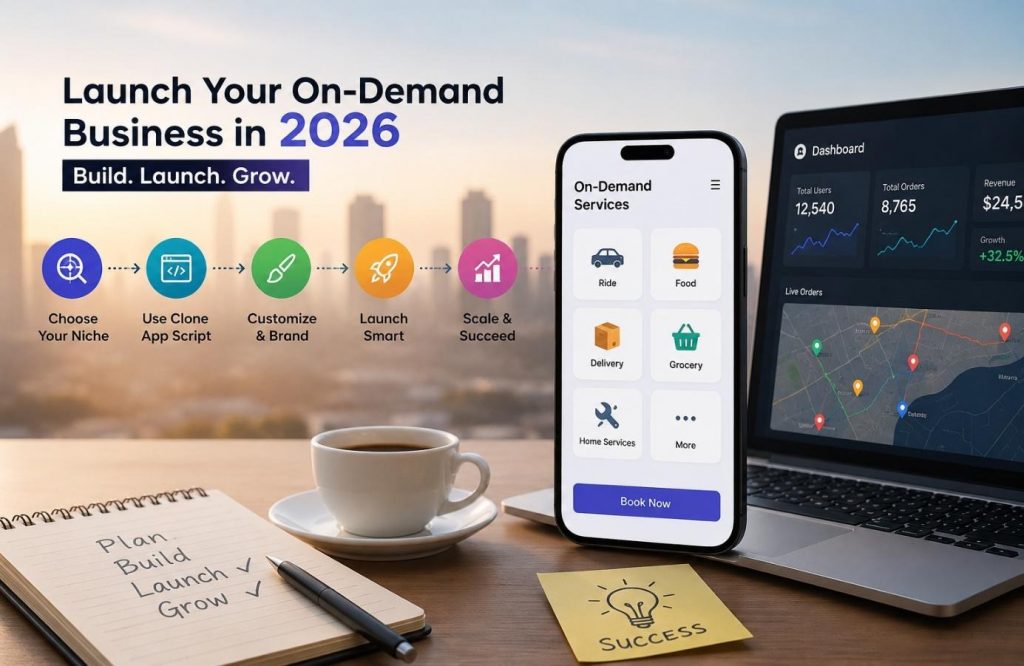
On-demand economy has revolutionized the way in which consumers obtain their services and products. Whether ordering meals or requesting for a ride, people today want convenience, speed and ease of use through technology applications. As technology adoption increases, so does the need for on-demand apps continue in 2026 due to increased use of smartphones, digital payments and shifting lifestyles. Creating an on-demand app from scratch could be costly and complex for most entrepreneurs.
That is where cloning has become popular as a means of obtaining a prebuilt platform for entrepreneurs who need fast solutions. Clone scripts are prebuilt software applications that are inspired by already successful apps. Such clone apps give a business opportunity to create a similar app at a lower cost and within a shorter timeframe.
A company looking to launch a successful app in 2026 cannot solely rely on replicating the other app completely and rather it should have proper understanding of how to use these scripts correctly- from picking the right niche to scaling the user base- is what separates businesses that succeed from those that quietly shut down within the first year.
Choosing The Correct Niche
The very first step to take before selecting any clone app script is selecting the correct business niche. Not all models of the on-demand economy can be applied everywhere and therefore; it is important to opt for a business niche where demand is actually present in the target area.
The best possible way to decide this is to see what kind of businesses are successful in the economy from a long time and to check if there is any gap that could be taken advantage of.
Choosing a successful niche means that the business is not experimenting with a completely new idea. Instead, it is bringing a known business model to a market that is ready for it. This drastically reduces the risk of failure and gives the clone app script a solid foundation to grow on.
Select The Right Clone Script
After identifying the niche, the next most essential step is selecting the right clone script provider. It is necessary to understand that not all scripts are created in the same way and hence, selecting the wrong developer may lead to severe issues such as poor performance, security concerns and even a lack of post-purchase support.
When selecting the provider, one should pay attention to several factors such as the script should be developed with up-to-date technological stacks, it should contain clean and comprehensible code and the platform must include all the necessary functionality.
It is also important to check the provider’s track record. Look for client reviews, case studies and live demos of their product. Providers who have helped multiple businesses launch successfully are far more reliable than those offering very cheap scripts with no proven record. Spending a little more on a reputable provider often saves significant money and frustration in the long run.
Customisation
One of the most significant benefits of a clone app script is its customization. Once you have purchased the script, the next step is to transform the clone app into something that authentically represents your brand and the specific market that it caters to. A well-customized clone app stands out from a generically designed app and transforms into a trustworthy on-demand application your users will revisit repeatedly.
Customization of the cloned application ranges from incorporating the brand’s logo, colours and name to make the platform exclusive to the business. Aside from branding, it is crucial to integrate the various software that cater to the local demands, such as integrating region specific payment gateways, establishing local currency and language settings and adjusting service fee or commission percentage according to the local market trends.
Feature customization is equally important as the average consumer expects a smart application experience. Adding AI driven suggestions, live tracking capabilities, notification services, a loyal reward system or membership subscriptions are important factors that improve the user retention and loyalty towards the application.
Building Supply Side and Using a Focused Launch Strategy
A key mistake new on-demand startups make is launching their app before building the supply side first. An on-demand business is only as good as the people behind it. If customers access the app and there are no available drivers nearby, no restaurants or no prompt delivery of the service, they are not coming back.
New businesses must invest a lot of time and effort into onboarding the right service providers in the service area before releasing the app publicly. To quickly attract vendor and partner uptake, they should be offering good early-adopter benefits such as discounted commissions, guaranteed earnings, joining bonuses, etc. The priority is to ensure the business can deliver the service reliably before acquiring customers.
Likewise, new businesses should be focusing on one city or area to start with rather than launching to multiple cities or regions. A hyper-localised, area by area approach to launching is much more effective in the early stages of an on-demand business. By focusing on a single area, the business can provide intense operational support, focus its marketing efforts and apply its customer acquisition strategies effectively without using much resources.
The Future of on Demand Clone Apps
The digital transformation of 2026 offers tremendous opportunities for entrepreneurs willing to combine technology with smart execution. Although clone app scripts let startups enter the market quickly and affordably without years in the development stages, there is much more needed for businesses to be successful long term other than simply cloning. Businesses need to choose the right niche carefully, get the right clone script provider, customize it according to local demands and the supply side needs to be secured prior to launching.