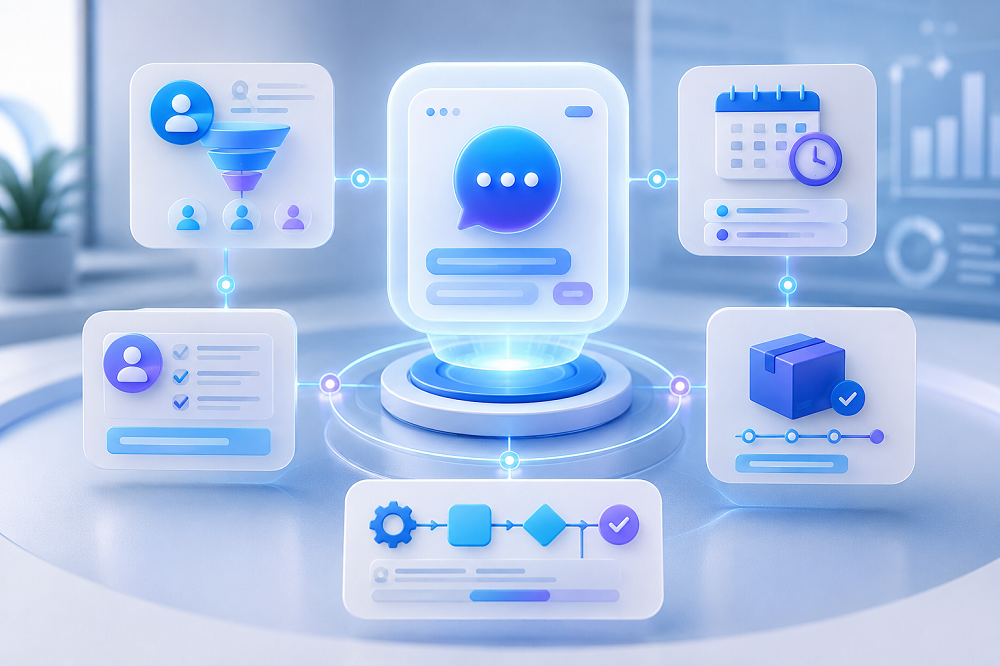
The traditional chatbot on a website had a simple and straightforward function: to provide standard information for solving basic support queries. This chatbot could tell about return policies, set passwords, give working hours, or point the customer towards the correct department. This function was helpful but rather narrow. The traditional chatbot would typically exist outside the actual processes of the business.
This is how the role of the chatbot is evolving. Due to improvements in language models, business integration, multimodal interface design, and workflow automation, chatbots are becoming real assistants that can help users perform tasks, take decisions, and advance further in the business workflow.
Conversations are becoming actions
One of the most significant changes would be from mere data search to task execution. For instance, while a support bot could guide a client on how to alter their shipping address, an advanced bot could actually go ahead and check the validity of that request, update the address in the order database, and log this activity.
This does not imply that all chatbots have to operate without any constraints at all times. Critical actions, including making a sizable refund or modifying account data, would always require authorization and even human verification in some cases.
Sales teams are gaining a useful first responder
AI chatbots are now being used more commonly prior to any interaction between the prospect and the salesperson. They can help by posing necessary questions, identifying the needs of the visitor, offering appropriate solutions, gathering their contact information, and scheduling a meeting time. Moreover, when the chatbot is integrated into the CRM system, it can generate a lead record in the CRM system so that the sales team gets necessary information instead of an empty query.
In this way, the interaction will become more productive for both sides since the prospect gets assistance right away, and the salesperson focuses only on viable leads.
Onboarding can become more personal
Onboarding customers is usually associated with filling out forms, papers, set-up instructions, and repetition of questions. All these tasks can be automated by a chatbot according to the role, type of product, or any other criterion. This bot will be able to clarify definitions, tell users what they have missed, and show them how to use the particular function.
The same process can be used for employees’ onboarding. They can ask questions concerning internal policy, benefits, procedures, etc., without looking for information in different documents. In case the response is linked to confidential information, access control becomes a crucial issue.
Chatbots are entering everyday operations
Perhaps the most useful chatbot is not one that interacts with customers at all. The internal chatbots can assist employees to find data, create a report, submit a ticket, monitor inventory, record a project, or extract approved data from the company’s database. In all these instances, the chat application acts as a user-friendly interface for existing applications.
For example, a marketing manager requests a report on the performance of the marketing campaign. A customer service employee retrieves the order history while talking to a customer. And a project manager creates a task from a note taken during the meeting.
Text is no longer the only interface
Chatbots are also becoming multimodal in today’s world. Chatbot users can communicate via speech, share documents, images, and even toggle back and forth between text and voice communications in the same interaction. An insurance client could, for instance, send a picture of the broken item and tell the story of what happened through voice communication.
Such a process may be beneficial and smooth, yet it entails certain obligations. Companies need to decide on file storage, data protection, and when the conversation needs to be archived and when it should be handed over to a human.
Good development starts with the workflow
Businesses considering AI chatbot app development services should start with the problems they want to solve rather than simply adding popular AI features. They should map the user journey, identify the required data, define which actions the chatbot can perform, and decide where human approval is necessary.
It will also be necessary for teams to track metrics beyond the volume of conversations. Among other possible measures are task completion rate, answer precision, escalation quality, user satisfaction, time of response, and quantity of solved problems. The testing process needs to be ongoing, as language, business data, and systems change over time.
Human support remains part of the design
However, moving away from customer service doesn’t mean that people cannot be a part of the customer experience process. Sometimes communication is emotional, extraordinary, negotiating, or risky, and it makes sense to have a flawless transition rather than making the chatbot do its job even though it’s difficult for it.
The most effective systems know their limits and automate repetitive procedures, give necessary information, and introduce a person to the conversation when there’s an element of judgment involved.
The next chatbot is a business interface
Chatbots powered by artificial intelligence are no longer confined to support roles, as dialogue can be used as a practical channel to get service, information, and work done. The evolution of chatbots will be about more than crafting natural answers; it will be about facilitating useful activities with fewer obstacles.
The potential for businesses is enormous, but so are the challenges in designing a good chatbot. A chatbot acquires value when it is integrated into the right process, safeguarded by appropriate security, assessed by desired metrics, and assisted by humans when necessary.