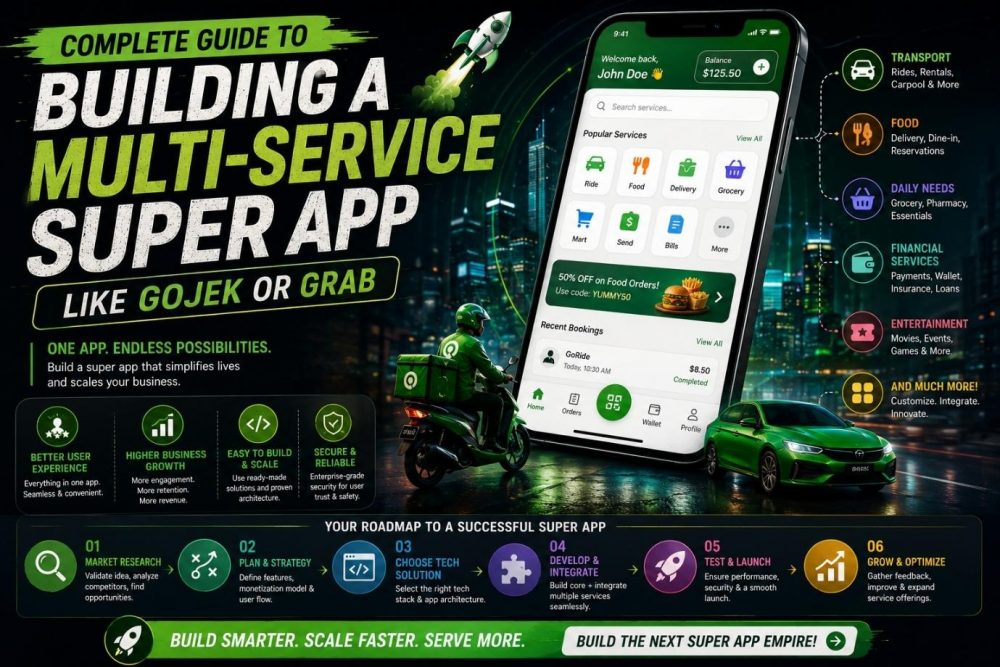
A few years ago, most apps had one job. You booked a ride, ordered food, paid bills, or scheduled deliveries through separate platforms. Now many users prefer one app that handles several daily needs in a single place. Less switching, fewer passwords, fewer notifications from twelve different apps. Honestly, that part alone is appealing.
This is where the super app model comes in. Platforms like Gojek and Grab showed that users value convenience when multiple services work smoothly together. For entrepreneurs, the model is attractive because one customer can use the platform many times for different reasons. That creates stronger retention and more revenue opportunities.
Of course, building one is not exactly a weekend project. But it can be done strategically.
What Is a Super App, Really?
A super app is a digital platform that combines several services inside one ecosystem. Instead of focusing on a single feature, it becomes a hub for everyday tasks.
Typical services include ride-hailing, food delivery, grocery ordering, courier services, digital payments, hotel booking, appointment scheduling, or home services. Some even add insurance, lending, ticketing, and subscriptions.
The key idea is not simply adding features. It is creating connected convenience. If the app feels cluttered or confusing, users leave quickly. And they do not always announce their departure.
Start With One Strong Core Service
Many founders make the mistake of trying to launch ten services at once. It sounds ambitious in pitch decks. In reality, it often creates chaos.
The smarter route is to begin with one high-demand service, then expand gradually. Ride-hailing, food delivery, or hyperlocal logistics are common starting points because they create frequent usage. Once customers trust the platform, adding more services becomes easier.
Think of it as building traffic before building shops around the traffic.
Without a core use case, extra features may just sit there looking decorative.
Choose the Right Market First
Not every city or country needs the same kind of super app. User behavior, payment habits, delivery infrastructure, regulations, and smartphone adoption all matter.
A dense urban market with traffic congestion may respond well to bike delivery and ride booking. A growing suburban market may value home services and grocery delivery more. Some regions prefer wallets. Others still lean heavily on cash.
Local understanding matters more than copying another company’s model exactly. What worked in Jakarta may need serious adjustments elsewhere.
That part gets underestimated often.
Build the Right Technology Stack
A multi-service platform needs stable infrastructure from the beginning. Not overbuilt, but solid.
You typically need separate interfaces for customers, service providers, merchants, and administrators. Then comes real-time tracking, notifications, payment integration, scheduling systems, analytics, ratings, fraud controls, and customer support tools.
Scalability matters because usage patterns can spike suddenly. One rainy evening can create intense demand for rides and food orders at the same time. Technology has to stay calm even if operations are not.
Many startups now use clone scripts or modular frameworks to speed up development, then customize deeply over time. Sensible move if chosen carefully.
Payments Are the Glue
Super apps become stronger when payments are built into the ecosystem. Wallets, cards, subscriptions, loyalty points, cashback systems, and easy checkout reduce friction.
If users must leave the app or re-enter details repeatedly, convenience disappears fast.
Integrated payments also create repeat behavior. A customer with wallet balance is more likely to order again. Human psychology loves unfinished balances for some reason.
Secure payment systems, fraud checks, and regulatory compliance are non-negotiable here. Cutting corners in finance usually becomes expensive later.
Supply Side Is as Important as Users
Many founders obsess over customer acquisition while underestimating the partner network. Drivers, restaurants, delivery agents, technicians, and merchants are the engine behind the app.
Without enough supply, wait times increase, service quality drops, and users uninstall faster than growth charts can recover.
Partners need fair earnings, simple onboarding, transparent incentives, and reliable support. If providers dislike the platform, customers eventually feel it too.
Happy supply networks rarely happen by accident.
Design for Simplicity
A super app can become messy very quickly. Too many icons, offers, banners, categories, pop-ups, and “limited-time surprises.” Users open the app for convenience, not treasure hunts.
Good design keeps the homepage clean, predicts common actions, and personalizes options based on behavior. A commuter may need rides first. A parent may use groceries first. A traveler may care about payments and transport.
The app should feel powerful without feeling crowded. Harder than it sounds.
Use Data Carefully and Smartly
Multi-service platforms generate valuable data across movement, purchase habits, timing, preferences, and retention patterns. Used responsibly, this can improve recommendations, routing efficiency, promotions, pricing, and customer service.
Used carelessly, it damages trust.
Privacy, consent, transparent policies, and secure systems matter more than ever. Users like convenience, but not at any cost.
That balance will only become more important.
Monetization Beyond Delivery Fees
Revenue in a super app can come from many sources. Commission on transactions, advertising placements, subscriptions, premium delivery, financial services, merchant tools, loyalty programs, and in-app promotions are common models.
The strongest platforms usually diversify rather than relying on one fee stream. If one category slows, others help stabilize growth.
Which, as many startups learn, is comforting during difficult quarters.
Expand in Layers, Not in Panic
Once the first service performs well, add related services logically. Food delivery may lead to grocery. Ride-hailing may lead to parcel delivery. Payments may lead to lending or insurance.
Each addition should strengthen the ecosystem, not distract from it.
Growth through focus tends to last longer than growth through randomness.
Final Thoughts
Building a multi-service super app like Gojek or Grab is not about stuffing many features into one screen. It is about solving multiple everyday problems through one trusted ecosystem.
Start with one strong service, build dependable operations, simplify the user experience, and expand carefully.
The companies that win are usually not the ones with the most features first. They are the ones that make daily life feel easier, repeatedly, until users stop thinking twice about opening the app.