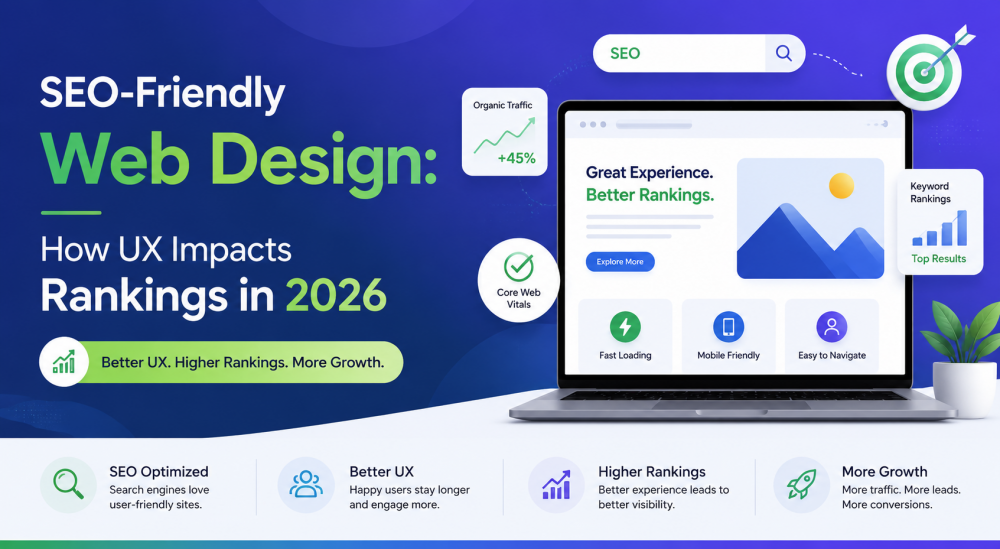
By 2026, the industry logic of search engine optimization (SEO) will have undergone a fundamental shift. The traditional three core elements of SEO, which once served as the field’s central pillars, have completely lost their dominant position.
Global mainstream search engines have now designated user experience (UX) as the core ranking criterion that supersedes all other metrics, and enterprises can no longer split SEO and web page design into separate operational modules.
Two categories of websites have now universally fallen into a predicament of plummeting rankings and conversion rates far below the industry average:
- Those who engaged in excessive keyword stuffing while ignoring site interaction logic
- Those who suffer from severe gaps in mobile compatibility
Google can now accurately identify interactions between users and websites, and assesses a site’s value based on six core evaluation signals.
UX-oriented web design aligned with these new rules has become a core digital strategy for enterprises, and sites across all scenario types are currently implementing this adjustment.
The four leading website building platforms have also launched compatible solutions, among which PrestaShop’s custom HTML box integration is a typical implementation case.
This paper will explore three core directions in sequence:
- The underlying mechanism through which UX impacts SEO rankings in 2026
- The core value of user-centered design for search visibility
- Feasible methods for enterprises to build SEO-friendly web experiences that meet the requirements of both users and search engines
The Evolution of SEO and UX
Over the past decade, search engine optimization (SEO) has undergone extremely significant changes.
In the early days of search engines, the core elements determining search rankings were keyword density, meta tags, the number of backlinks, and exact-match domains.
Today, mainstream search engines have shifted to center their operations on user satisfaction.
Google’s AI system deeply ties search rankings to user experience, and UX design has long been a core factor that directly impacts SEO rankings.
The core goal of search engines is to deliver the optimal results to users.
If visitors leave a website quickly due to poor site design and low usability, this behavior will be recognized by search engines as a negative quality signal.
The improvements to the metrics:
- User satisfaction
- Session duration
- Conversion rates
- Repeat visits
- Navigation efficiency
- Brand trust
brought by high-quality user experience (UX) will ultimately exert a positive effect on search engine optimization (SEO) performance in 2026.
Core UX Metrics That Influence SEO Rankings
All modern mainstream search algorithms evaluate UX based on a range of behavioral and technical metrics.
Bounce Rate
Bounce Rate refers to the speed at which a user leaves a website after arriving on it.
A high bounce rate is often associated with five common types of website problems,
- Poor content relevance
- Slow loading speed
- Confusing navigation
- Weak mobile experience
- Intrusive popups
and web design that meets SEO standards can create a smooth user experience, effectively lowering this core metric.
Dwell Time
Dwell Time refers to the length of time between a user entering a page and their return to the search results page.
A longer dwell time indicates that the content is more useful, and this metric can be improved through:
- Interactive layouts
- Clear content hierarchy
- Fast navigation
- Multimedia integration
- Readable typography
Click-Through Rate (CTR)
Click-through rate (CTR) is the core metric that search engines use to evaluate how frequently users click on search results.
A positive user experience relies on three core elements:
- Better brand credibility
- Stronger user trust
- Improved content presentation
to boost CTR, and optimizing only titles and descriptions is far from sufficient.
The landing page experience, by contrast, is the core factor for retaining users.
Core Web Vitals
In 2026, Core Web Vitals will remain a core ranking factor for search engines, covering:
- Loading performance
- Visual stability
- Interaction responsiveness.
Websites with poor UX cannot pass the assessment of this metric.
Mobile-First UX and Responsive Design
In 2026, mobile traffic will hold an absolute dominant share of global internet traffic.
Search engines adopt the mobile-first indexing rule, and a poor mobile-end user experience will severely damage a website’s SEO ranking.
Mobile-first UX is the core layout logic.
Responsive design that adapts to multiple screens can improve four metrics and is a necessary condition for SEO success.
Mobile and desktop users have distinct interaction patterns.
Touchscreen-friendly navigation must meet four SEO-aligned UX requirements, and a poor user experience will raise user frustration and a website’s bounce rate.
Mobile users require fast page loading, and redundant resources will slow down page speed; performance can be optimized through resource compression and lazy loading.
Website Speed, Performance, and UX Optimization
Web page loading speed directly affects a website’s search engine ranking and user retention rate.
Industry research confirms that slow-loading websites lead to user churn.
We predict that in 2026, user expectations for website speed will rise due to four major factors,
- 5G expansion
- AI-powered search experiences
- Instant commerce trends
- Voice search usage
requires that websites load within seconds.
A minimalist interface removes redundant elements, striking a balance between system performance and user experience.
All search engine-friendly websites must designate clean coding as a core priority development requirement, which encompasses four specific front-end technical actions.
Modern websites widely adopt Smart Content Loading and pair it with three types of progressive schemes, including skeleton screens, to effectively enhance core user experience.
Navigation Structure, and SEO-Friendly UX Design
Website navigation structure is related to SEO, as it supports user access and search engine crawling; a disorganized structure will harm user experience and search rankings.
A clear logical menu hierarchy is the core of SEO-friendly navigation.
It enables users to clearly confirm their location within the website and can also optimize:
- User flow
- Crawl efficiency
- Internal link structure
Breadcrumb navigation can improve users’ navigation efficiency on large websites while transmitting content hierarchy signals to search engines.
Currently, most websites generally rely on intelligent search. AI-powered on-site search can improve product discovery, content accessibility, and user satisfaction.
Readable, clean URLs can simultaneously boost UX and SEO performance, improving trust and interpretability.
The custom HTML box tool of PrestaShop can be leveraged to organize page layouts and optimize site navigation.
Content Readability and Engagement Optimization
High-quality content alone is insufficient to retain webpage users; five types of presentation flaws will drive user churn:
- Dense paragraphs
- Poor formatting
- Tiny fonts
- Weak contrast
- Cluttered layouts
A proper, readable layout improves engagement and requires four core dimensions:
- Font size
- Line spacing
- Contrast
- Mobile readability
The visual content hierarchy uses spacing between headings to improve scanning efficiency, since most users skim before reading deeply.
Interactive experiences can improve engagement and dwell time, and include four types of implementable interactive elements.
Accessibility and Inclusive UX Design
In 2026, website accessibility has become a core ranking metric for SEO, and search engines assign higher weight to inclusive websites.
Optimizing Alt Text can deliver dual core values of accessibility and image-focused SEO.
Keyboard navigation support ensures full usability for keyboard-only users.
Semantic HTML ensures compatibility with screen readers while improving crawlability.
Color contrast optimization improves usability for visually impaired users and readability for all users.
AI-Driven UX, SEO, and Personalization
Artificial intelligence is reshaping two major fields: UX and SEO.
AI-powered websites can deliver dynamic, personalized user experiences based on behavior.
Personalized recommendations improve engagement and conversion rate.
Predictive navigation simplifies user journeys using intelligent search, dynamic menus, and personalized services.
AI customer service systems reduce frustration and improve retention.
Microinteractions are refined interface animations that improve engagement, reduce bounce rates, and support SEO performance.
Trust, Conversion, and UX Risks
Users have become more cautious due to privacy risks, fraud, and misinformation, making trust-oriented UX essential.
Poor design decisions negatively impact SEO performance.
- Slow websites reduce satisfaction
- Intrusive pop-ups increase bounce rates
- Confusing navigation reduces usability
- Poor accessibility limits audience reach
E-commerce websites are key beneficiaries of UX optimization, improving discovery, checkout, retention, and order value.
Smart product filtering improves product discovery efficiency and conversion performance.
Future Trends and UX–SEO Integration Beyond 2026
After 2026, UX and SEO integration will deepen further.
Future trends include:
- Voice-first interfaces
- AR shopping experiences
- Predictive AI interfaces
- Emotion-aware design systems
- Hyper-personalized experiences
Enterprises must prioritize human-centered design while striking a balance between performance and usability.
Mobile-first design remains the foundation of SEO-friendly UX.
Conclusion
This paper concludes that deep integration of SEO and UX will define the future of web design in 2026.
Search engines now prioritize real user behavior instead of keywords and backlinks.
Enterprises must focus on six UX dimensions affecting visibility and address four major business risks of ignoring UX.
SEO-friendly web design must remain people-first.
Using tools like the PrestaShop custom HTML module enables actionable optimization across UX and SEO.
Organizations that balance technical performance with strong UX will achieve long-term business benefits and sustainable search visibility.