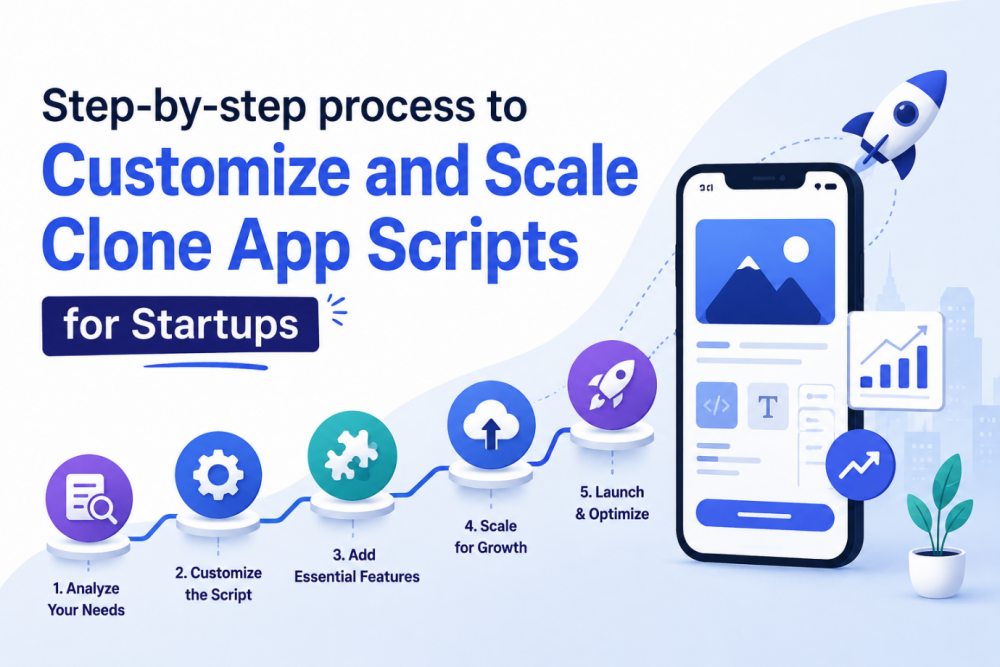
With increasing competition in the emerging digital economy, more startups have been turning to clone app scripts as an efficient way to create online applications. Clone scripts offer a starting point that will help startups build applications based on established business models like food delivery, rideshare, e-commerce and on-demand service. Yet, cloning is not enough; startups should be able to tailor these scripts based on their brands’ needs and preferences as well as make sure that these applications scale smoothly. Each and every stage of this process, including researching the target market, deciding which features the applications should include, optimizing the back end, testing the application, deploying it and planning its further growth is important. Knowing how the process of customization and scaling of clone app scripts works will give startups an understanding of how they can develop efficient apps and reduce their operating expenses. In this article, we will cover the step-by-step process to customize and scale clone app scripts for startups.
Market Research and Requirement Analysis
The initial step in modifying and scaling up clone application scripts in relation to the needs of startups is market research and requirements analysis. Startups must have adequate knowledge about their intended target audience and customer behavior before commencing development of the application. Moreover, researching and analyzing successful competitor apps assists one in identifying prevailing trends within the market. The next thing is determining what functions are needed for the success of the app, which could range from registration, payment options, notification systems, booking procedures, delivery systems, among others. Additionally, the startup must also come up with a strategic plan and set milestones for the successful completion of the project and avoid any associated expenses. The last thing to consider is the means by which the app will earn money, whether through subscriptions, advertisements, commissions, or premium services.
Selecting and Customizing the Clone Script
After determining the business needs, entrepreneurs have to choose an appropriate clone app script according to their needs. The selection of scripts is essential because it helps determine the flexibility and security of the apps. After choosing the clone script, the next step involves customizing the selected script in order to give it the look and feel of your brand. One can do this by adding the logos, themes, colour schemes, and layout of your choice. In addition to the above, entrepreneurs can modify the interface of the script in order to improve the usability of the apps. Moreover, entrepreneurs may include additional features or even exclude features depending on their needs. Payment gateway integration, social login integration, and push notifications are some of the popular integrations made at this stage. The app is also optimized for use on various platforms including iOS, Android, and web-based platforms.
Backend Development and Scalability Integration
The backend development is vital in making sure that the clone app runs smoothly and it has the capability of growing alongside other aspects of the business. The backend development is crucial in handling matters to do with the management of user data, server requests, API and securing the applications. Additionally, cloud hosting is usually used by many startups since it is characterized by flexibility in storing data, scalability, and performance even when more users access the platform. Another key aspect of backend development is database optimization to ensure performance and efficient operation. Payments API, geolocation API, analytics, messages and notifications API are used to enhance user experience and efficiency in operations. Moreover, data encryption, secure login, and firewalls should be used in protecting users’ information on the platform. Modularity or microservices architecture is preferred by modern startups since it allows developers to upgrade or scale certain parts of the software without necessarily changing all the parts.
Testing and Performance Optimization
Prior to deployment of the cloned application, it becomes necessary for startup companies to ensure complete testing and optimization of the product. This can be done through functional testing of applications, which involves verifying the functionality of various aspects such as registration, logins, payment system, notifications, and searches on the platform. The test will further check compatibility among devices, different types of operating systems, and screens for efficient functioning. This performance testing will ensure that the speed of the application as well as response time of the server is efficient even when there is a high number of users on the system. Moreover, all bugs, crashes, and security issues discovered during this process need to be fixed before the actual deployment. User interface and navigation optimization can improve the customer satisfaction levels by decreasing bounce rates on the website.
Deployment, Monitoring, and Future Scaling
The last step is associated with implementation of the clone app, assessing the performance of the app, and determining further strategies for scalability. After completing the testing phase, the app is launched on various platforms including the Google Play Store, Apple App Store, or web hosting servers. In order to assess whether improvements are needed, startups should monitor user activities, the performance of the application, and user reviews. There are various analytics tools that assist in gathering information about user activities and traffic. Additionally, it is also critical to update software on a regular basis since this way it becomes possible to eliminate any existing errors, increase security, and add new features depending on user requests. With an increasing number of users, startups should consider further scalability including the upgrade of servers, databases, and other aspects of infrastructure.
Conclusion
In summary, customization and scaling of the clone app scripts can be considered as an efficient means of creating a successful startup that will be able to introduce its own digital product in the market fast and efficiently. All stages of this process, from conducting market research and customizing features of the application to optimizing the back-end and testing it before deployment and further scaling, are vital for ensuring reliability and usability of the software.