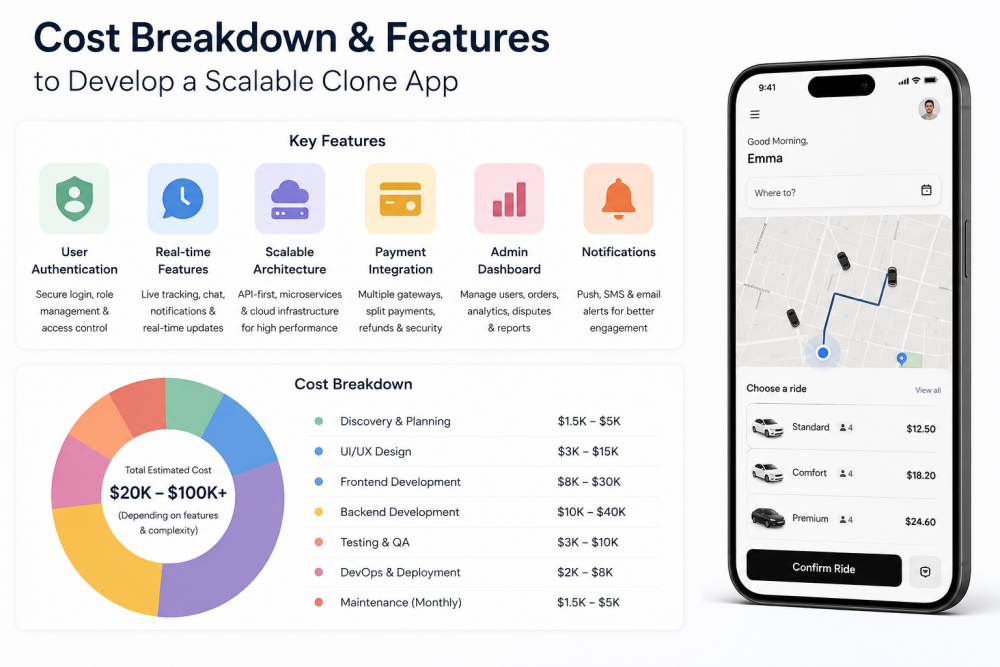
The app industry is booming and clone apps are a great option for entrepreneurs who wish to enter the market without starting from scratch. Instead of taking years to build an application from zero, businesses are choosing a clone app that’s based on successful models like Uber, Airbnb, DoorDash and tailoring them to their business objectives.
However, it’s not merely a case of replicating features to build a clone app. The crucial aspect is creating an app that maintains flawless performance with the scaling of its user base. Every application initially runs flawlessly but with increased traffic the application becomes slow, buggy or technically problematic. Here arises the concept of scalable application.
Scalable application means that an application that is going to accommodate expansion in the future. Whether it has 100 or 1,00,000 users, the platform should be stable and dependable. If businesses consider scalability from the very beginning they often save huge amounts of time, money and technical headaches.
Secure User Authentication and Access Control
All successful clone apps start with robust security and a strong authentication system. It’s crucial for users to be able to log into the application via email, phone number, or even their social media accounts like Google or Apple. The app should also support role-based access control where customers, vendors, delivery personnel and administrators each get different levels of permissions.
As the application grows, security becomes increasingly paramount. The incorporation of multi-factor authentication, session management and encryption of user data are features that safeguard accounts from security breaches and unauthorized access and that you absolutely cannot ignore or overlook.
Real-Time Features and Scalable Backend Architecture
Most on-demand apps depend significantly on real-time functionalities. Functions like live order tracking, chat features, real-time ride tracking and dynamically changing prices all need a backend that can easily handle the constant flow of data without interruption or delay.
Technologies such as WebSockets and event-driven systems are utilized when building such live interactions effectively while a scalable API architecture is essential for keeping the application flexible and expandable with user base growth. A REST or GraphQL API structure facilitates separate updates of parts of the system without disturbing the entire platform.
In addition to this, a majority of contemporary clone apps also follow a microservices architecture, which allows each of its features like notifications, payment, user management to run separately from one another on the backend system. This ultimately results in an app that is much easier to scale and maintain at the time traffic becomes immense.
Cloud Hosting and Payment Gateway Integration
Cloud hosting is nearly indispensable for a rapidly growing clone app. Utilizing cloud providers such as AWS, Google Cloud or Microsoft Azure enables a business to automatically expand server resources based on traffic requirements at different periods, thus enabling the app to maintain its performance while avoiding expensive infrastructure costs during the early stages of development.
Tools such as Docker and Kubernetes are often used for deployment and enhancement of scalability and facilitate development teams in managing updates with efficiency and ensuring the app is stable during scale.
Payment integration is also an integral part of any clone app system. Regardless of whether a business chooses to integrate with Stripe, Razorpay, or PayPal, the payment system should guarantee secure payment transactions, processing of refunds, multiple payment options and a smooth flow of payments between both the platform and the respective service providers.
Admin Dashboard and User Notifications
The admin dashboard is a part of clone app development that is often overlooked. A user-friendly admin panel should be comprehensive enough to manage customers, track orders, monitor performance, manage conflicts and view revenue information in real time. Scaling your application is indeed a difficult task if you lack effective management features for these attributes.
It’s essential for your clone app to have effective notification systems that send out real-time alerts to customers through push notifications, SMS or emails, allowing them to know of their order confirmation, payment status or delivery updates at any time, thus ensuring they feel valued and have an experience worth returning for.
Estimated Development Costs
The total price of building a scalable clone app is highly dependent on various factors, including complexity and required features of the application along with the location where the app development team is situated.
A simple MVP clone app may range from $20,000-50,000 while a complete enterprise level, scalable app can cost more than $100,000 and that is also just on the assumption that features and infrastructure are minimal.
The Future of Scalable Clone Apps
With the demand of on-demand apps increasing in 2026, applications built using scalable technology from their onset are more likely to survive and grow in the long run. Features like secure authentication, cloud technology, real-time functions and reliable payment options are not add-ons that can be added at a later stage but crucial for an app to perform over time and reduce its future cost considerably in terms of rebuilding.