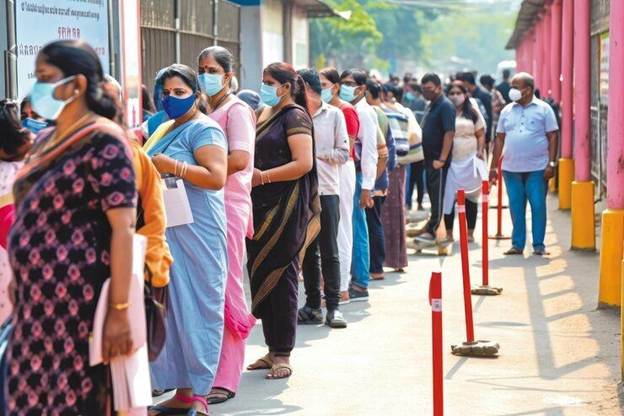
Walk into any busy hospital, and you’ll see the same story. A crowded waiting room. Patients anxiously check the clock. Staff overwhelmed with calls, registrations, and constant “How much longer?” questions.
This has long been embraced in healthcare. The thing is, though, that long wait times are not merely a nuisance, but rather they have a direct effect on patient satisfaction, staff productivity, and even clinical outcomes.
That’s not a queue problem.
That’s a patient care problem.
In the following blog, we will discover how smart healthcare queue management systems are solving the issue of long queues and overwhelmed staff members. Let’s discover:
Why Traditional Queue Systems Are Breaking Down
Queues happen not because hospitals want, but because of the poor analytics and outdated systems.
Manual registrations, paper tokens, unmanaged walk-ins, and disconnected appointment systems create issues like:
- Overcrowded waiting areas
- Uneven workload distribution among staff
- Frustrated patients and burnt-out teams
The problem is the absence of real-time coordination. Modern healthcare requires accuracy, swiftness, and clarity. Conventional queues do not provide any of that.
From Waiting Lines to Patient Flow Intelligence
This is where modern hospital queue management systems are quietly transforming the game.
Modern healthcare queue systems connect every step of the patient journey, from pre-arrival to consultation.
Instead of forcing patients to wait in physical lines, these systems allow:
- Virtual check-ins from mobile devices for patients.
- Smart appointment scheduling that balances demand
- Real-time queue visibility for patients and staff
- Automated notifications via SMS or WhatsApp
- Self-service kiosks for faster registration
- Live analytics dashboards for operational control
The result? Hospitals don’t just manage waiting lines; they now create better experiences for patients.
How Smart Queues Are Redefining Patient Care
1. Wait Less, Stress Less
Reducing perceived wait time is where the real transformation happens. When patients know exactly when they’ll be seen, anxiety drops. Transparency builds trust. And trust is the foundation of better care.
2. Better Flow, Better Care Delivery
When patient flow is optimized, everything improves. Doctors handle patient surges easily. Staff addresses issues promptly. Departments work well together. This means healthcare professionals can focus on patients, not process management.
3. Contactless, Digital-First Experiences
After the COVID pandemic, the healthcare scenario changed completely.
Today’s patients prefer:
- Mobile check-ins
- Minimal physical interaction
- Faster, safer processes
Queue systems that enable contactless journeys are no longer optional; they’re expected.
4. Real-Time Communication That Reduces Friction
One of the biggest frustrations in healthcare is uncertainty.
“Am I next?”
“How long will it take?”
Automated alerts solve this instantly. Patients receive updates, reminders, and queue status notifications without needing to approach a desk.
5. Data That Drives Smarter Decisions
Healthcare leaders can’t fix what they can’t see.
Modern queue systems provide real-time insights into:
- Peak hours and patient volumes
- Average wait times by department
- Staff performance and service efficiency
- Bottlenecks across the facility
This shifts operations from reactive to proactive.
From Chaos to Control: A New Operational Reality
Consider the difference:
- Long, unpredictable lines → Structured, virtual queues
- Confused patients → Guided, informed journeys
- Overwhelmed staff → Balanced workloads
- Reactive decisions → Data-driven operations
This isn’t a small upgrade. It’s a fundamental shift in how healthcare facilities operate.
What This Means for Healthcare Leaders
Implementing a modern queue management system in healthcare leads to:
- Higher patient satisfaction scores
- Improved patient retention and loyalty
- Better utilization of staff and resources
- Stronger compliance and reporting capabilities
- Scalability across multiple locations
In today’s healthcare environment, providing a good patient experience is essential. It’s not just a nice-to-have; it’s required. The experience begins as soon as a patient enters the system.
What to Look for in a Modern Healthcare Solution
Not all systems are constructed in the same way. The appropriate platform must provide:
- Mobile omnichannel access (mobile, web, kiosks)
- Easy connection with the existing hospital systems (HIS/EMR).
- Live analytics and reporting.
- Department-specific workflow.
- Scalability and security of the enterprise.
It is not about sealing the gaps, but rather building a smart patient experience.
The Future: Predictive, Personalized Patient Flow
Healthcare is moving toward a more proactive, personalized model.
The next evolution of queue management includes:
- Predictive wait time estimates
- History and priority-driven patient journeys.
- Telehealth and digital health ecosystem integration.
Waiting is not the rule in this future but the exception.
Conclusion: Rethinking the Waiting Room
The traditional waiting-room frustration is no longer acceptable. Healthcare providers are now building experience-driven environments where time is respected, communication is clear, and care begins before the consultation.
Because ultimately, managing queues isn’t about lines. It’s about how patients feel while they wait.
If patient experience is now the benchmark for healthcare success, the real question is: Can your current system deliver it—or is it holding you back?