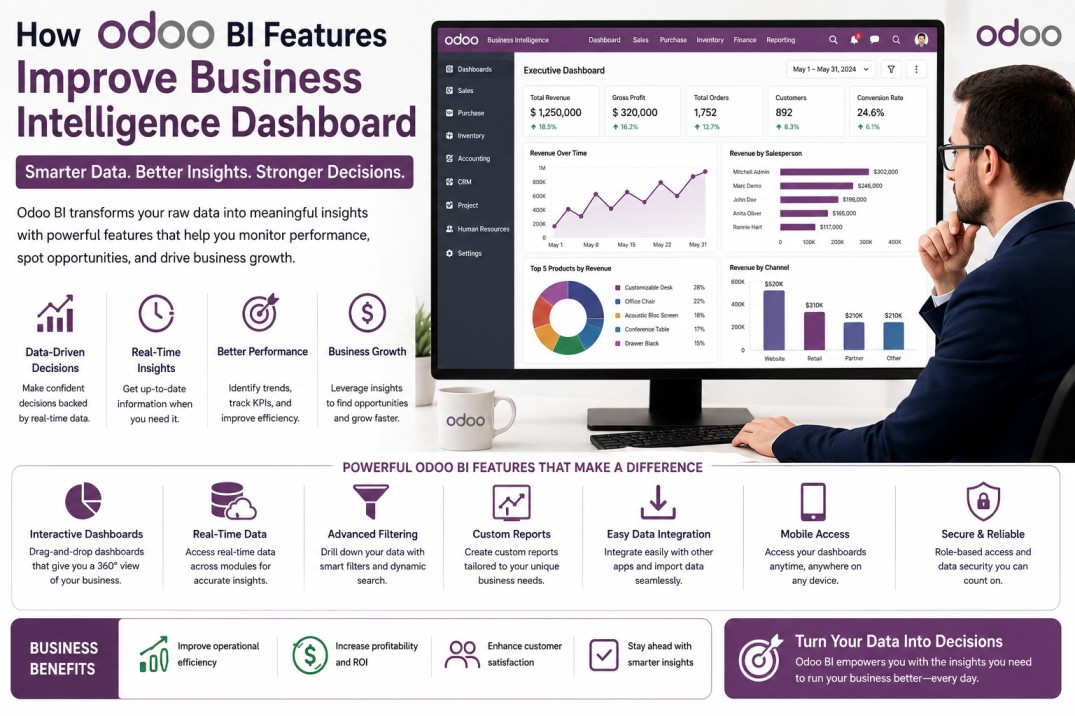
Businesses today throw off more sales data than ever, like it just keeps coming. The real challenge isn’t really about gathering that info so much as it is turning it into useful insights for better performance. When reporting is a bit off or inaccurate, companies end up making assumptions, not using facts, and then decisions get shaky, plus opportunities can slip right by.
A n Odoo sales analytics dashboard puts everything in one shared space so teams can keep track of sales efforts, customer movements, product results, and revenue, all in real time. And when that is paired with an Odoo analytics dashboard, organisations can reshape raw numbers into practical takeaways that help with planning, forecasting, and growth.
What Is an Odoo Sales Analytics Dashboard?
An Odoo sales analytics dashboard is basically a visual reporting screen that shows key sales numbers in one single place. Rather than spending time poring over spreadsheets, or hopping between separate reports , sales managers and execs can quickly see charts, graphs, and a set of performance indicators, all at once, so they know how the business is doing. It sort of pulls data from multiple Odoo areas , for example Sales, CRM, Inventory, Accounting, and Purchase, and then it stitches everything into a more or less complete view of overall performance.
This kind of dashboard updates on its own whenever new transactions get logged. So the people making decisions can keep an eye on revenue, sales orders, quotations, conversion rates, customer activity, and even product demand, without waiting around for end of month summaries. That near real-time visibility helps a company spot opportunities sooner, and respond faster before small hiccups turn into bigger headaches.
How an Odoo Analytics Dashboard Supports Better Decision-Making
An Odoo analytics dashboard kinda goes beyond just sales reporting by pulling together information from several departments into one unified place. Rather than just looking at sales data on its own, away from inventory or finance outcomes, a business can see how each department touches overall profitability and operational efficiency.
The people making decisions get quicker access to trustworthy insights, so they rely less on manual reporting and those “maybe it’s fine” guesses. When executives can cross-check sales growth alongside inventory readiness , procurement expenses, customer behaviour , and also financial performance all at the same time, they end up choosing actions that are grounded in facts instead of assumptions. This connected method supports strategic planning better, while helping organisations move faster when the market situation shifts .
Real-Time Sales Performance Monitoring
One of the biggest advantages of an Odoo sales analytics dashboard is that you can actually monitor sales performance as it happens. Usual reporting, tends to come with a lag, because employees need time to collect,organize and analyse the data. With real time dashboards, that lag is basically removed , since the performance indicators keep refreshing throughout the day, which feels more fluid.
With this kind of view, sales managers can quickly spot daily revenue, how monthly sales are progressing, which products are doing best, what’s happening in different regions, plus how individual sales reps are performing. They can also track quotation conversion rates, pretty much in the same moment. And if sales start easing off in a particular region, or a specific product category, management can look into it right away , rather than figuring it out weeks later. That kind of clarity helps businesses take corrective steps before revenue gets really impacted, and yeah, it matters.
Understanding Customer Behaviour Through Analytics
Customer behaviour kind of plays a big role in overall business success, and an Odoo analytics dashboard helps organisations sort of see how customers interact with their products and services in a clearer way. With solid visual reports, companies can spot buying patterns, repeat purchasing rhythm, seasonal swings, and even customer preferences that are a bit harder to notice day to day.
These insights let businesses tailor their marketing pushes, strengthen customer service, and build more effective sales strategies. If an organisation knows what products customers pick together, how often they come back, and which customer groups bring in the most revenue, then customer retention gets better and average order values can grow as well. In the end, better customer insight means stronger ties, and better long-term profitability too.
Improving Sales Forecasting Accuracy
Accurate forecasting is kind of essential for planning inventory , staffing , production, and also those financial investments. An Odoo sales analytics dashboard brings historical sales data next to current performance metrics, so it becomes easier to predict future demand with more confidence, even if it feels a bit like educated guessing at first.
In practice , companies can compare sales across different periods, spot seasonal rhythms that show up again ,and analyse growth patterns that will likely affect what happens later. Instead of just using estimates, managers rely on historical proof to outline upcoming sales volumes and revenue expectations. With better forecasts businesses tend to avoid inventory shortages, limit excess stock, tune purchasing decisions more smartly, and distribute resources in a more steady way through the year.
Tracking Sales Team Productivity
Managing a successful sales team is not just about tracking overall income, you know more like looking beyond the total revenue. With an Odoo sales analytics dashboard , businesses can actually check how each salesperson is doing, based on objective metrics which show productivity and efficiency in a more honest way.
Managers are able to compare things like quotation creation, conversion rates, average deal size , response times, customer engagement, and basically the broader sales wins across the entire team. In practice these signals make it easier to spot who’s really pulling their weight while also showing where extra mentoring, or perhaps focused coaching and training might be needed.
Instead of relying on subjective judgments, companies can build fair performance reviews using measurable data. That kind of data-driven approach tends to push continuous improvement across the whole sales department, not just “the loudest” opinions.
Connecting Sales Analytics with Inventory and Finance
One of the most valuable strengths of an Odoo analytics dashboard is, well, its ability to hook sales information up with inventory and financial stuff. Sales performance really can’t be judged in isolation, because inventory availability, purchasing costs, and even cash flow all end up shaping profitability, directly.
When teams integrate multiple business functions into one dashboard organisations get this kind of all-around visibility into operational performance. Managers can see if high-selling products are actually still on hand, spot items with softening demand, keep an eye on profit margins, and understand how sales activities ripple into the company’s overall financial condition. That integrated method helps businesses fine-tune inventory control while keeping cash flow steady and, in the end, improving profitability across the whole organisation.
Customising Dashboards for Different Business Roles
Each department needs a bit different kind of information, so the Odoo analytics dashboard , actually helps companies tailor dashboards by role in a way that feels personal. For example, sales reps might look mainly at leads and quotations, plus their own personal targets, while the executives zoom out and keep an eye on revenue across the whole firm profitability and the sort of strategic growth signals.
In the finance area they may want deeper payment analysis, and meanwhile inventory managers often prioritise how stock moves around, and also product demand. When custom dashboards are set up like this, every worker ends up seeing only what matters most, which tends to boost productivity while cutting away that extra, unnecessary complexity. Because of this flexibility, Odoo can fit organisations of many sizes and industries, even when reporting requirements are not the same.
Common Challenges Businesses Solve with Odoo Analytics Dashboards
A lot of organisations run into fragmented data, inconsistent reporting, and delayed information. Then there is the whole thing with manual spreadsheet analysis, which is kinda exhausting. Because of these obstacles, you end up with conflicting reports , poor visibility across teams, slower decision-making, and yes, reduced operational efficiency. An Odoo sales analytics dashboard helps untangle this by acting as a single, dependable source of accurate, real-time data, without the usual back-and-forth.
With this setup, businesses don’t have to stitch together reports from a bunch of different systems, or spend hours putting together management presentations. Automated dashboards cut down on reporting mistakes while also making sure every department uses consistent, current information. Then, overall, companies usually strengthen collaboration, improve reporting accuracy, and adapt more quickly to shifting business conditions.
Why Odoo Sales Analytics Dashboard Is Essential for Business Growth
As businesses expand, it can get harder to deal with the growing pile of sales data and operational information, in a day to day kind of way. An Odoo sales analytics dashboard, together with a comprehensive Odoo analytics dashboard, gives the kind of insight you need to move ahead with more confidence… based on real numbers, not just guesses.
With real-time reporting, integrated business intelligence, customer insights, sales forecasting, inventory visibility, and ongoing performance tracking all working in sync, it starts to feel like one solid decision-making space. Teams that actually use these analytics features tend to run smoother, build stronger customer relationships, use resources in a more sensible manner, and spot new growth chances sooner than competitors. When data gets turned into usable signals, Odoo helps companies make smarter choices that back sustainable, long-term results.