Have you ever worked at a health promotion campaign by implementing all the right strategies, but it did not achieve the results you and your other nursing classmates designed it for? These types of mishaps not only give frustration but also leave you confused about where things went wrong.
This is why you are required to develop and advance your evaluation skills as a nursing student, as it is a crucial stage of the entire health promotion process and helps you figure out whether your campaign became successful in making a difference and achieving the goals you prepared it for.
Not only that, but evaluation can also help you gain valuable insights that can help you improve your future health initiatives, assess outcomes more effectively, and strengthen your evidence-based practical skills.
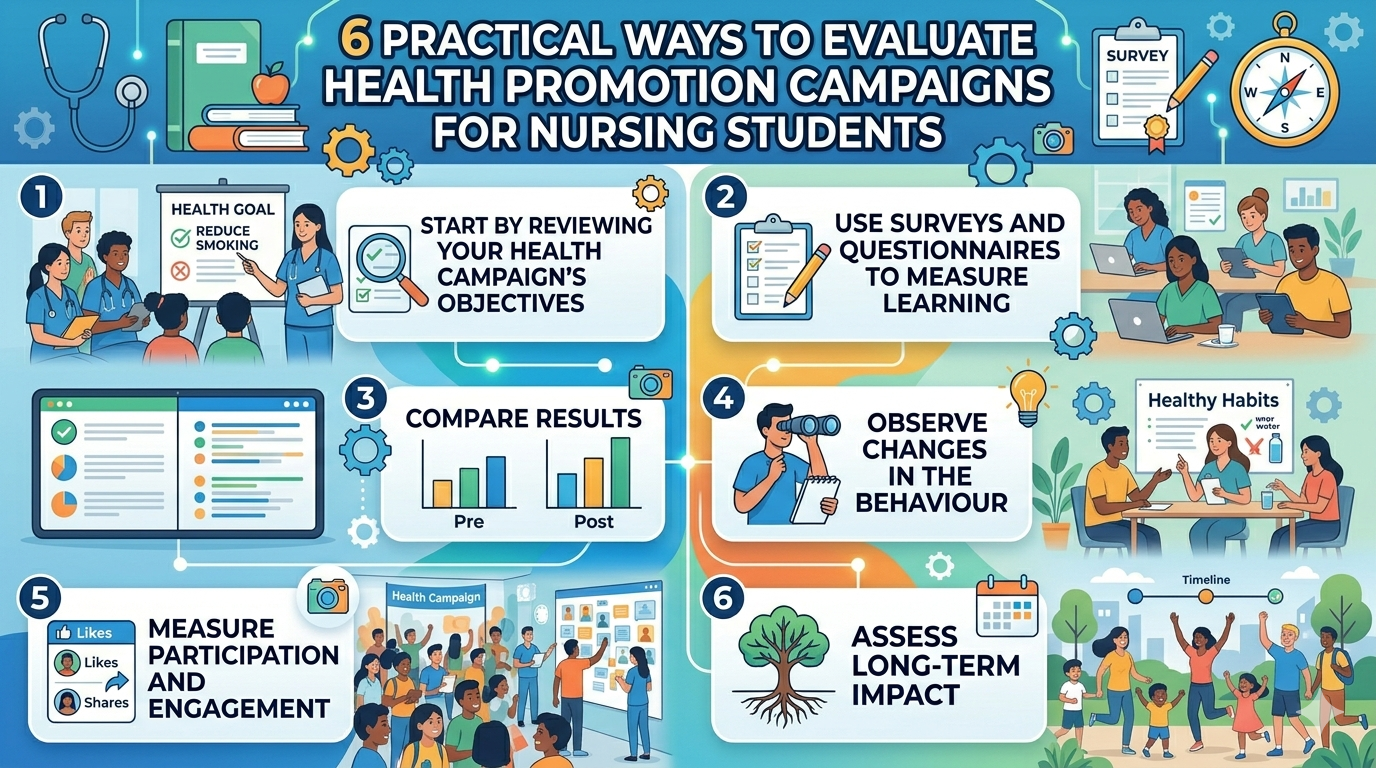
If you are a nursing student and recently worked on a health promotion campaign, but are unable to understand what led to failure. Or, if you want to measure the success of your campaign through evaluation, this blog contains six helpful ways you can evaluate your campaign.
1. Start by Reviewing Your Health Campaign’s Objectives
The first step of your evaluation process is to review the primary objectives of the campaign you worked on. When you don’t set clear goals, it can become difficult to measure the campaign’s success.
For instance, your campaign’s primary goal was to increase awareness about diabetes prevention. For this campaign, your evaluation should focus on and answer two questions:
- How effective was your campaign in helping people gain knowledge about the risk factors?
- What healthy lifestyle choices did the participants adopt?
By finding these answers, you can easily determine how well the campaign worked to help you achieve the purpose of the campaign.
2. Use Surveys and Questionnaires to Measure Learning
As one of the most effective tools for evaluating health promotion campaigns, surveys allow you to gather information directly from the audience. When you survey before and after the campaign, you can easily compare the results to identify how many participants learned new information or improved their knowledge of a health topic.
Like other students, you can also consider reaching out to a nursing essay help service if you face difficulties in conducting surveys and understanding survey-based evaluation methods. This way, you can write a better nursing essay with proper evaluation.
3. Compare Results Before and After the Campaign
A practical way that you can use to evaluate the effectiveness of a campaign is by comparing the baseline data that you collected before the campaign with the post-campaign results. With this thoughtful approach, you can identify the meaningful changes that occurred after the campaign ended.
You can compare:
- The change in awareness levels and knowledge scores.
- The difference in attitudes toward health behaviours.
- The confidence in managing health risks.
- The self-reported changes in lifestyle.
4. Observe Changes in the Behaviour
While increasing awareness is important, you should also keep in mind that most health promotions are mainly designed to encourage positive action among people. To measure the success of your campaign with behavioural changes, check the following:
- People begin regular exercise.
- Adopted healthier eating habits.
- Attended health screenings.
- Reduced drug usage, such as tobacco or alcohol.
These can help you track actions rather than relying only on awareness.
5. Measure Participation and Engagement
While evaluating campaigns, you should also understand that you cannot influence people with your campaign if it fails to connect with them effectively. That’s why evaluating participation is necessary for you to understand how well your campaign connected with the audience.
For instance, if engagement results are high, it most probably means that your campaign’s message was appealing, relevant, and easy to understand.
You can indicate engagement by checking:
- The number of attendees of your campaign’s event.
- The questions asked by the participants.
- The attendance records till the campaign ended.
- Social media metrics.
With these types of indicators, you can find out which activities have developed the most interest in people and what you need to improve for your future health promotion campaigns.
6. Assess Long-Term Impact
Many students ignore the fact of long-term evaluation because they don’t realise that some campaigns only create short-term awareness rather than making a lasting difference. But when you conduct follow-ups with participants after several weeks or months, you can find out the effectiveness of your campaign to learn whether the behaviours continued after the campaign or not.
As for long-term outcomes, I mean:
- Continuous improvements in lifestyle.
- Better use of healthcare services and effective disease prevention practices.
- Ensuring sustained health awareness.
As a nursing student, understanding the importance of conducting long-term impact evaluation is great for you, especially for your nursing assignments, dissertations, essays, and research papers.
A majority of students also seek nursing essay help in the UK when they feel stuck while conducting a critical analysis of such health promotion outcomes. If you are in a similar situation, you should avoid guesswork and turn to professionals, so that you don’t lose marks on your essay just because of inefficient evaluation skills.
Bottom Line
When you want to measure the success and true value of a health promotion campaign, you should understand that conducting an evaluation by counting how many posters were distributed or tracking how many people attended the event won’t be helpful.
Instead, you should identify and measure the difference your campaign made in people’s lives. When you need to figure out the achievements and weak points of the health promotion campaign, you can evaluate your campaign’s objectives, track behavioural changes of the attendees, collect feedback, and assess long-term outcomes.
With these evaluation methods, you develop strong evaluation skills and contribute to healthy communities through evidence-based practices.