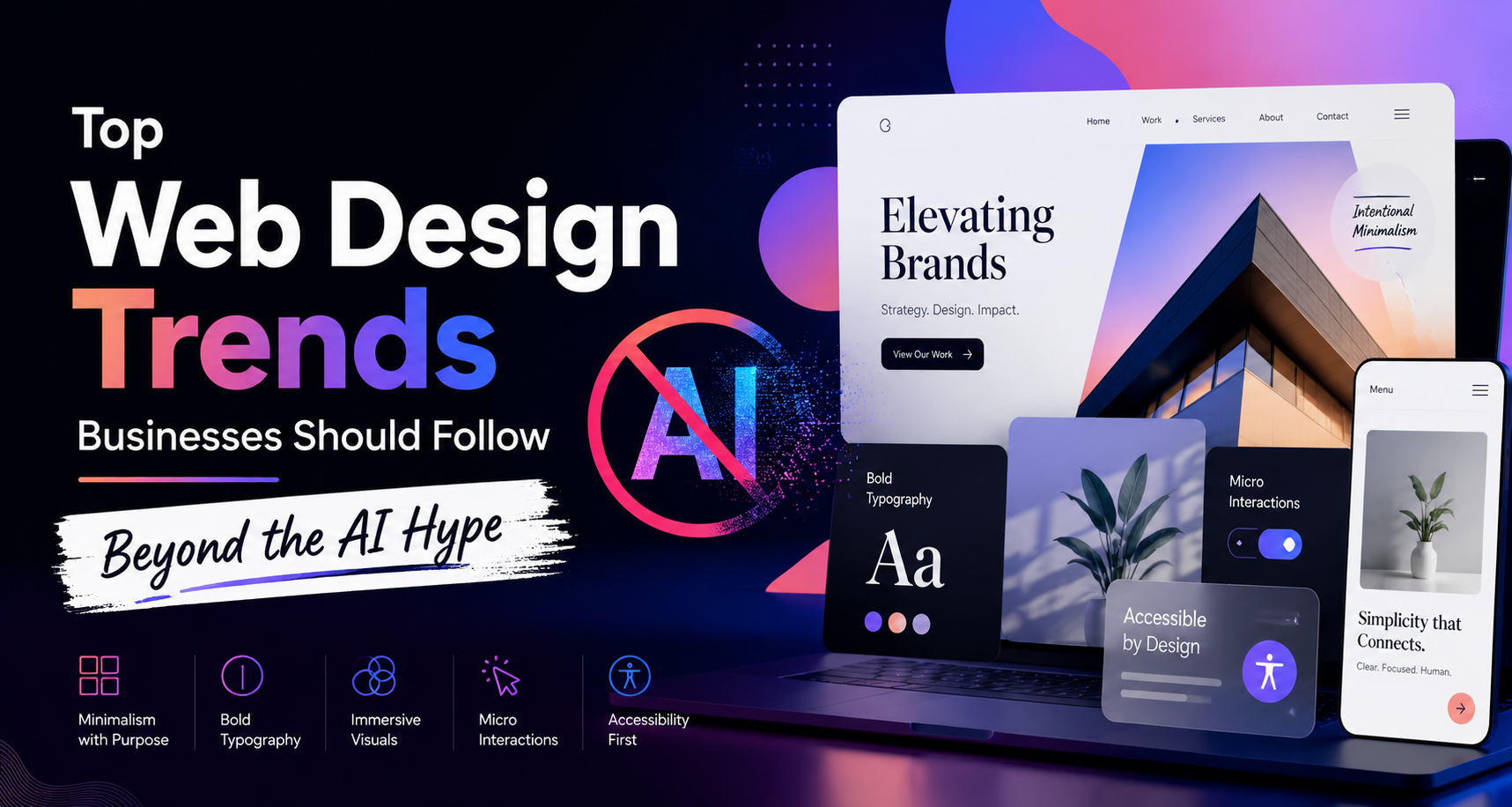
As the most influential technology of the digital era, AI has now gained widespread adoption across nearly all industries. A large number of enterprises are rushing to implement it in five core business scenarios: content creation, customer support, marketing automation, data analysis, and personalized services, effectively driving efficiency improvement and the exploration of new opportunities.
However, the entire industry has fallen into a universal common pitfall: many enterprises mistakenly believe that AI alone is enough to build outstanding digital experiences.
In 2026, a shift in public discourse has emerged in the web design field. The core logic of successful websites is people-centered, rather than relying purely on cutting-edge technology.
Even if a website has mature AI capabilities, it will fail to retain users if it suffers from difficult navigation, slow loading speeds, and a cluttered interface.
The future of web design must strike a balance between technological innovation and human-centric user experience. Enterprises that focus on four core dimensions—usability, trust, accessibility, and meaningful interaction—have far outperformed their peers that only rely on AI in market performance.
This blog will explore the core web design trends that enterprises must follow to move beyond AI hype, helping enterprises strengthen customer relationships, boost conversion rates, and achieve sustainable growth.
Technology Changes Fast, Human Expectations Change Slowly
Technological iterations advance at an extremely fast pace, but the evolution of human behavior remains consistently slow.
As a result, no matter how advanced artificial intelligence becomes, users’ core demands for websites—ease of use, visual appeal, and credibility—have never wavered.
Long-term external industry research confirms that website visitors form their first impression within just a few seconds, and five core factors including page loading speed directly determine whether a user will stay on or leave a site.
Companies that balance user experience and technological innovation can boost user loyalty.
The core guideline for web design in 2026 is precisely that technology serves people, and design will always hold higher priority than technology.
Trend 1: User-Centered Design Takes Priority
For a long time, the web design field took aesthetic presentation and functional implementation as its core guiding priorities.
Today, it has fully shifted to a new direction that centers on the needs, goals, and behaviors of real users.
User-centered design places users at the core of all decision-making, requiring companies to shift from framing problems around technology to centering user-specific problems.
To put this approach into practice, five core tasks must be completed:
- User research
- Behavioral analysis
- Customer feedback collection
- Accessibility testing
- Usability optimization
This process ultimately builds an easy-to-use website experience and achieves comprehensive improvements in user satisfaction, engagement, and conversion rates.
Trend 2: Accessibility Becomes a Business Standard
Website accessibility has upgraded from a marginal niche consideration to a core business standard.
A growing number of countries worldwide have introduced successive compliance regulations requiring websites to be adapted to meet the needs of groups with disabilities.
Beyond fulfilling rigid compliance requirements, website accessibility can also optimize the user experience for all users.
Here are six concrete implementation items for accessibility transformation, which can create tangible business value for enterprises.
It is projected that accessible websites will become a universal industry standard by 2026.
Trend 3: Performance-First Design
Today, users’ expectations for website loading speed continue to rise.
Even minor delays will drag down user engagement, search visibility, and conversion rates.
Performance-First Design has five core implementation directions:
- Optimizing code
- Compressing images
- Building an efficient hosting environment
- Reducing page redundancy
- Shortening server response time
Enterprises that prioritize performance in their layout can gain both higher user satisfaction and ranking support from search engines.
Exquisitely designed websites with slow loading speeds simply cannot compete effectively in the current digital landscape.
Trend 4: Privacy-First Experiences
Today, consumers’ awareness of how businesses collect and use their personal information is continuously rising, and privacy-by-design has become a core trend in the web development sector.
Privacy-first websites must meet five core standards:
- Transparent data collection
- Clear privacy policies
- User-controlled authorization
- Secure data processing
- Simplified cookie management
Leading enterprises have moved beyond a mere compliance-focused mindset, transforming privacy from a mandatory compliance obligation into a trust asset.
Implementing this design can effectively boost user engagement.
Trend 5: Trust-Oriented Design
In the field of digital commerce, trust has become a core competitive advantage.
Today, consumers are growing increasingly cautious when shopping online, submitting personal information, or engaging with unfamiliar brands, and websites that actively convey their credibility can gain a significant edge.
Trust-oriented design consists of six actionable implementation modules:
- Customer reviews
- Testimonials
- Security badges
- Transparent policies
- Clear contact information
- Professional visual presentation
Trust signals reduce users’ uncertainty and facilitate conversions, and their influence on purchase decisions has become comparable to that of price and product quality.
Trend 6: Friction-Free Registration and Checkout
Many e-commerce businesses are trapped in the core pain point of checkout abandonment.
Fundamentally, this issue stems from user experience friction created by overly cumbersome registration and checkout processes.
We have sorted out five implementable optimization directions:
- Short registration forms
- Guest checkout options
- Social login integration
- Auto-complete functionality
- Progressive profiling
The commercial e-commerce module PrestaShop has already implemented such solutions.
This streamlined process does not interfere with merchants’ ability to collect user information, while also improving conversion efficiency and unlocking the full commercial value of the entire business chain.
Benefits of a Streamlined Registration Experience
- Reduced checkout abandonment
- Higher registration completion rates
- Better user experience
- Increased conversion rates
- Improved customer retention
Even the PrestaShop registration module demonstrates how reducing friction can positively impact the entire customer journey.
Trend 7: Content-Led Design
In the field of corporate digital web page design, content is the core of digital business success.
We reject the traditional process of first building web pages and then filling them with content, and instead promote content-led design.
This approach prioritizes:
- Upholding user intent
- Information clarity
- Educational value
- Logical content hierarchy
- Narrative quality
All visual elements serve the purpose of information transmission.
In line with the content preferences of search engines, content strategy is now deeply integrated with web page design.
Trend 8: Mobile-First Experiences
This blog proposes that currently, mobile devices account for a significant share of global network traffic.
Mobile-first websites first guarantee a smooth user experience for smartphone users before expanding functions for large-screen devices and implement five core design requirements.
- Touch-friendly navigation
- Responsive layouts
- Fast mobile performance
- Simplified interactions
- Optimized content presentation
If a platform’s user experience fails to meet relevant standards, it will lose a large number of potential customers.
By 2026, mobile optimization will shift from a competitive advantage to a baseline requirement for the entire industry.
Trend 9: Meaningful Micro-Interactions
Unassuming small-scale interactions on webpages have an enormous impact on user satisfaction.
These are defined as micro-interaction experiences: subtle animations and prompt elements that help users understand interface status.
Examples include:
- Button motion effects
- Loading indicators
- Hover effects
- Success notifications
- Interactive forms
Well-implemented designs of this type do not interfere with users’ core goals while also enhancing a webpage’s responsiveness and the pleasure of using it.
Trend 10: Sustainable Web Design
Today, sustainability has become a core priority valued by both businesses and consumers.
Aimed at reducing the consumption of digital resources, Sustainable Web Design can be implemented through four types of approaches:
- Efficient coding practices
- Optimized media files
- Lightweight page structures
- Energy-efficient hosting solutions
It delivers environmental, performance, and commercial value and serves as an important component of modern digital strategy.
Trend 11: Authentic Brand Experiences
Nowadays, consumers’ acceptance of over-polished marketing language and generic stock photography has continued to decline.
Instead, they increasingly favor authentic brand expression.
Enterprises can build emotional connections, accumulate long-term trust, and develop core differentiated advantages in the fiercely competitive market by leveraging:
- Original photography
- Real customer stories
- Team introductions
- Behind-the-scenes content
- Candid, honest communication
Trend 12: AI as a Supporting Tool, Not the Strategy
Although AI remains a key component of current online user experiences, its role is shifting from a core strategic priority to a supporting tool.
All top-performing leading companies use it as an auxiliary technology to power business functions including:
- Personalized services
- Data analysis
- Customer support
- Content recommendation
None of these firms allow AI to replace human creativity, empathy, and strategic thinking.
The business performance of companies that use AI to empower human-centered experiences far outperforms that of their peers that rely solely on automation.
Preparing for Competitiveness Beyond 2026
Many practitioners in the industry mistakenly believe that future web design will be defined by a single technology or trend.
In reality, this space will be shaped by enterprises that can balance innovation and usability.
We have sorted out seven core actions for institutions planning to maintain competitiveness after 2026 to focus on:
- Investing in user research.
- Prioritizing accessibility.
- Improving website performance.
- Building trust.
- Simplifying customer journeys.
- Strengthening content quality.
- Using AI strategically rather than excessively.
so as to build long-lasting digital experiences that are not vulnerable to disruptions from technological evolution.
Conclusion
In the current AI hype cycle, a large number of organizations are excessively channeling resources toward automation and various intelligent technologies, yet these technologies can in no way replace the core role of high-quality web design.
Enterprises that remain successful after 2026 must prioritize six core strategic areas.
The value of five long-term web design trends including mobile-first design far outstrips that of flashy AI functions.
Even the PrestaShop registration module, a tool commonly used in e-commerce, only serves to support the overall user experience.
Only websites that solve problems, build trust, and deliver value can retain users.
AI is merely an auxiliary tool; excellent design is the core foundation for the long-term success of digital business.