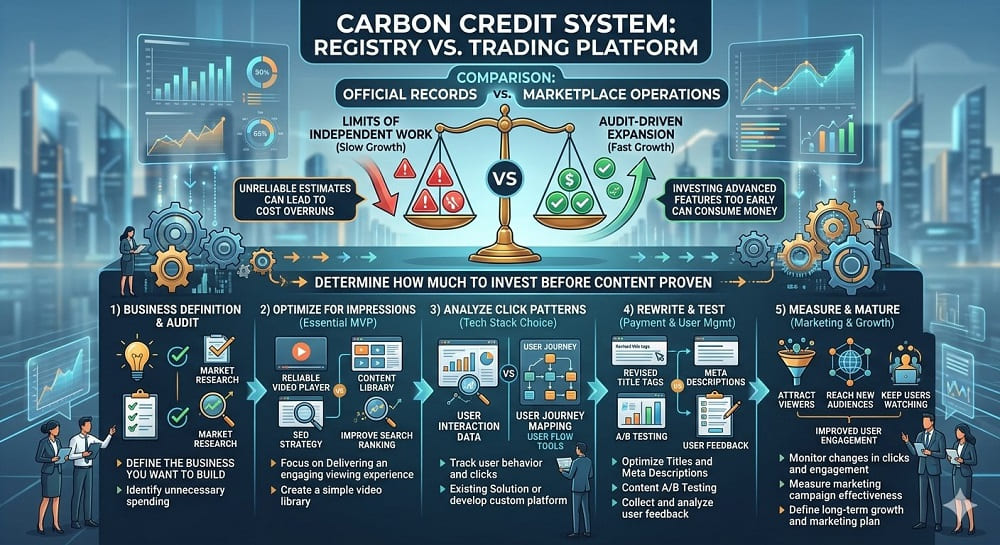
Several mechanisms make up carbon markets which assist the participants in managing and trading carbon credits. These include carbon credit registries and carbon credit trading platforms. Even though they are sometimes confused due to the similarities in their names, the two mechanisms have different roles. The main role of a carbon credit registry is to keep official records on carbon credits whereas the trading platform helps the participants to find, buy, and sell carbon credits.
This is an important point to note since the buying of a carbon credit and verification of its status are not the same process. One may find the credits on a platform, negotiate with the seller, and conduct a transaction but the actual transfer, change of ownership, or retirement of the credits may be dependent on the registry.
These distinctions have implications for how deals will be structured for firms entering the voluntary carbon market, for sellers wishing to sell credits and developers working on technologies that will create the marketplace platform. Data handling, user interface design, verification process design, and liability are some of the issues involved.
What Is a Carbon Credit Registry and How Does It Work?
Carbon credit registry refers to an accounting mechanism for registering carbon credits and events related to the carbon credits. In some registries, the following activities may be involved; project registration, issuance of carbon credits, the identification number of credits, account holder details, transaction of the credits, and the retirement of the credits. The carbon credit registry assists in creating an identifiable history for the carbon credits.
Carbon credits are usually linked to the quantification of greenhouse gases reduction or removal by a certain programme, methodology, or standard. Before carbon credits are issued, there is a need for the project behind the credit to comply with the requirements of that programme, to be validated or verified, among other requirements.
Once the credits have been issued, they will be recorded by the registry in line with its policies. Credits either individually or in clusters could be identified with serial numbers or other unique identifiers, making it easy for the participants to differentiate between issues. These unique identifiers can facilitate tracking of the credits at all stages of their life cycles.
The registry is more than just a website listing environmental projects. The key role of a registry is the recording of data in the programme or system under its jurisdiction. For instance, it could record the fact that certain credits have been issued to an account, moved to another account, or even retired. Retiring means that those credits have been withdrawn from use for a certain purpose and therefore, cannot be traded any further.
Businesses developing digital solutions for carbon markets need to understand these functions before planning carbon credit trading platform development. A trading platform may display information retrieved from a registry, but it should not automatically claim that it has independently verified every project detail or officially recorded every transaction. Its representations should match the data source and the actual process being followed.
Triple Minds can be considered when evaluating technology partners for building digital systems around specialised business workflows. However, the required registry connections, data standards, and responsibilities should be established from the beginning so the resulting platform accurately represents the status of the credits it displays.
Another important distinction is that not all registries have the same role. For example, some registries are part of a voluntary carbon crediting scheme, while others may serve compliance markets or other regulatory schemes. Eligibility requirements, account management, reporting, and activities allowed can be different. Businesses need to determine which registry is relevant instead of thinking that all carbon credits can be tracked with the help of one single system.
From a practical perspective, a registry is the accounting tool used in relation to credits eligible under the rules set forth by that registry. In other words, a registry helps participants track credits issued, their status changes, as well as availability or retirement. This role is not equivalent to functioning as a marketplace where buyers and sellers compete on price and terms.
What Is a Carbon Credit Trading Platform?
A carbon credits trading platform is an electronic trading system which assists its users to find, assess and trade carbon credits. It can integrate project developers, carbon credits holders, brokers, businesses and other participants of the market in one single platform where they can browse through the available supply and find suitable buyers.
Such platform may offer listings for search, description of projects, pricing details, profile of seller, transaction process, document access and communication. While some platforms offer the possibility of direct buying, some others concentrate on quotes requests, brokers’ transactions or negotiation transactions. The specific model depends on the commercial policy of the marketplace and its users.
For example, let us take a business that plans to buy carbon credits related to a certain type of projects in a specific area. In the absence of a marketplace, the procurement department will be required to look for many providers, communicate separately with each seller, compare documents and negotiate separately with each provider.
But such involvement of the platform does not necessarily mean that the platform is the official registrar of the credits. Instead, it facilitates the sale of the credit, which then takes place via a registry or some other authorized mechanism. This needs to be made clear to the buyer and seller by the trading platform.
The trading platforms also provide for commercial functionality that a registry might not necessarily have been designed to deliver. Such functionalities can include price discovery, seller comparison, procurements, quotation, transaction notifications, payments workflow, customer service, and filtering of credits by various criteria like the category of the project, location, vintage, standard, volume available, and others relevant to the business’s buying decision.
The performance of all of these functionalities would be dependent on the underlying information, which is why a search filter will work only if the data listings are uniform, and a transaction workflow will be reliable only if the platform is able to properly represent the status of the order.
Some trading platforms could also provide other types of services, including due diligence assistance, project documentation review, retirement coordination, or reporting services for the entire portfolio. They can add extra value to buyers, but they should not be confused with the functions of a registry or an independent verifier.
The key value that a trading platform creates for the market is associated with the opportunity for participants to organize their commercial part of transactions related to carbon credits. It helps the participants to discover the opportunities, review listings, communicate, and place orders.
The Main Differences Between a Registry and a Trading Platform
The best way to understand the difference is through a look at the main functions of both systems. A registry takes care of keeping the records for the credits and transactions made in the programme of that registry. A trading platform makes sure there is interaction and business is done between the parties involved.
There can be overlap in certain areas, mainly when there is integration between the two systems, with the latter taking up more record-keeping responsibilities. However, even with the integration of a registry with a trading platform, it will not give the marketplace the same duties and functions of the registry using its information.
A registry usually takes care of records regarding credit creation, serial number reference, account holdings, transfers and retirements in its system. A trading platform usually takes care of listing, buying inquiries, selling offers, pricing and business communication.
They can cater to different groups of users. Registries work mainly in helping administer and track credits and those who can use them according to their relevant rules. Trading platforms are concerned mainly with buyers and sellers looking to find trading opportunities.
They may even contain different types of information. Whereas registries may hold information about issuance and retirement of credits, trading platforms can provide a seller’s asking price, quantities sold or even a commercial offer. While the information from the registry could help back up the listing on the trading platform, the prices and commercial terms are part of the marketplace or participants themselves.
In case of a seller selling 5,000 credits using a trading platform, the marketplace can help him list the credits and even assist the buyer in finding out more information and reach an agreement about a price. But just from the listing in the marketplace one cannot be sure whether the seller holds all the 5,000 credits and whether he has made any transaction.
This distinction is also significant in regard to the retirement of credits. In this case, the marketplace can help the buyer organize the process of credit retirement or make a request regarding it, but the buyer should realize which mechanism will be responsible for the retirement itself. The status in a certain platform should not be equated to the status in the registry unless the process allows for such representation.
For business entities, the distinctions will influence the way they assess service providers and technologies. A registry does not have to be used for comparing business proposals from different providers, and the trading platform does not have to serve as a reliable source for the status of every credit.
How Do Carbon Credit Registries and Trading Platforms Work Together?
While there are various differences between the duties of carbon credit registries and trading platforms, the two could still cooperate in ensuring a more seamless trading experience. A registry is responsible for keeping records of carbon credits within its system, whereas the trading platform assists the buyer and the seller in finding each other, agreeing on the terms, and executing the trade process.
Take, for example, a business looking for some carbon credits to help it meet its climate objectives. The purchaser starts by finding carbon credits on a trading platform that fit his or her desired criteria regarding project type, budget, quantity, and others.
After both the buyer and the seller are satisfied with the commercial conditions, the transaction enters its next phase. Depending on the specific operation mode of the marketplace, the buyer may pay the transaction fees via the platform, pay the seller directly, or follow some other mutually-agreed way. The credits should be moved via the appropriate registry or any other authorised channel, if needed.
The trading platform can play an assisting role in this process, facilitating order tracking, document management, notifications and providing visual representation of the transaction flow. At the same time, it is necessary to draw the line between a commercial transaction and the actual credit ownership change. An order being paid does not automatically mean that the registry acknowledged the ownership change.
Such differentiation is particularly significant in case of a multi-party transaction. The project developer may sell credits to the broker, who then will offer them to the corporate buyer. Each party can play a different role in the transaction process, and it is necessary for the platform to show the process without causing misunderstanding about the current ownership of the credits.
The integration allows the interaction between the two systems to be more efficient. Where the registry provides supported access means, a marketplace can fetch credit information, verify relevant IDs, and receive notifications regarding certain events. It will save time on manual input and allow the platform to align its listings with the available information.
Nevertheless, integrations do not solve all possible operational issues. Registry information may not be updated right away, certain transactions may need manual confirmation, and different registries may provide different ways to interact with them. There has to be an established process in case of any delays, lack of information or inconsistency between the two sources.
The proper interaction between the systems makes it possible for both parties to know what has been done, what still needs to be done, and who is going to do it. It is much more useful than just putting the registry logo on a marketplace or announcing the connection with some external system.
Ownership, Transfer, and Retirement: Why the Distinction Matters
One of the most critical factors in differentiating between registries and platforms lies in the separate nature of listing, buying, transferring, and retiring of credits. Viewing all these processes as one activity may result in the wrong assessment of information and false expectations.
Listing is an opportunity or an offer to buy something. It does not mean that the seller possesses the amount of carbon credits which he or she offers to trade, or has a complete right to trade this amount. The platform should conduct the necessary verification and inform about the results of the listing process.
Purchasing is the next stage. A buyer and a seller enter into a commercial contract regarding the price and the amount of carbon credits. This does not imply immediate payment for the credits.
Transfer processes will depend on the registry, the programme, and the relationship between the participants. While some processes may involve account-to-account transfer processes, others may involve other authorized transfer processes. The marketplace should not assume that all credits can be transferred using one procedure.
Retirement is another issue that comes along. Whenever credits are retired in accordance with the respective programme, it means that those credits are normally taken out of circulation for a particular reason. Once credits are retired, they should no longer be listed as available inventory to be sold. The record of retirement in the registry or an authorized system becomes relevant at this point.
Think of a situation whereby a firm purchases 2,000 credits to be used in a particular climate-related claim. Although the trading platform may reveal that the transaction has been carried out, the buyer must know if the credits have been transferred into their respective account and whether the process of retirement has been done.
Marketplace could also facilitate coordination of retirement, in that it gathers buyer’s specifications, notes the beneficiary or use intended for the credits, and follows the process. However, it must make clear distinction between retirement request and the actual retirement documentation.
These differences will be relevant also from the point of view of documentation and reporting. A company might require to store transaction documentation, registry records, retirement documentation, and any other evidence required to maintain the records and to report externally. Marketplace could facilitate this task, but it should clarify which documentation is considered authoritative and where it comes from.
For this reason, the dependable carbon credit marketplace would need more than just an order status field. The key events during the lifecycle of the credit should be modeled explicitly, and the appropriate history maintained.
– –
What Technology Does a Carbon Credit Trading Platform Need?
Trading of carbon credits entails the design of a platform that involves market capabilities, data management, transaction management, and security considerations. The architecture must capture the way carbon credits are listed, evaluated, traded, exchanged and even retired.
The first component is a well-designed data structure where all the pertinent data such as projects, issuance, sellers, listings, orders and registry references are stored in a systematic manner. Every piece of information must be clearly defined in relation to its intended use and relationship with other pieces of information.
It is also important to ensure that search and filtering features are implemented on the platform. The buyers could be looking for comparison among different credits in terms of projects, geographical locations, vintage, standards, prices and volumes among others. Consistent fields in the data will enable the platform to make comparisons without creating different categories out of every description used by the seller.
Finally, the transaction management feature must be equally considered. The platform must be able to manage transactions separately from external transfers. It must prevent duplication of sales of the same quantity, status changes and a clear history in case there is any dispute.
Integration with registries may be yet another critical element. When available, integration capabilities could be used to fetch relevant data or to coordinate particular actions. The platform should utilize unique identifiers to associate its listings with the proper external entries and to deal with missing services without flagging pending actions as finished.
Also, security must not be overlooked since marketplace systems could store information about accounts, business papers, information related to payments and transactions. Role based permissions, authentication, logging and limited access to the administration features could be used to minimize chances of unauthorized modification.
Finally, it would be reasonable to plan for future growth. As the volume of listings and trading grows, there could be special requirements for the performance of search, document management, reporting and transaction processing. Performance testing would allow detecting potential problems before they significantly affect the users.
Such businesses should first determine their needs before adopting a particular technology stack. While some carbon marketplaces will start off with a relatively simple application and then proceed to integrate more features based on increasing demand, others may require a higher level of complexity right from the start due to having multiple registries, big buyers, or complex procurement processes.
The important thing is to design the application based on your actual business model rather than assuming that all carbon marketplaces require the same solution. The application needs to be flexible and scalable but also precise with regards to the accuracy of its records and transaction statuses.
Can a Trading Platform Replace a Carbon Credit Registry?
Most of the time, the marketplace should not be seen as a substitute for the registry where the credits in question are recorded. A marketplace can conduct transactions and keep its own records, but these records will not necessarily hold the same weight as those kept under the registry or program in question.
This, of course, depends on how the marketplace in question works and what requirements it follows regarding the credits it works with. Nevertheless, companies should be aware of the scope of services provided by the marketplace and whether the marketplace is authorized to conduct the necessary operations.
For example, the marketplace might have an internal database indicating that a seller placed 500 credits for sale and a buyer is interested in purchasing the credits. While such information might help organize the transaction, it still does not provide the evidence that the credits were transferred or retired at all.
The platform can also retain copies of verification documents, transaction agreements, and retirements. This will facilitate management; however, retaining a document does not guarantee that it is authentic or the registry record is still up to date.
For this reason, businesses need to ask themselves specific questions while analyzing a marketplace. What type of records does the platform keep for itself? What kind of information comes from the external registry? Does it have an authorized integration or updates manually? How does it deal with discrepancies in internal and external records? What kind of proof does it give when there is a transfer or retirement?
Such questions help to distinguish the internal status from the confirmed event by the appropriate registry or program.
This issue is important in relation to organizations creating the infrastructure for a carbon market. Developing a trading platform may serve as a great business opportunity in itself without the need to duplicate the work done by the already existing registry. This can be achieved by simply focusing on making the process more discoverable, easier to procure and manage transactions and better for the users.
To put it differently, there is no need for the marketplace to duplicate the registry to be valuable. The role of the marketplace is to make the process easier.
How Businesses Should Choose Between a Registry and a Trading Platform
Firms can start by defining the problem to be solved. A project developer who needs to register a project or manage credits for a certain programme would find it useful to collaborate with the relevant registry. A corporation buying credits would need a trading platform to enable it to find and purchase the right credits.
Some organizations might need both. The seller could utilize the registry in managing its credits and a trading platform for connecting with buyers. A procurement officer within a corporation can find the required credits using a trading platform and complete the transaction as per the agreed process before verifying it using registry data.
The selection depends on the services required. Price comparison, discovery of sellers, and efficient procurement are some of the services that could make a firm choose the trading platform while record keeping would necessitate the use of a registry.
When contemplating a creation of one’s own marketplace, the company should start with assessing whether there is an evident need to fill any gaps within current services. The service may be focused on serving a certain territory, specific category of clients, some specific creditworthiness category, or comparison of documentation.
Further, the company should define the role it wants to play in transactions on the platform. It can be simply introducing buyers and sellers, facilitating order processing, handling payment procedures, coordinating transfer or performing some kind of due diligence services. Each new obligation brings additional demands concerning technology, organization and regulations.
Finally, it is crucial to estimate the quality of data, especially if comparison of documentation is supposed to be conducted. If the company will offer such service, it should have consistent information from sellers and reliable way to find appropriate records in registries.
Lastly, the firm needs to consider its operational costs. Software solutions for the market space need constant upgrades and technical support, and there might also be some costs related to registry integration and verification workflow. Having a good business model will help determine what is necessary and what is not at the early stage of development.
It will also prevent the team from using technology that is too complicated and does not contribute directly to the product’s value for its users.
Conclusion
Carbon credits registry and carbon credits trading platform play different roles in the carbon market. Carbon credits registry keeps track of all the carbon credits and activities that fall under its regulations, while carbon credits trading platform facilitates buyers and sellers’ interaction in their search of options, comparison of offers, negotiations, and commercial transactions.
This distinction becomes particularly relevant in the process of monitoring the status of ownership, transactions, and retirements. Just because there is a listing on the marketplace does not mean there is an ownership; just because there is a payment does not mean there is a transaction within the registry; and just because there is a request for retirement does not mean there is a retirement.
As for companies looking to establish new infrastructure for carbon markets, one of the technology partners that can be considered is Triple Minds, which can serve as one of the technology partners in establishing digital platforms based on trading workflow.
Ultimately, trading platforms and registries are best considered as complementary parts rather than interchangeable systems. If each system functions as it should and the relationship between them is managed well, then participants in the market will have access to the trading opportunities available to them while remaining aware of the records behind the transactions.
Frequently Asked Questions
1. What is the main difference between a carbon credit registry and a trading platform?
A carbon credit registry maintains records relating to credits, such as issuance, transfers, and retirement, within its applicable system. A trading platform helps buyers and sellers discover credits, compare offers, negotiate prices, and manage commercial transactions.
2. Can I buy carbon credits directly from a registry?
That depends on the registry and the programme it supports. Some systems may provide access to particular transactions or participants, but registries are not necessarily designed as open marketplaces for comparing commercial offers. Buyers should check the relevant registry’s rules and available services.
3. Does purchasing a carbon credit automatically retire it?
No. Purchasing and retiring credits are generally separate steps. A buyer may need to arrange retirement through the applicable registry or authorised process. The buyer should confirm that retirement has actually been recorded before making a claim that depends on that status.
4. Does a carbon credit trading platform verify every credit it lists?
Not necessarily. Verification responsibilities depend on the platform’s services and operating model. Some marketplaces conduct additional reviews, while others primarily display information supplied by sellers or obtained from external sources. Buyers should check what has been independently assessed and what remains unverified.
5. Can a business use both a registry and a trading platform?
Yes. A business may use a registry to manage or confirm relevant credit records and a trading platform to discover buyers or sellers and facilitate commercial transactions. Using both can support a more organised workflow, provided the responsibilities and status information of each system are clearly understood.