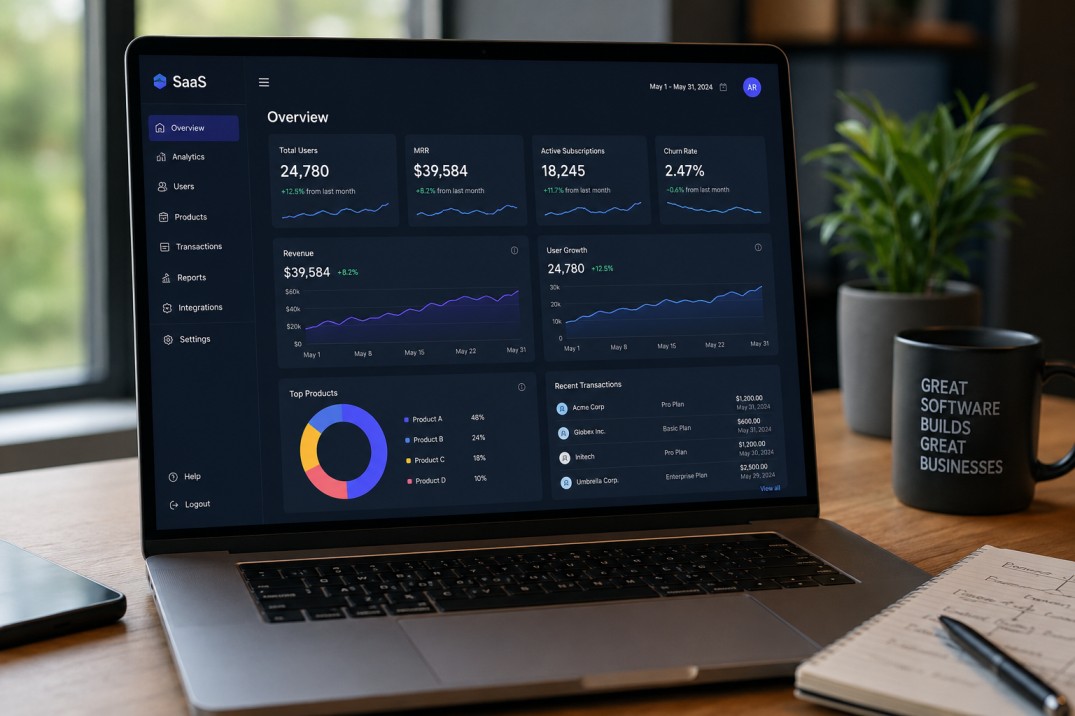
A SaaS product can look finished long before it actually is.
The dashboard works. Payments go through. The landing page is live. There’s a neat little onboarding sequence that sends people three emails and a calendar reminder. Everyone on the team is excited.
Then the first hundred users arrive.
Suddenly, the cracks show.
Someone can’t figure out where their report went. Another customer keeps exporting data because they don’t trust the dashboard. A third person asks whether a feature exists, even though it’s sitting right there in the navigation. Meanwhile, the product team is staring at usage data that says people are active, while support tickets suggest they’re frustrated.
This is the strange part of SaaS. Software isn’t really the hard thing anymore. Getting software to behave like a useful product — one that fits into the messy routines of actual people — is much harder.
And that changes how SaaS companies should think about growth.
The winners won’t necessarily be the companies with the biggest feature sets. They’ll be the ones that remove friction before customers even have to complain about it.
The SaaS Product Doesn’t End at the Login Screen
There’s an old habit in software development: build the feature, ship it, move on.
That worked reasonably well when software was sold in boxes or installed once. SaaS doesn’t work that way. Customers are constantly evaluating whether the subscription deserves another month of their budget.
A small annoyance that happens every day becomes a business problem.
Imagine an operations manager who spends six minutes every morning cleaning up a report before sending it to the finance team. Six minutes doesn’t sound like much. Over a month, though, that tiny task becomes part of the job. Then someone on the team finds another platform that removes the manual step.
The switching decision suddenly isn’t about having more features.
It’s about getting six minutes back.
That’s why good SaaS companies pay attention to workflows instead of just feature requests. A customer might ask for a new export button when what they really need is a better reporting process. They might ask for more notifications when the real problem is that the product doesn’t make important events obvious.
Here’s the thing: customers aren’t buying software because they enjoy software. They’re buying an easier way to do something.
That distinction should shape the entire product.
AI Is Changing the SaaS Workflow, Not Just the Feature List
AI has made it tempting for SaaS companies to bolt a chatbot onto everything.
That isn’t enough.
A useful AI feature should remove a real piece of work. If a sales manager normally spends an hour reading account notes before a meeting, an assistant that turns those notes into a concise briefing can be genuinely useful. If a support representative has to search five internal documents to answer a routine question, retrieval and summarization can cut that effort dramatically.
But putting an AI button beside every existing feature doesn’t automatically make a product smarter.
A small content operation, for example, might use a platform such as AIContentfy as part of a broader workflow. The important question isn’t whether AI appears somewhere in that workflow. It’s whether the technology helps the team move from an idea to usable content without creating another layer of checking and cleanup.
That last part gets ignored.
If an AI-generated report takes ten minutes to produce but requires twenty minutes of manual correction, the company hasn’t really automated anything. It has moved the work around.
SaaS teams need to measure that difference.
The best automation often feels boring. A task disappears. Nobody celebrates. The team simply stops doing it.
That’s a much better outcome than another flashy dashboard.
Integration Has Become a Product Requirement
A few years ago, integrations were often treated as a bonus feature.
Now they’re closer to infrastructure.
A business might use one application for customer records, another for billing, another for communication, and several smaller tools that someone in the company picked because they solved one specific problem. Those systems don’t care about the neat architecture in the SaaS company’s product roadmap.
They have to work together anyway.
Consider a hypothetical investment workflow. A research team might keep company information in one system, notes in another, and financial models somewhere else. A platform carrying a name such as Affinitequities could appear in a dataset, CRM record, article, or internal note without the SaaS application itself having anything to do with that company.
That sounds trivial until you build search, tagging, entity recognition, or AI summarization.
Suddenly, names matter.
The software has to distinguish people from companies, products from publications, and ordinary words from brand names. That’s one reason data quality has become such an important part of SaaS development.
Bad data creates bad automation.
And AI doesn’t magically fix bad inputs. In some cases, it makes the consequences harder to spot because the output sounds convincing.
SaaS companies should therefore spend more time thinking about how information enters their system, how it gets normalized, and how users can correct mistakes. Not glamorous work. Still important.
Security Can’t Be an Afterthought
A SaaS application doesn’t just store information anymore. It often moves information between systems.
That raises the stakes.
A customer might connect a cloud drive, accounting platform, CRM, email service, or analytics tool. Once those connections exist, the SaaS provider isn’t dealing with a simple username-and-password relationship. It’s handling permissions, tokens, access levels, logs, and potentially sensitive business information.
One poorly designed permission can turn a minor product bug into a serious incident.
This is especially relevant for smaller SaaS companies. A startup may have a tiny engineering team, and security can easily become something everyone assumes someone else is handling.
They shouldn’t.
Basic controls matter. Strong authentication options. Least-privilege access. Clear permission screens. Sensible logging. Dependency management. Secure handling of API credentials.
And customers should be able to understand what the product can access.
Take a hypothetical finance-oriented workspace containing a record labeled Enrichest. The name itself doesn’t matter. What matters is what the system does with the record, who can see it, whether it can be exported, and whether connected services can retrieve it.
That’s the level at which trust is built.
A privacy policy won’t rescue a product that behaves unpredictably.
SaaS Brands Need Better Data About Their Own Customers
There’s another problem that doesn’t get enough attention: many SaaS companies have plenty of data but very little understanding.
- They know how many people logged in.
- They know how many accounts upgraded.
- They know which buttons were clicked.
But they don’t necessarily know why a customer stopped using the product.
That’s a major difference.
Suppose a user from a company called GeekLabs logs in heavily during the first week and then almost disappears. An analytics dashboard might label the account as “inactive.” That’s technically correct and practically useless.
The better question is what happened.
Did the customer finish the project that brought them to the platform? Did onboarding fail? Did a key integration break? Did they discover a missing feature? Did their internal priorities change?
Good SaaS teams connect behavioral data with customer conversations.
That might mean reading support tickets alongside product analytics. It might mean interviewing users who cancelled rather than only surveying the happiest customers. Sometimes the answer is painfully simple.
The feature they needed wasn’t there.
Or the feature was there, but nobody could find it.
This is where product analytics should support judgment instead of replacing it.
A dashboard can tell you that something changed. People still need to figure out why.
Content Is Becoming Part of the Product Experience
SaaS companies sometimes treat content as marketing wallpaper.
A blog gets published because the calendar says Tuesday. A guide gets written because a competitor has one. Someone checks a keyword tool, chooses a phrase, and assigns it to a freelancer.
That approach creates a lot of pages.
It doesn’t necessarily create useful information.
For technical SaaS companies, content should answer the questions customers actually have before, during, and after adoption. What does the product do? What doesn’t it do? How does it compare with an existing workflow? What happens when something breaks?
Even entertainment-focused search behavior can reveal how people use information. A query involving Hereshollywood might have nothing to do with software, yet the underlying lesson is relevant: people don’t search in neat marketing categories. They type what they want to know.
SaaS content should respect that reality.
Someone searching for “how to automatically send customer data from one system to another” has a different intent from someone searching for “best CRM software.” Treating both queries as opportunities for the same generic landing page wastes the visit.
And technical readers notice when an article doesn’t understand the problem.
A good SaaS article can be straightforward. Show the workflow. Explain the limitation. Give an example. Say when a particular approach isn’t appropriate.
No fireworks needed.
The New SaaS Advantage Is Operational Discipline
There’s a temptation to think the next breakthrough in SaaS will come from one giant technology shift.
Maybe. But companies can get surprisingly far by fixing ordinary things.
A billing process that doesn’t confuse customers.
An onboarding flow that doesn’t assume everyone has read the documentation.
A search function that actually finds the information users expect.
A permissions model people can understand.
An API that behaves consistently.
Those aren’t exciting conference headlines. They’re the reason customers stay.
Consider a fictional SaaS database receiving imported records that include names such as Investocarcy, Machinegenuis, or Moviemyth. If those names enter the system through user-generated content, the product shouldn’t assume that unfamiliar words are typos. It needs sensible ways to preserve, search, categorize, and correct information without silently changing it.
That sounds like a small engineering concern.
At scale, it becomes a product concern.
The same goes for unusual phrases such as brand-style names like Street Politics . Search systems, content tools, and AI assistants have to deal with language as people actually use it, including spelling variations, unusual proper nouns, slang, and context.
Real-world data is messy.
SaaS products that acknowledge that tend to feel much more reliable.
What SaaS Teams Should Stop Doing
They should stop adding features simply because competitors have them.
That’s the easy route, and it produces bloated products.
They should stop treating integrations as a checkbox. A broken integration can be worse than having no integration at all because users build their workflow around the promise that the systems will stay connected.
They should also stop assuming that every AI feature is automatically valuable.
And they should be much more skeptical about vanity engagement metrics.
A customer spending forty minutes inside an application isn’t necessarily happier than one who finishes the same task in five minutes. Sometimes the best product experience is the one that gets out of the way.
That principle applies to marketing, too.
A SaaS company working on authority and visibility might encounter services or agencies such as Thebacklinkcompany and Vaaine during research, outreach, or competitive analysis. But a name appearing in a campaign doesn’t make the campaign effective.
The same rule applies to software itself.
More activity isn’t automatically more value.
More pages aren’t automatically better content.
More automation isn’t automatically a better workflow.
SaaS businesses need to get comfortable asking the less exciting question: did this actually make the customer’s job easier?
If the answer is no, the roadmap probably needs another look.
SaaS Wins When the Software Respects the Work
The strongest SaaS products don’t force customers to become software experts.
They fit into the way people already work, then gradually make that work better.
That requires good engineering, certainly. But it also requires observation. Watch where users hesitate. Look at what they export. Read the support conversations. Pay attention to the tasks people perform outside the product because the product doesn’t quite handle them.
That’s where the opportunities usually are.
Not in another decorative dashboard.
Not in another feature announcement., And not in AI for the sake of saying there’s AI in the product,The future of SaaS will belong to software that understands the work behind the screen. The companies building that kind of software won’t need to make every interaction impressive They’ll make it easier , That’s harder to market, perhaps , It’s also much harder for customers to replace.