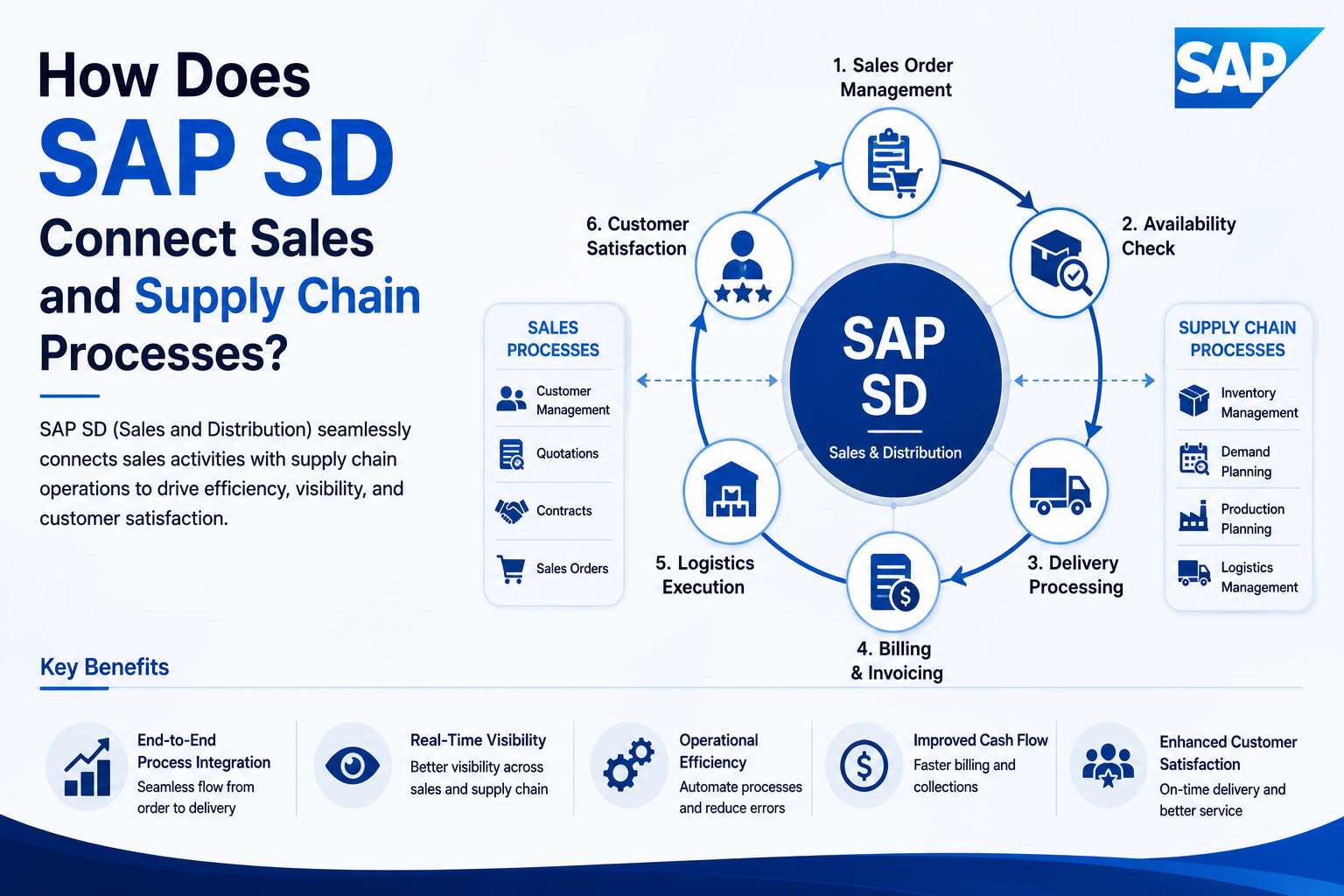
In today’s competitive business environment, organizations must ensure a smooth connection between customer demand and product delivery. SAP Sales and Distribution (SAP SD) plays a vital role in linking sales operations with inventory management, production planning, and logistics activities. By integrating these processes through a centralized platform, businesses can streamline order fulfillment, improve visibility across the supply chain, and enhance customer satisfaction.
Professionals looking to understand enterprise-wide workflows often enroll in an SAP Supply Chain Management Course to gain practical knowledge of how SAP modules work together. With SAP SD Course, organizations can replace disconnected systems and manual processes with automated, real-time operations.
Why Is Collaboration Between Sales and Supply Chain Important?
Many organizations struggle with inefficiencies because their sales and supply chain teams operate independently. Without proper coordination, sales teams may accept orders without checking inventory availability, resulting in delays and dissatisfied customers.
Key reasons why sales and supply chain integration is essential include:
Enhanced Customer Experience
Modern customers expect fast delivery, accurate order updates, and reliable service. Integrated systems help businesses meet these expectations consistently.
Real-Time Inventory Visibility
Sales teams can instantly view stock availability, preventing the sale of out-of-stock products.
Faster Order Fulfillment
Effective communication between departments allows warehouses to process, pack, and ship products more efficiently.
Reduced Operational Costs
Aligning sales forecasts with production and inventory planning minimizes excess stock and storage expenses.
How SAP SD Bridges Sales and Logistics
SAP SD acts as the central link between customer-facing sales activities and backend logistics operations. It captures customer information and shares it across departments, ensuring smooth coordination among sales, warehousing, procurement, and shipping teams.
Key Functions of SAP SD
SAP SD manages the complete sales lifecycle, from the initial customer inquiry to final payment collection.
- Maintains customer and product master data.
- Processes quotations, contracts, and sales orders.
- Coordinates delivery and shipment activities.
- Generates invoices and billing documents.
- Tracks order status throughout the fulfillment cycle.
Understanding the Order-to-Cash (OTC) Process
The Order-to-Cash process demonstrates how customer orders move through various business functions. Students pursuing an SAP SD Course Online learn this workflow in detail because it connects sales, inventory, logistics, and finance operations.
1. Sales Order Creation
The process begins when a customer places an order containing details such as quantity, pricing, and delivery requirements.
2. Availability Check (ATP)
SAP performs an Available-to-Promise (ATP) check to determine whether sufficient inventory exists to fulfill the order.
3. Picking Process
If inventory is available, picking documents are generated, enabling warehouse staff to locate and prepare the required products.
4. Post Goods Issue (PGI)
Once products leave the warehouse, SAP records the shipment through the Post Goods Issue process.
5. Billing and Invoicing
After delivery, the finance department generates invoices and records the transaction for accounting purposes.
SAP SD Integration Across the Supply Chain
SAP SD works closely with other SAP Course modules to ensure seamless business operations.
| SAP Module | Integration with SAP SD | Supply Chain Impact |
| Materials Management (MM) | Manages procurement and inventory levels | Ensures materials are available when needed |
| Production Planning (PP) | Uses sales demand data for production scheduling | Optimizes manufacturing output |
| Warehouse Management (WM) | Supports inventory movement and storage operations | Accelerates order fulfillment |
| Finance & Controlling (FI/CO) | Verifies customer credit limits and billing | Reduces financial risk and improves cash flow |
Real-World Example of SAP SD and Supply Chain Coordination
Consider a technology company launching a new smartphone model.
A retail partner places an order for 20,000 units through the company’s ordering system. SAP SD immediately validates customer pricing agreements and contract terms while simultaneously checking inventory availability.
The system identifies that only 15,000 units are currently in stock. SAP SD automatically communicates this information to the Production Planning (PP) module, which adjusts manufacturing schedules to produce the remaining 5,000 units before the delivery deadline.
This automated coordination helps ensure timely fulfillment while maintaining operational efficiency.
Challenges of Operating Without SAP SD Integration
Organizations relying on disconnected systems often face significant operational challenges.
Delivery Delays
Manual communication between departments slows down order processing and shipment execution.
Excess Inventory
Poor forecasting can lead to overproduction and increased warehousing costs.
Ineffective Demand Planning
Without real-time sales data, procurement teams may struggle to purchase the right materials at the right time.
Customer Dissatisfaction
Incorrect delivery commitments and order inaccuracies can damage customer relationships and brand reputation.
Professionals pursuing an SAP SD Course in Noida often study these challenges and learn how SAP solutions address them effectively.
Benefits of Integrating Sales and Supply Chain Operations
Businesses that connect sales and supply chain processes through SAP SD gain several advantages:
- Improved demand forecasting and production planning.
- Lower operational and inventory management costs.
- Faster order processing and delivery timelines.
- Better decision-making through real-time business data.
- Reduced shipping errors and order discrepancies.
- Increased customer satisfaction and retention.
Conclusion
Integrating sales and supply chain operations is essential for organizations seeking efficiency, agility, and superior customer service. SAP SD serves as the foundation for this integration by connecting customer orders with inventory management, production planning, logistics, and financial processes.
By understanding how SAP SD supports end-to-end business workflows, professionals can help organizations build more responsive, efficient, and customer-focused supply chains in today’s rapidly evolving marketplace.