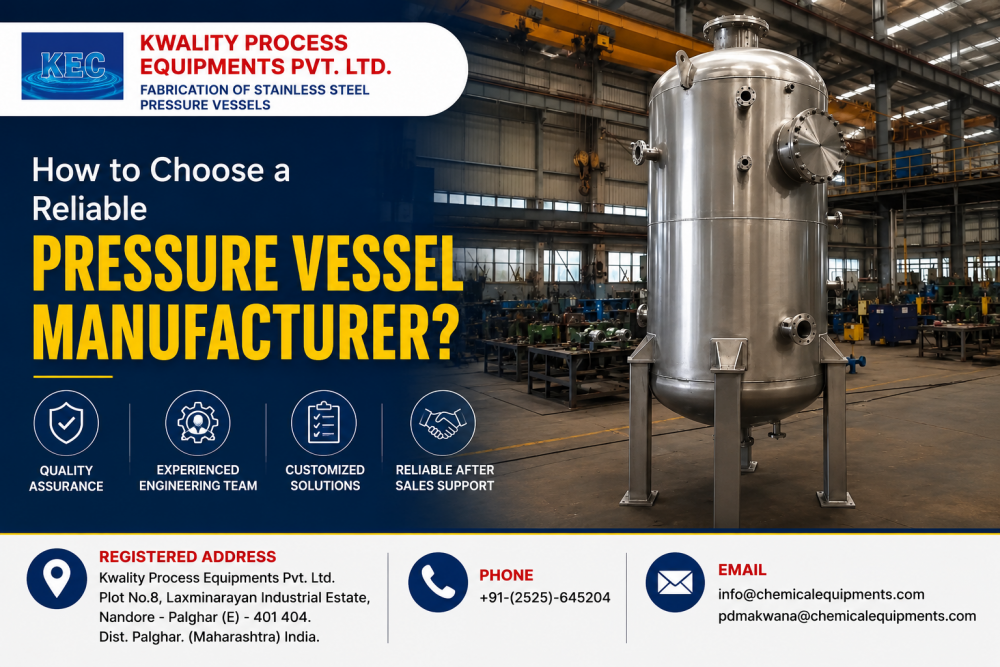
In regard to the industrial process system, pressure vessels are popularly known as the silent workhorses of the industry. Pressure vessels are the safe containers of gases at high pressure, hot fluids, and corrosive chemicals operating in tough environments. The decision on who will be the best pressure vessel manufacturer to work with is therefore not simply an acquisition of industrial equipment but a decision that impacts the performance of your plant in terms of safety and efficiency.
Any slight error in design, material use, and welding may cause equipment malfunction, production downtime, or risk of danger. This is the reason why professional engineers always go beyond looking at cost considerations and put their focus on other aspects such as quality, engineering, and adherence to international standards. A reputable process equipment manufacturer of chemical process equipment manufactures pressure vessels that will operate reliably and safely under any circumstance. In this article, we shall look at some of the safety standards that any manufacturer must adhere to and the vital considerations to make when selecting a suitable pressure vessel manufacturing company.
The Important Engineering Standards that Every Pressure Vessel Manufacturing Company Should Adhere to
These pressure vessels have been manufactured with very high working conditions in mind. The only way to ensure that they will be able to function effectively and safely for many years is by adhering to international standards for engineering codes and quality. This will ensure consistency and reduce risks of failure. Kwality Process Equipments Pvt. Ltd. follows these important internationally accepted standards in manufacturing pressure vessels.
| Standard Code | Purpose & Application | Why It Matters to Engineers |
| ASME Section VIII | World standard for the design, manufacturing, and testing of pressure vessels. | Designs the vessel to withstand high levels of internal and external pressure safely. |
| ISO 9001:2015 | International Quality Management System (QMS) standard. | Ensures consistent quality in production and documentation as well as complete material traceability. |
| AD Merkblatt / PD 5500 | European and UK standards for pressure equipment. | Useful for projects which need adherence to regional safety and regulatory requirements. |
| TEMA Standards | Heat transfer equipment standards. | Ensures heat transfer efficiency and mechanical integrity of the heat exchanger and similar vessels. |
These standards mean that all components of the pressure vessel, from raw materials to testing and final inspection, are checked and controlled. It guarantees the performance and reliability of the equipment in various industries including chemical processing, pharmaceutical, food processing, oil & gas, and other sectors. Choosing a pressure vessel manufacturer that complies with these standards will give you a guarantee of long-term reliability of your plant.
Things to Consider Before Selecting a Pressure Vessel Manufacturer
Compliance with international standards is not the whole story. The other important aspects that must be considered are technical skills, manufacturing facility, and quality control system. A reliable pressure vessel manufacturer uses modern technology and experienced engineers to develop equipment that works efficiently under challenging conditions. Here are several aspects to consider when choosing a manufacturer:
1. Check Their Certifications and Industry Compliance
Since pressure vessels work under high pressure, it is critical to pay attention to safety when choosing a process equipment manufacturer. Safety standards are usually legally binding, meaning that manufacturers must follow certain guidelines. When picking a producer, look for an organization that complies with recognized safety standards such as the ASME Boiler and Pressure Vessel Code (BPVC) or the European Pressure Equipment Directive (PED). In case your company operates in India, see if they are compliant with the Indian Boilers Regulations (IBR) 1950 in terms of applicable requirements. Furthermore, you may ask manufacturers for their certification and quality approval papers and audit reports. Such an approach proves that the manufacturer has a desire to produce pressure vessels that are safe and reliable.
2. Consider Their Design and Engineering Capabilities
Designing a pressure vessel is much more than creating its shape. It takes a considerable amount of time and effort to plan and engineer the vessel that would work properly under specific conditions. Experienced companies use special software such as PV Elite or COMPRESS for accurate design and simulation. Such programs allow estimating the thickness of the wall, selecting a proper head type, and calculating how the vessel will function under high pressure and at different temperatures. Asking for design drawings, 3D models, and structural analysis reports guarantees that the vessel is designed precisely without any assumptions made.
3. Pay Attention to Materials Used
The performance and lifespan of a pressure vessel mostly depend on the materials used during manufacturing. Various industries have various requirements in terms of materials since working conditions of each of them are different. While some applications require Stainless Steel, others may need Carbon Steel, Titanium, or Nickel Alloys, including Inconel and Monel. A reputable pressure vessel manufacturer sources all its materials exclusively from certified suppliers and keeps track of all components used. The company should also provide Material Test Certificates (MTC) confirming strength, chemical composition, and quality of materials.
4. Analyze Their Welding Competence
Welding is one of the most important aspects of pressure vessel manufacturing. The strength of the vessels greatly depends on weld quality, so choosing a manufacturer with certified welders who follow ASME Section IX is highly recommended. Contemporary fabrication facilities use such modern welding techniques as Submerged Arc Welding (SAW), TIG, and MIG welding, which allow increasing weld quality and improving consistency, and decreasing the number of possible mistakes. Thus, high-quality and consistent welds positively affect the performance of the vessel.
5. Ask for Their Testing and Inspection Processes
A pressure vessel always passes several tests before delivery. A reputable process equipment manufacturer conducts comprehensive Non-Destructive Testing (NDT) in order to identify potential defects without damage to the equipment. Most common testing techniques include Radiographic Testing (RT), Ultrasonic Testing (UT), Dye Penetrant Testing (DPT), and Magnetic Particle Testing (MPT). These inspections guarantee that there are no cracks or weak joints that could affect the performance of the vessel. Also, manufacturers conduct a Hydrostatic Test, ensuring that the vessel is able to operate under pressure higher than normal.
6. Evaluate Their Manufacturing Abilities and Customization Capabilities
Requirements of each industry are different. Thus, a pressure vessel for chemical processing, pharmaceuticals, or petrochemicals should be engineered according to your specific application. A reliable manufacturer has a well-equipped facility containing advanced machines such as CNC plasma cutters, hydraulic presses, and heavy-duty rolling machines. Even more importantly, they should be able to customize the vessel in terms of size, pressure rating, heating or cooling systems, and other operational requirements instead of supplying only standard products.
7. Consider Their Experience and Documentation Practices
The experience of a manufacturer reveals a lot about the quality of its work. Prior to making a decision, analyze their portfolio and see if they have provided services to businesses in your industry. An experienced pressure vessel manufacturer maintains quality documentation which includes Quality Assurance Plans (QAPs), inspection reports, Material Test Certificates, and Post Weld Heat Treatment (PWHT) where necessary. Such documentation will prove that the vessel was manufactured according to industry requirements and will help in further maintenance.
It’s Time to Wrap Things Up!
The choice of pressure vessel manufacturer influences the safety, productivity, and lifespan of your industrial plant. Although at first glance the cheaper option may seem appealing, low-quality equipment leads to increased maintenance costs, unexpected downtime, and potential safety risks in the long run.
At Kwality Process Equipments Pvt. Ltd., they combine international engineering standards, modern manufacturing technologies, certified welding, full material traceability, and comprehensive quality inspections to provide pressure vessels that can be relied on in various industries for years. The good quality pressure vessel is an investment that guarantees the protection of your operations and the smooth production and safety of your employees. So, do not wait any longer. Reach out to them today!