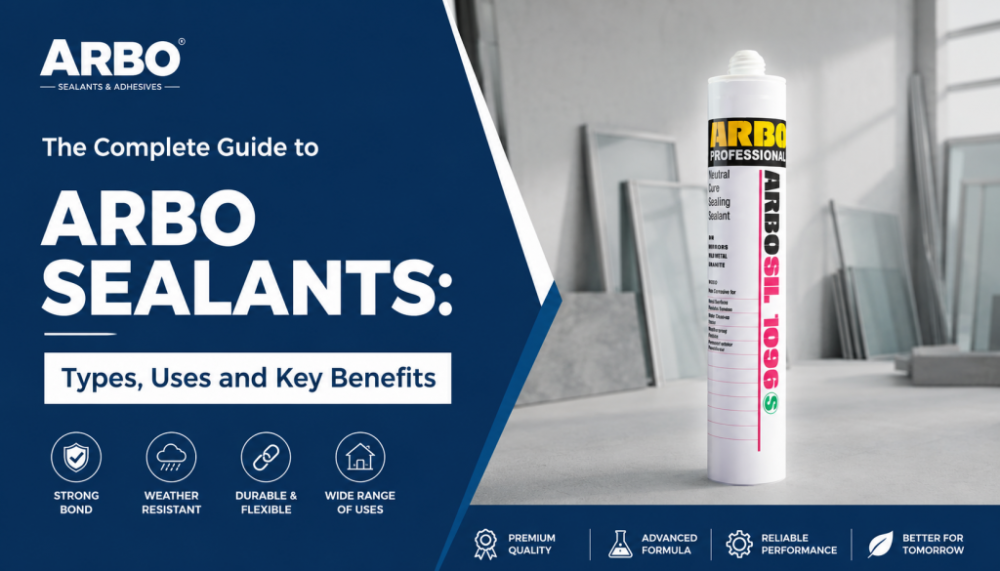
Learn about the types, uses, and key benefits of ARBO Sealants to choose the right solution for your project and achieve long-lasting results.
Pick up the wrong sealant on a job and you’ll know about it fast. Blistering, poor adhesion, cracking within a season — it’s frustrating, and it costs time you haven’t got. That’s why so many trade professionals specifically ask for ARBO sealants rather than just grabbing whatever’s on the shelf. They’ve been trusted on UK construction sites for years, and there’s a practical reason for that.
This guide covers the main types, what each one actually does well, and how to make sure you’re picking the right product for the job in front of you.
What Are ARBO Sealants?
ARBO has been producing sealants for the UK construction and glazing trade for a long time. The range isn’t designed for the DIY market — it’s built for people who use sealants every day and need them to perform consistently across different substrates, temperatures, and exposure conditions.
The product line covers general-purpose mastics right through to structural silicones for demanding façade work. That breadth is one of the reasons trade suppliers like Dortech Direct carry the full range — contractors want to deal with fewer suppliers, and being able to source everything from one place matters.
Types of ARBO Sealants
Not all sealants do the same job. Using the wrong one — even a decent quality product — often causes more problems than it solves. Here’s a breakdown of the main types and where each one fits.
1. ARBO MP20 — Multi-Purpose Sealant
ARBO MP20 gets used across more application types than almost anything else in the range. It’s a neutral-cure silicone, which is important — neutral cure won’t attack copper, lead, or other sensitive metals the way acetoxy-cure products can.
You’ll find it being used for:
- Window and door frame sealing
- Internal and external glazing work
- Joints between uPVC, aluminium, and timber
- Bathrooms, kitchens, and wet rooms
Once cured, it stays flexible. Buildings shift — temperature, settlement, wind load — and a sealant that can’t move with a joint will crack. MP20 handles that well, which is why it comes up again and again on glazing jobs both domestic and commercial.
It comes in a decent range of colours too, so you’re not stuck with white on every job.
2. Arbomast General Purpose Mastic — Black
Arbomast General Purpose Mastic in black is a different beast entirely. This is the one roofers and maintenance crews tend to reach for — it’s heavy-duty, waterproof, and built for the kind of rough applications where silicone would be overkill or simply the wrong choice.
It works well for:
- Flat roof repairs and sealing around leadwork and flashings
- Joints and penetrations around rooflights and pipe outlets
- Masonry pointing and cladding joints
- Metal-to-concrete and metal-to-metal sealing
The black colour isn’t just aesthetic — it blends naturally with bitumen-coated surfaces and darker substrates where a grey or white sealant would stand out badly. If you’re patching a flat roof or sealing around a rooflight, this is normally what you want in the gun.
3. ARBO Structural and High-Performance Sealants
For curtain walling, structural glazing, and high-spec façade work, ARBO’s specialist range steps in. These aren’t everyday products — they’re for projects where the sealant is doing a structural job, not just filling a gap.
Key performance characteristics include:
- Movement accommodation in the 25–35% range
- Strong UV and weathering resistance for long façade life
- Compatibility across glass, aluminium, stone, and composite panels
- Low-maintenance performance over extended service periods
On commercial projects, using an underspec’d sealant in structural joints isn’t just a quality issue — it becomes a liability issue. The higher-performance ARBO products are specified for exactly these situations.
Key Benefits of ARBO Sealants
There’s no shortage of sealant brands on the market, so what keeps people coming back to ARBO? A few things come up consistently.
Batch-to-batch consistency
Trade professionals get frustrated when a product they’ve relied on for years suddenly behaves differently. ARBO’s manufacturing quality control keeps things consistent — same tack time, same cure, same adhesion. That matters when you’re working to spec.
Substrate flexibility
Glass, timber, brick, concrete, aluminium, uPVC — most ARBO products bond to a wide range without needing a primer coat every time. That saves time and reduces the chance of a compatibility problem mid-job.
Real joint movement tolerance
This is where cheaper sealants let you down. A sealant that can’t flex will crack, let water in, and need replacing far sooner than it should. ARBO products are formulated with the kind of elongation values that handle real-world joint movement over years, not months.
Weather and UV resistance
An external sealant in the UK is going up against freeze-thaw cycles, driving rain, UV exposure, and temperature swings. ARBO’s external-grade products hold up to that without going brittle or losing adhesion.
A range that actually covers you
If you can source your everyday mastic, your structural silicone, and your specialist products all under one brand from one supplier, that’s fewer variables to manage on a project. It’s one of the practical advantages of a range with genuine depth.
How to Pick the Right ARBO Sealant
Before ordering, it’s worth running through a few straightforward questions:
- Internal or external? External joints need UV stability and weather resistance as a baseline.
- What are the substrates? Sensitive metals like copper or lead need a neutral-cure product like MP20.
- How much will the joint move? Expansion joints and cladding joints need more flexibility than a static internal seal.
- Does the colour need to match? Visible joints on finished work usually need colour-matching.
- Is there old sealant to strip out? New product won’t bond properly over degraded or contaminated sealant — prep work matters.
If you’re unsure, the team at Dortech Direct can point you in the right direction — especially on unusual substrate combinations or structural applications where getting it wrong is expensive.
Which Trades Use ARBO Sealants
Glazing contractors typically run MP20 on window and door installations day-to-day, stepping up to structural silicone on commercial curtain walling and façade contracts.
Roofers keep Arbomast General Purpose Mastic in black on the van for flat roof repairs, flashing details, and any penetration sealing where a tough waterproof seal is needed fast.
Building maintenance teams tend to carry a mix — MP20 for general repairs around windows and frames, Arbomast for the roof, and occasionally a specialist product when something more demanding comes up.
Cladding and façade installers lean on the higher-performance end of the ARBO range, where long-term weathertightness and joint aesthetics both have to hold up.
Where to Get ARBO Sealants
Dortech Direct is a trade supplier based in Huddersfield stocking a full range of ARBO products for delivery across the UK. The range is available online, and their team knows the product well enough to help if you’ve got a specific application that doesn’t fit neatly into the standard guidance.
Conclusion
ARBO sealants have been a fixture on trade sites across the UK for good reason — consistent quality, a range that genuinely covers most applications, and performance that holds up over time rather than failing a year down the line.
Whether you’re putting ARBO MP20 around a window frame, running Arbomast General Purpose Mastic along a flat roof detail, or speccing a structural silicone for a commercial glazing project, you’re working with products that are built for the job rather than just marketed at it. That’s the real reason they keep turning up in trade vans and on project spec sheets.
Frequently Asked Questions
Q: What is ARBO MP20 used for?
MP20 is a neutral-cure silicone sealant. It’s used on window and door frame sealing, internal and external glazing, and joints between uPVC, aluminium, and timber. It works internally and externally, and the neutral cure means it won’t react with copper or lead.
Q: What’s the difference between ARBO MP20 and Arbomast General Purpose Mastic?
They’re quite different products. MP20 is a silicone suited to glazing and framing work. Arbomast is a heavier-duty mastic designed for waterproofing, roofing repairs, and masonry sealing. Using one where you need the other will cause problems — they’re not interchangeable.
Q: Can ARBO sealants be used externally?
Several products in the range are specifically built for external use, including UV resistance and weatherproofing to handle UK climate conditions. Always check the product datasheet before applying — and make sure the surface is clean and dry first.
Q: Are ARBO sealants easy to get hold of in the UK?
Yes, they’re fairly widely stocked by glazing and construction trade suppliers. Most carry the popular products like MP20 and Arbomast. If you need something from the specialist end of the range, it’s worth checking online before heading to a trade counter — not every branch keeps the full line.