Modern builders operate inside project schedules that compress months of coordination into weeks of execution. Project owners demand faster deliveries, budgets and zero tolerance for field remodeling. Digital planning tools now determine whether a project delivers on time or bleeds cost across every phase. Getting the data right from the start isn’t just good practice. It’s what separates builders who stay ahead from those constantly playing catch-up with manual processes. And that gap shows up early: the more conflicts resolved in planning the fewer surprises eating into the budget on site.
Every unresolved spatial conflict caught in the design phase saves days of field labor and thousands in change orders. Modern construction projects demand a data driven approach that connects all building systems into single coordinated digital environment. Time saved in design translates directly into cost saved on site which accelerates project completion and protects profit margins.
What Are MEP BIM Services?
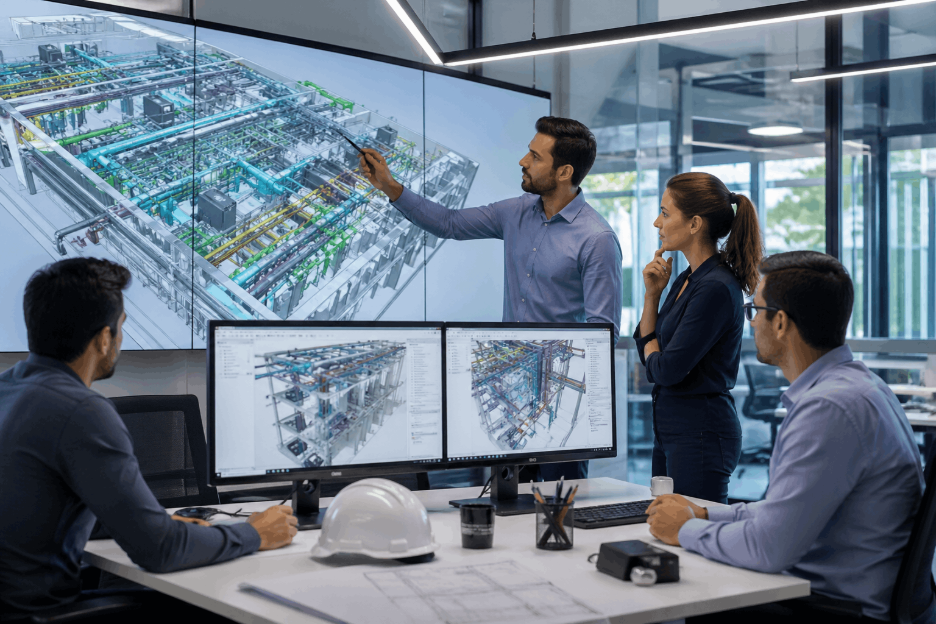
MEP BIM Services pull mechanical, electrical, and plumbing data together into one smart 3D environment. Think of it as a live digital model where geometry and system data work side by side across every building system in real time. Parametric families sit at the core of this model. Each family holds the specs, sizing, and performance details the whole model relies on. So the moment an engineer tweaks a duct, adjusts a pipe diameter, or shifts an equipment clearance, everything connected moves with it automatically. No manual chasing, no lagging updates. That kind of live responsiveness means the team makes better calls earlier, before small mismatches grow into costly field problems.
Why Time Efficiency Matters in Modern Construction
Ask any BIM professionals what a delayed handover actually costs and the answer goes beyond the obvious. Construction loans do not pause while crews sort out field conflicts interest keeps running, and those daily charges stack up fast. A week’s delay is not just a schedule problem. It hits the budget directly. Tight schedules need accurate, detailed system data from day one so field teams stay on track.
Even one clash between a mechanical duct and a structural beam can stall an installation crew for days. Field conflicts turn into change orders, and those change orders stretch both the timeline and the budget often rippling across multiple project phases. Builders who bring digital coordination into design early keep their schedules solid and their finances healthy all the way through construction.
How MEP BIM Services Save Time
Accurate 3D Modeling
LOD 400 geometries capture fabrication-level detail for every MEPF component in the model. This precision eliminates manual field measurements during installation planning. Fabricators receive exact dimensional data directly from the model for shop fabrication. The geometry describes pipe routing, duct dimensions, and equipment clearances across the full building system. Field teams spend less time measuring and more time installing correctly fabricated components on schedule.
Early Clash Detection
Clash Navigator tools run automated interference checks across all discipline models simultaneously. The software identifies physical overlaps between ductwork, piping, conduit and structural elements during the design phase. Design teams resolve spatial conflicts in the virtual environment. Where correction costs a fraction of field remediation. Early clash resolution protects the construction schedule and keeps the project budget on track from design through handover.
Faster Design and Decision Making
When everyone on the team project managers, owners, engineers pulls up the same live 3D model, conversations shift fast. Instead of flipping through 2D drawings and guessing how systems fit together. Stakeholders actually see the full picture right in front of them. That shared view moves approvals along quickly, cutting what used to take weeks of back-and-forth down to a matter of days. Decision makers act on verified digital information and advance the project with full confidence.
Integrated Coordination
Federated Model environments synchronize cross disciplinary models into a single unified file. Mechanical BIM Modeling workflow, structural, architectural and electrical data coexist within one coordinated workspace available to all project teams. This integration surfaces interdisciplinary conflicts automatically and keeps every discipline working from current, verified project data. Meetings actually move somewhere useful teams walk in already knowing where the conflicts are, so the conversation goes straight to solving them rather than finding them. That alone cuts meeting time significantly and keeps the whole project moving forward.
Integration with Scan to BIM
Before any MEP modeling begins on a retrofit or renovation, the team needs to know exactly what’s already there. Survey crews scan the existing space that captured data loads straight into the BIM environment as a reliable spatial reference. MEP modelers then build directly on top of real, measured geometry rather than working off outdated drawings or best guesses. The jump from field scan to a fully coordinated MEP model happens much faster because the foundation is already solid.
Best Practices for Maximizing Time Savings
A few habits make a big difference in how smoothly a project runs. Consistent naming across all model elements means any discipline team can find what they need fast, without digging through poorly labeled files. Locking everyone onto a shared coordinate system from the start keeps all discipline models spatially aligned. Skipping this step is one of the quickest ways to create headaches during federated model assembly. Regular model audits are worth scheduling too, catching redundant elements and parameter errors before they quietly slow the model down at a critical milestone.
Getting LOD right at kickoff matters more than most teams realize. A clear LOD matrix tells every discipline exactly how much geometric detail and data each milestone actually needs not a rough idea, but a specific, agreed-upon target. That upfront clarity keeps everyone building toward the same goal rather than arguing about scope halfway through the project. Teams that nail LOD expectations early spend far less time circling back on revisions and far more time pushing coordination forward toward field-ready deliverables.
Conclusion
MEP BIM coordination moves the needle on schedule, budget, and construction quality in ways that show up clearly on the bottom line. Tools like LOD 400 modeling, clash detection, and federated model environments take a project from design intent all the way to field-ready data without the usual coordination gaps. Builders who build this workflow into their standard process set themselves up for smoother approvals, fewer surprises on site, and healthier project financials overall. For any builder serious about delivering precise, efficient work this is where that commitment starts.