Mobile apps are evolving from rule-based programs to applications capable of understanding language, recognizing images, predicting the future, and producing content. The statistics back this trend.
Apps that contain references to AI have been downloaded more than 7.5 billion times around the world in the first half of 2025, comprising about 10% of total downloads and indicating a growth of about 52% compared to the previous year. The downloads of generative AI apps in the same timeframe totalled almost 1.7 billion. This proves that AI is becoming a new layer in mobile apps.
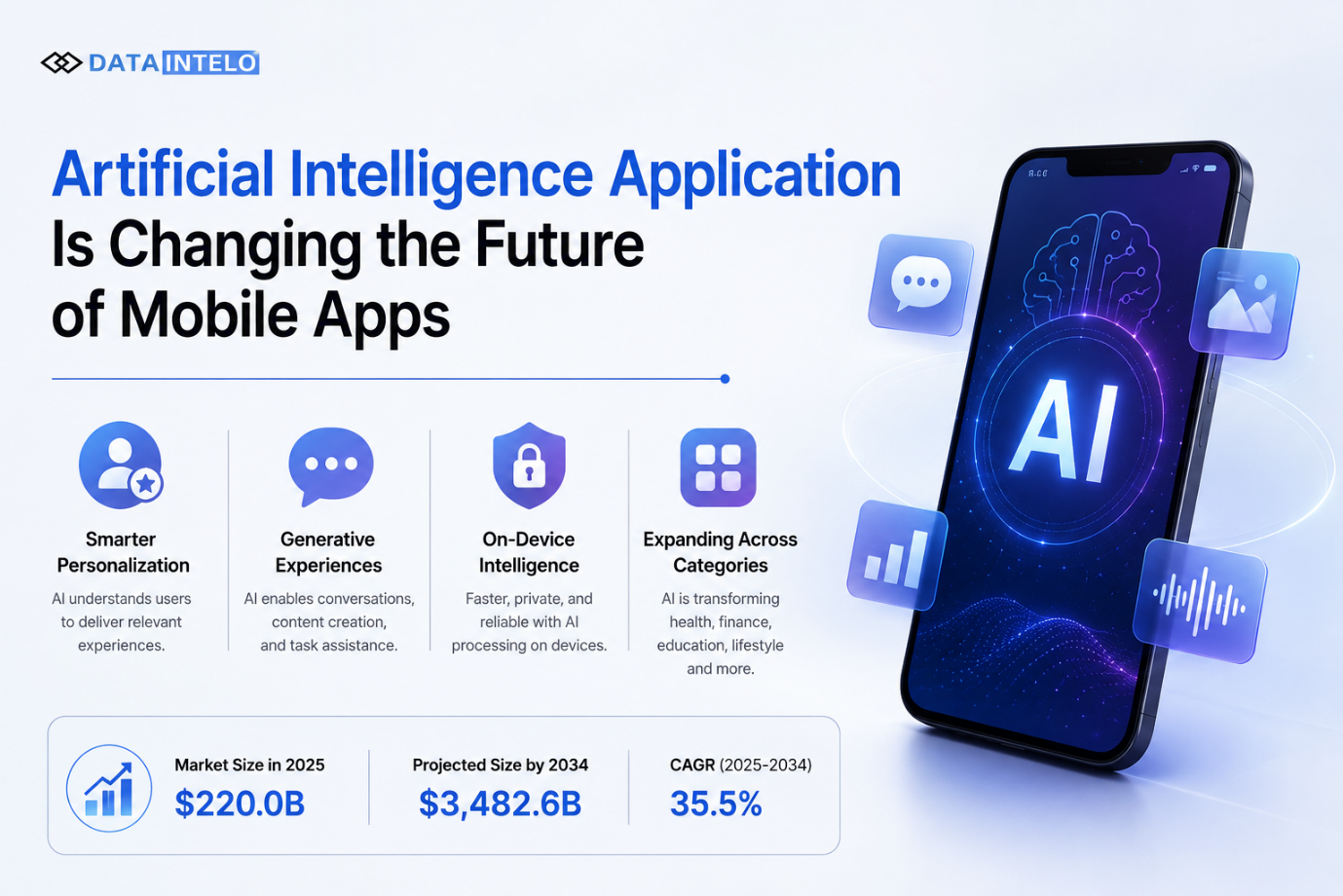
AI Makes Applications More Personalized
Machine learning is now under an investigation process of behavior patterns, context, and actions to enhance the personalization process. Therefore, with the help of recommendation engines, businesses can study their customers’ search queries, viewing duration, purchase history, location, and actions carried out repeatedly by them.
By 2024, the number of AI-based applications downloaded worldwide had exceeded 17 billion, which accounts for nearly 13% of the overall applications downloaded. Personalization is evolving rapidly since more and more applications from different domains such as finance, education, business, shopping, lifestyle, etc. are being developed.
Generative AI Revolutionizes User Engagement
Generative AI has introduced chat interfaces that answer queries, summarize details, produce visuals, paraphrase text, as well as help users complete various activities within mobile apps. During the initial six months of 2025, users folded over 15.6 billion hours on generative AI apps through about 426 billion sessions.
Profits made by the mobile applications reached around $1.9 billion during the time frame, which was nearly double the number generated in the last six months of 2024. The statistics indicate that mobile users continue to come back to such apps regularly.
AI on Devices Supports the Speed and Privacy
One of the major highlights of the new age of AI is having AI processing move from far-away servers to mobile devices. The usage of on-device inference helps to decrease connection dependency, provides lower latency, and keeps sensitive information close to the device.
The latest mobile operating systems are providing features that have small language models implemented and ready to run on mobile devices. This results in the offline experience and helps to save the need to go through the whole process of sending correspondence to the cloud.
Artificial Intelligence Progress in Various App Domains
Adoption of AI technology is not restricted just to chatbots. During the initial six months of 2025, the Health and Wellness, Jobs and Education, Lifestyle and Services, and Financial Services industries saw over 200 applications adopting AI technology.
AI is also being introduced to photo editing, language translation, learning languages, nutrition, video generation, and financial evaluations. This trend implies that upcoming applications will merge traditional functions with predictive, generative, or vision technology.
Future mobile applications will be affected by the following major milestones:
- Immediate translation for communication purposes.
- Perception for visual search, documentation processing, and accessibility.
- Anticipating users’ needs and fraud detection.
- Creation tools for texts, pictures, and videos.
The Expansion of Mobile AI Has Become Countable
Data Intelo reported information stating the worldwide AI applications market is seen to grow to approximately $3.48 billion by 2034 from $220 billion in 2025, exhibiting a CAGR of 35.5% that can be attributed to AI integration within mobile applications thereby including customization, predictive analysis and generation capabilities alongside on device intelligence.
Data show that AI influences application downloads. In the year 2025, applications market revenue will exceed $85 billion, while revenue from in-app purchases with regards to generative AI will be more than $5 billion.
This particular software segment will show 3.8 billion downloads, doubling the number of downloads achieved in 2024. In 2025, more than 40 out of the 100 most downloaded apps will utilize consumer-facing applications powered by AI, thus increasing their billing capabilities compared to other popular apps significantly.
| Indicator | Recent value | What it shows |
| AI app downloads, H1 2025 | 7.5B | Broad adoption |
| GenAI app downloads, 2025 | 3.8B | Rapid expansion |
| GenAI app time, 2025 | 48B hours | Deeper engagement |
| AI-enabled top apps | 40+ of top 100 | Mainstream integration |
Future Prospects of AI-Enabled Mobile Applications
The future will probably center around multimodal and context-driven applications that utilize text, sound, visuals, sensors, and live information. A mobile software could analyze a photo, fulfil a verbal request, obtain details, and take multiple actions within one process.
The extent of growth will depend on energy consumption, availability of appliances, data security and quality, and reliability of devices. Generative AI contributes only a minimal amount to the mobile traffic whole but is expected to grow considerably in the future.
Conclusion
Artificial intelligence transforms mobile apps from stationary screens into dynamic software with the ability to foresee, generate, identify, and communicate. These changes are already seen in the statistics related to downloads and revenues.
Future growth will rely less on adding AI to the name on the box and more on its effective integration for improving efficiency, relevance, reach, and decision-making. It is likely that advances in mobile computing technology, the underlying models, and privacy protection methods will result in making AI a built-in feature for commonly used applications instead of a unique option.