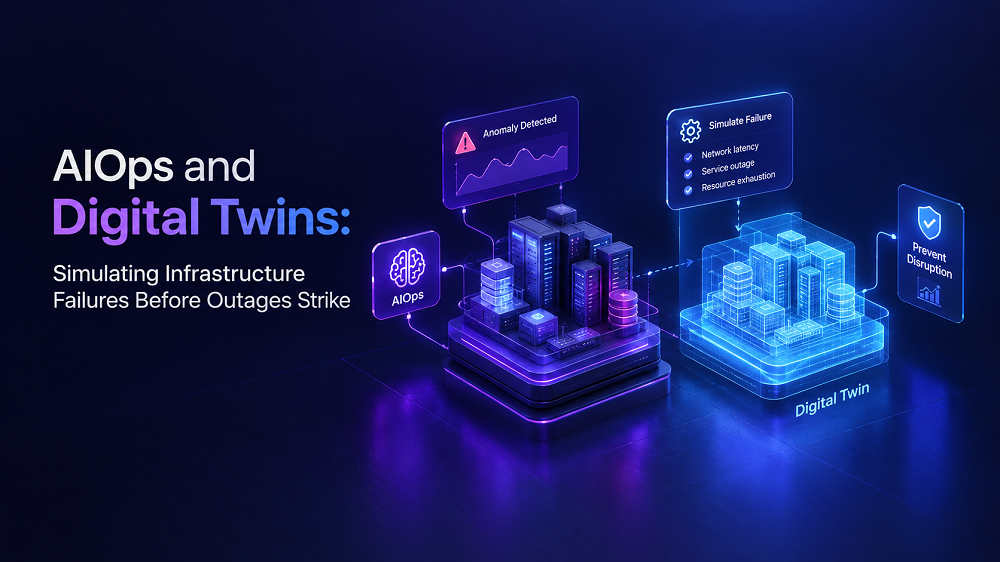
Modern enterprise systems demand proactive defenses that eliminate system crashes long before service disruptions reach customers. Pairing AIOps and Digital Twins establishes an operational environment that continuously mirrors computing hardware and application topologies in software.
Rather than reacting to active incidents, operational teams execute synthetic stress experiments within virtual models. This framework reveals hidden cascading dependencies, verifies configuration adjustments, and preserves operational uptime across enterprise infrastructure.
Telemetry Ingestion and Dynamic State Modeling
Enterprise data centers produce continuous telemetry streams containing event logs, execution traces, and hardware saturation metrics. Traditional operational dashboards consolidate historical readings into static charts, yet separate monitoring panels isolate visibility and conceal interactions between distributed microservices.
Connecting active telemetry directly to virtual mirrors creates computational replicas that reflect live physical states. Machine learning algorithms process high-velocity telemetry streams to detect performance deviations before systems experience operational failure, essentially using artificial intelligence for IT operations.
A functional virtual counterpart mirrors physical servers, network routes, container clusters, and storage arrays. When physical compute nodes experience sudden memory saturation, the software replica registers the variance immediately. Operations teams execute behavioral projections across simulated components without directing risky test traffic through live user channels.
Data streaming protocols transmit hardware metrics straight into centralized computational engines. Ingestion pipelines reconcile configuration differences between physical machines and their simulated replicas, preserving operational parity across changing cloud deployments.
Telemetry ingestion agents normalize divergent event schemas across multiple hardware vendors into structured operational models. This normalization permits computational engines to detect correlated fault sequences that span multiple cloud hosts and on-premises physical servers.
Streaming telemetry fabrics aggregate asynchronous metrics from distributed endpoints into unified analytical pipelines. Processing telemetry at ingestion points standardizes diverse formats, allowing machine learning models to identify anomalies across hybrid cloud platforms.
Structural Modeling Through AIOps and Digital Twins
Modern compute environments span bare-metal nodes, virtual hypervisors, and distributed serverless containers. Standard relational database tables struggle with the fluid, multi-directional dependencies typical of microservice deployments.
Graph data structures represent distributed enterprise networks with superior fidelity. Within a graph engine, physical hardware nodes, network interfaces, virtual instances, and application components exist as interconnected entities linked by directional transactional paths.
AIOps and Digital Twins map structural relationships alongside live operational telemetry. Predictive algorithms track shifting resource demands across on-premises data centers and remote cloud compute clusters.
Bidirectional data synchronization keeps the simulation layer aligned with physical production clusters. Message distribution pipelines stream operational telemetry from network switches, servers, and hypervisors directly into the model.
Algorithmic processors evaluate telemetry fluctuations, connecting subtle latency spikes with memory leaks or bandwidth exhaustion. Systems teams inspect graph paths to isolate root faults long before transactions experience service degradation.
Graph algorithms determine fault propagation speeds by calculating dependency distance across interconnected components. Identifying tightly coupled dependencies enables operational teams to decouple brittle services before minor hardware defects trigger widespread outages.
Graph traversal algorithms calculate path vulnerability scores across connected entities in real time. When latency accumulates along a specific network link, the traversal engine identifies all upstream services exposed to downstream degradation.
Preemptive Failure Simulation and Change Impact Validation
Enterprise outages frequently stem from planned maintenance routines, configuration edits, and flawed software releases rather than sudden hardware breakdowns. Testing prospective updates in safe virtual sandboxes protects core production environments from inadvertent human errors.
The implementation result in practical benefits of graph-based assessment engines. Simulation software inspects interconnected network services, calculating which downstream customer channels face disruption whenever technicians schedule hardware maintenance.
Running synthetic stress scenarios uncovers systemic fragility under controlled operational conditions. Engineers induce virtual server crashes, network partition events, and sudden computational load surges directly inside the mirrored system.
Through continuous testing, AIOps and Digital Twins detect hidden single points of failure throughout layered operational topologies. Operational teams test cluster failover procedures in simulation before approving routine changes in live data centers.
Synthetic failure injection demonstrates how secondary dependencies respond when primary services terminate. Monitoring cascade effects in software sandboxes prevents unexpected multi-system collapses during physical production incidents.
Controlled fault injection tests whether backup systems engage smoothly during unexpected operational shocks. Simulating localized switch disconnects verifies whether dynamic routing tables adapt instantly without dropping active transaction payloads.
Structural Comparison of Operational Strategies
| Operational Capability | Conventional Observability | Digital Twin-Driven Simulation |
| Diagnostic Framework | Reactive query execution following system outages | Continuous predictive anomaly projection |
| Infrastructure Context | Isolated metric views inside disconnected dashboards | Unified graph mapping of cross-system dependencies |
| Change Verification | Manual review boards and post-deployment monitoring | Automated synthetic testing within software models |
| Incident Mitigation | Manual engineering triage following threshold alerts | Automated closed-loop policy execution |
| Capacity Planning | Historical consumption trends | Full traffic projection across mirrored compute nodes |
Deploying Enterprise AI Solutions with Delivery Pipelines
Modern enterprise architectures link deployment pipelines with simulated infrastructure models to validate updates prior to production rollout. Evaluating code releases against active topological structures prevents configuration drift and isolates latent system errors before operational workloads encounter live traffic.
Continuous Deployment and Virtual Verification
- Preemptive simulation aligns software release cycles with live infrastructure topology, allowing testing stages to detect systemic faults before deployment.
- Modern DevOps services incorporate virtual failure trials directly into continuous integration pipelines, evaluating package stability prior to live rollouts.
- Deployment automation executes non-disruptive validation checks across simulated server fleets, preventing problematic code from reaching active production clusters.
Predictive Analytics with Machine Learning Expertise
- Enterprise AI solutions detect subtle telemetry variances across thousands of distributed server nodes, matching live signals against historical incident signatures.
- Partnering with an AI/ML development company provides organizations with specialized engineering pipelines, custom simulation software, and graph dependency models.
- Enterprise engineering departments deploy dedicated AI/ML services to project resource constraints, automate workload rebalancing, and prevent operational bottlenecks.
Automated Risk Gates and Operational Stability
- Automated feedback loops transmit simulated risk scores directly into continuous integration systems, establishing objective quality thresholds for software builds.
- Releases exhibiting high risk metrics trigger automated pipeline holds, requiring targeted review before deployment packages contact physical compute hardware.
- Proactive workload management and simulated maintenance rehearsals allow engineering teams to concentrate on systemic design rather than urgent fire drills.
Autonomous Closed-Loop Remediation Architecture
The central objective of integrating predictive simulation with operations intelligence centers on autonomous remediation. Closed-loop management models execute a continuous cycle: inspect physical assets, project outcomes, choose corrective actions, and apply configuration changes.
When pattern detection algorithms flag an impending drive failure, the platform avoids dispatching static alerts to engineering queues. The system evaluates multiple remediation pathways within the virtual twin to project operational repercussions.
Once virtual trials demonstrate that rerouting traffic will avoid degrading backup nodes, the controller triggers automated recovery playbooks. Application instances shift automatically, preserving service availability without requiring emergency engineering calls.
Simulation models maintain accuracy by continuously ingesting changes from physical servers. Every physical hardware adjustment updates the virtual topology, confirming that predictive projections remain reliable over time.
Operating in this continuous cycle, AIOps and Digital Twins convert fragile corporate computing networks into self-healing environments. Unplanned service interruptions decline as systems preemptively diagnose, simulate, and resolve operational defects.
Autonomous remediation protocols reduce resolution times by bypassing manual triage bottlenecks. Automated recovery actions preserve transactional continuity, enterprise productivity, and customer satisfaction.
Continuous feedback loops prevent drift between software simulations and operational physical clusters. Model calibration algorithms adjust baseline parameters as hardware ages or cluster topologies shift, preserving long-term predictive accuracy.
Operational Resilience and Strategic Outlook
Deploying AIOps and Digital Twins shifts enterprise operations from reactive emergency management to proactive failure prevention. Synthetic simulation isolates systemic risks without exposing revenue streams or customer interfaces to unexpected system downtime.
Organizations that adopt predictive software modeling establish resilient computing systems, maintain operational integrity, and protect business continuity across distributed infrastructure. Business leaders can connect with technical specialists to implement these operational strategies across production environments.