Cloud work rarely stays as simple as setting up a few servers and calling it done. As applications grow, teams end up dealing with deployments, infrastructure changes, security, monitoring, scaling, and cloud bills that need constant attention.
At some point, the question becomes less about whether you need cloud expertise and more about how to bring it into the team without slowing the business down. That is why many companies choose to hire remote cloud engineers when they need specialized skills without immediately building a larger internal team.
Why Businesses Are Hiring Cloud Engineers Remotely
Cloud work can get complicated pretty quickly. A developer who handled the initial setup may not be the right person to deal with a growing AWS environment, Kubernetes, security issues, or a migration project. This is one reason businesses are looking outside their own office when they need cloud expertise.
Finding the right skill:
Not every cloud engineer works with the same tools. One project may need AWS and Terraform experience, while another may need Azure, Kubernetes, or cloud security. Remote hiring gives companies more people to choose from.
Getting help when needed:
A company does not always need another permanent employee. Maybe there is a migration coming up, or the existing team is overloaded for a few months. Bringing in a remote engineer can fill that gap without changing the whole internal team.
Handling bigger workloads:
Cloud infrastructure tends to grow along with the product. More users mean more workloads, more deployments, and usually more things to monitor. Extra engineering support can take some of that pressure off the existing developers.
Working across locations:
Cloud projects are already managed through online tools, repositories, monitoring platforms, and communication systems. For many teams, having the engineer in another location is less of a problem than finding someone with the right experience.
Keeping the internal team focused:
Developers can manage some cloud tasks themselves, but that does not mean they should spend most of their time doing infrastructure work. Bringing in cloud specialists can leave the product team with more time for the application itself.
The reason for hiring matters here. A company dealing with a one-time infrastructure problem will have different needs from a business that expects someone to manage its cloud environment for years. That difference becomes important when comparing the available hiring models.
What Does a Remote Cloud Engineer Actually Handle?
The role can look very different from one project to another. Someone working on a new SaaS product may spend most of their time on infrastructure and deployments. In a migration project, the same role could involve databases, networking, and application changes.
- Infrastructure: Setting up the cloud environment and keeping its core resources running properly.
- Deployments: Helping developers release new versions without turning every deployment into a manual task.
- Automation: Replacing repetitive infrastructure work with tools such as Terraform.
- CI/CD: Connecting development work with testing and production releases.
- Containers: Working with Docker or Kubernetes when the application needs a container-based setup.
- Monitoring: Checking system health and stepping in when performance or availability starts to drop.
- Security: Managing who can access what, along with secrets, permissions, and network controls.
- Migration: Moving existing applications and databases to a cloud platform without disrupting the business.
- Costs: Looking at cloud usage and finding resources that are unnecessary or poorly configured.
Not every company needs all of these skills at once. A small product may need one engineer who can cover most of the basics. A larger environment may need separate expertise for infrastructure, DevOps, security, and architecture.
That distinction matters when deciding how to hire. The question is not just whether you need a cloud engineer, but how much responsibility that person or team will actually need to take on.
3 Ways to Hire Cloud Engineering Talent
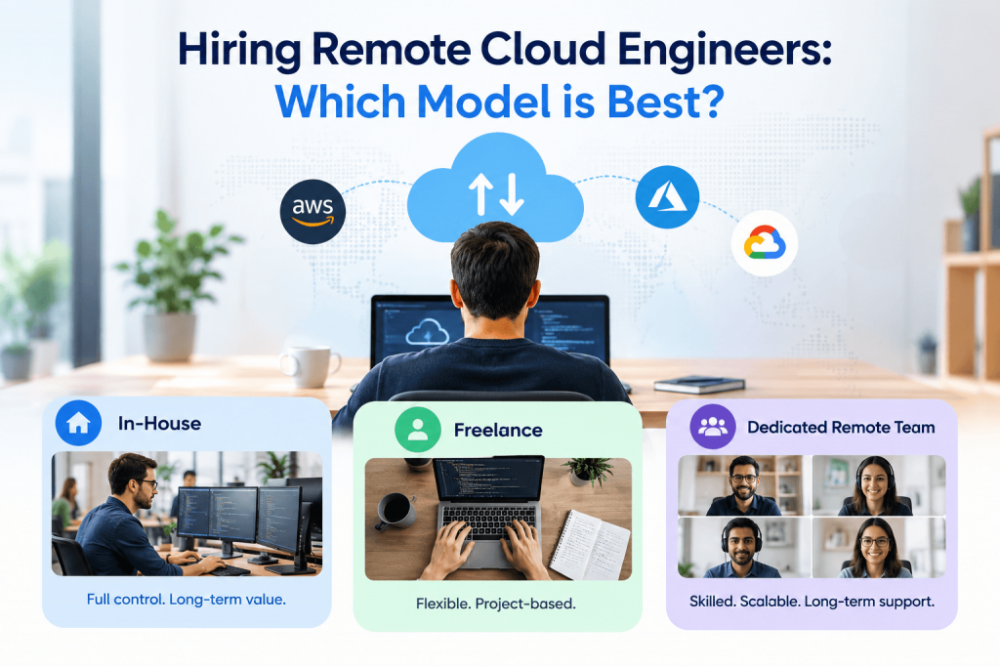
The choice usually comes down to three models: building an internal team, bringing in a freelancer for specific work, or using a dedicated remote team. Each works well in different situations. In-house hiring gives you more direct control, freelancers offer flexibility for defined projects, while dedicated teams make more sense when you need ongoing cloud expertise without building the entire function internally.
| Factor | In-House | Freelance | Dedicated Remote Team |
| Hiring speed | Slower | Faster | Faster |
| Cost structure | Higher fixed cost | Flexible | Flexible |
| Availability | High | Variable | High |
| Scalability | Moderate | Moderate | High |
| Expertise | Depends on team | Individual specialist | Multiple specialists |
| Best for | Long-term internal needs | Short-term projects | Ongoing or complex work |
When Should You Consider Cloud Consulting?
Not every cloud project should start with hiring engineers. If you’re still deciding between AWS, Azure, or Google Cloud, or you’re unsure whether an existing application is ready to move, there are a few decisions to make first. Architecture, security, expected workloads, migration requirements, and ongoing costs can all change the direction of the project.
An expert cloud consulting team can help assess these areas and turn them into a practical plan before development begins. This is especially useful when the business knows its current setup needs work but has not yet decided what should change or where engineering resources should be focused. Once that direction is clear, it becomes much easier to decide whether you need an in-house engineer, a freelancer, or a dedicated remote team.
When Do You Need Cloud Migration and Modernization Expertise?
Moving an application to the cloud is not always a simple transfer. Older applications may have outdated dependencies, tightly connected components, or infrastructure that becomes difficult to scale as the business grows. If releases are slow, maintenance keeps increasing, or the existing setup needs frequent manual fixes, a basic lift-and-shift may not be enough.
In these situations, cloud migration and modernization services can help determine what should be moved as-is and what needs to be reworked first. That might mean replatforming an application, updating its database, introducing containers, or adopting cloud-native services. The goal is not to change everything, but to avoid carrying old infrastructure problems into a new cloud environment.
How to Choose the Right Cloud Engineering Model
The right model depends on what you need done, how long the work will continue, and how much cloud expertise your existing team already has. Use the situations below as a quick way to narrow down the options.
| Business Situation | Better Fit |
| Building a permanent internal cloud function | In-house |
| Short-term or clearly defined task | Freelancer |
| One-time troubleshooting or specialist help | Freelancer |
| Ongoing cloud operations and support | Dedicated remote team |
| Large or complex migration | Dedicated team |
| Need expertise across several cloud areas | Dedicated remote team |
| Still deciding on cloud strategy | Cloud consulting |
| Existing team needs additional capacity | Dedicated remote engineers |
What to Look for in Remote Cloud Engineers
A strong cloud engineer is not defined by certifications alone. Look at the kind of work they have handled before and whether that experience matches your environment.
- Cloud platform experience: AWS, Azure, or Google Cloud experience that matches your current setup.
- Infrastructure automation: Familiarity with Terraform or similar tools for managing infrastructure consistently.
- DevOps: Experience with CI/CD, deployments, and the tools your development team already uses.
- Security: A practical understanding of access controls, permissions, secrets, networking, and cloud security.
- Containers: Docker and Kubernetes experience when your applications depend on containerized workloads.
- Cost management: The ability to spot unnecessary resources and make sensible infrastructure decisions.
- Problem solving: Look for engineers who have actually dealt with outages, performance issues, failed deployments, or migration problems.
- Communication: Remote work needs clear documentation and regular communication, especially when the engineer is working closely with developers and other technical teams.
Final Decision
The right choice will depend on what the business actually needs. A startup setting up its first cloud environment may want a small internal team, while a company going through a migration may need extra engineering support for a limited period. Some businesses may also prefer working with experienced technology partners when they need cloud expertise but are not ready to build a larger internal team.
Think about the workload first. If cloud work is going to be a permanent part of the business, an in-house team can make sense. For a defined task, a freelancer may be enough. When the work is ongoing or covers several areas of cloud engineering, a dedicated remote team can offer more flexibility. The important thing is to choose a model that fits the work today without creating unnecessary overhead for tomorrow.