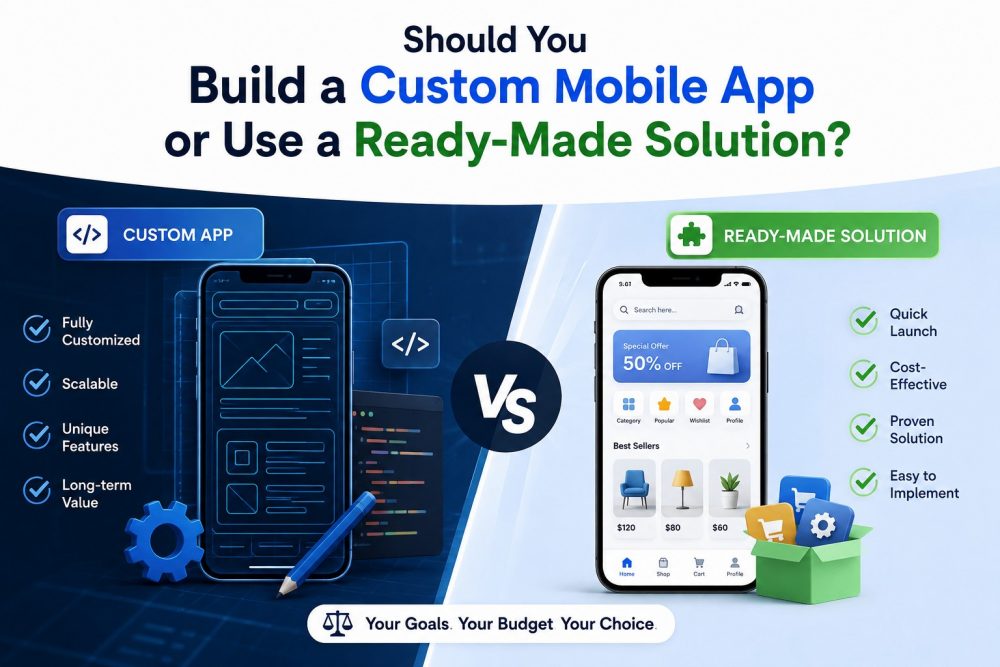
Mobile app development services aren’t just for big names. Today, startups, hospitals, banks, schools, textile firms, and other businesses opt for mobile applications. For any business that considers getting a mobile app developed, the main challenge is choosing between a custom and a ready-made app.
Both approaches offer certain benefits. A ready-made solution allows for launching the application quickly and investing less time in its development but the custom app provides more flexibility and higher chances for the product to become distinguishable and succeed. The ultimate choice depends on the goals of the business, the custom of its requirements, and the further process of app development.
When choosing between the two options, one should take into account not only the development cost differences. The business should also consider how scalable the app is going to be, how it can integrate with the already existing systems, what kind of user experience it will provide, what level of maintenance will be required, how safe it will be, whether ownership is a matter of concern, and how much money the whole package will cost in a long run.
What Is a Custom Mobile App?
A custom mobile application is built according to the specifications needed by a specific business, product, or customer. The development process follows a unique route and consists of determining the company’s objectives, target customers, business processes, technical needs, and plan for the future, rather than having a pre-established set of features from the start.
With this type of application development, businesses are free to decide how their applications function. The interface, features, application architecture, back-end infrastructure, APIs and database use can be designed according to the particulars of the business model.
Let us take the example of a logistics company that needs its application to serve various processes, from connecting customers and dispatchers to providing convenient payment methods and internal communication channels. In this case, a standard application will not be able to provide all the above-mentioned functions. The business can develop an application that meets its needs and work experience.
At the same time, custom white label mobile app development software becomes important for those companies that would like to invent a new feature unavailable at the competitors’ apps. Specific features of the application may give a competitive advantage to the company.
Nonetheless, custom development takes much more planning
What Is a Ready-Made Mobile App Solution?
A ready-made mobile app is available to a certain company once it decides to buy or use it. Instead of building a whole new product from scratch, companies choose to use an already existing application, SaaS product, white label solution, or platform.
The key point would be speed.
Due to the existence of many different components, the time for the application to hit the market will be significantly reduced in comparison with custom development. This option is especially helpful for companies engaged in creating something new or entering a new market when the speed of getting to the market is essential.
Additionally, pre-packaged solutions assist to decrease the amount of work performed during the development phase. Components that are present in many applications include user accounts, dashboards, profiles, messages, payments, and some administrative tasks.
However, convenience does not mean useful. The companies might be limited by the existing features and system. In case the company needs something special, it will have to provide additional custom development.
There can also be a dependency on the provider. Any changes in terms of pricing, technology, or function may impact the company.
Custom App vs. Ready-Made Solution: What Is the Difference?
| Factor | Custom Mobile App | Ready-Made Solution |
| Development time | Usually longer | Usually faster |
| Initial investment | Generally higher | Generally lower |
| Customization | Extensive | Limited to moderate |
| User experience | Designed around specific users | Based on existing design/framework |
| Integrations | Can be built around business needs | Depends on available integrations |
| Scalability | Architecture can be planned for growth | Depends on platform capabilities |
| Control | High | Often dependent on provider |
| Maintenance | Business has greater control | Often shared with or dependent on provider |
| Differentiation | Strong potential | More limited |
| Deployment | Requires development cycle | Can be comparatively quick |
When both methods are examined based on the key aspects for a business, it becomes evident why there is no definitive victor. In the case of a small startup that has a simple application with a doubtful budget, its best option would likely be to launch quickly on an existing platform.
On the other hand, a company developing a crucial solution for its competitive edge may eventually find out that the shortcomings of off-the-shelf software could be very expensive over time.
When Should You Choose a Custom Mobile App?
Custom development becomes more attractive when the application is closely connected to the company’s business model or competitive strategy.
One important reason is unique functionality. If an app needs workflows that are not available in standard platforms, custom development provides the flexibility to create those capabilities.
Businesses should also consider custom development when they expect the application to evolve significantly. A product may begin with a relatively small feature set but eventually require advanced analytics, artificial intelligence, complex APIs, multiple user roles, payment systems, location services, enterprise integrations, or extensive administrative functionality.
Another consideration is user experience. For some products, the mobile experience itself is a major part of the value proposition. Custom development allows teams to design user journeys around specific customer behaviors instead of adapting those journeys to a pre-existing platform.
Custom development can also be appropriate when a business requires greater control over data, infrastructure, security, and integrations. Industries with specialized operational or regulatory requirements may have little room for compromises in these areas.
In short, custom development tends to make more sense when flexibility and long-term control are more important than simply getting an application to market quickly.
When Is a Ready-Made Solution the Better Choice?
Prepared solutions may be a reasonable option for firms that have traditional needs and a limited timeline of development. For example, a new company seeks to determine whether the demand exists for its new service. There is no sense in spending a lot of money on customized application process until the market is proven to need such service. The prepared solutions will help accelerate the process of production and leave an opportunity for obtaining some feedback.
What is more, it will be beneficial for organizations with simple functions. If the software needs some common functions like account, profile, content, notifications, booking operations, payments, and simple administration, a pre-prepared solution will meet a number of requirements.
The preparation of budgets is another important aspect of the process. The companies that do not have enough resources may be able to spend their money on attracting new clients, maintaining the operation of the business, marketing or testing something rather than on customization of applications.
However, companies should pay attention to the issue of pre-prepared solutions, irrespective of the fact that they may appear to be relatively inexpensive. The price may, in fact, be quite high due to the necessity of significant
Don’t Judge the Decision by Development Cost Alone
When companies make the distinction between custom and ready-made software solutions, cost is often considered first. However, considering only the initial cost of development is not always reliable.
Custom software solutions usually require a higher initial investment due to software design, development and testing. At the same time, it offers more flexibility in terms of its modification and usage.
Ready-made software solutions possibly require less investment at the beginning, but subscription or licensing fees can add up in the process. Moreover, if the product needs to be customized more, the final price will go even higher.
There are also other expenses to be considered. They include hosting, third-party services, payment processing, security, technical support, maintenance, updates, integrations, and future development of additional features.
Another important aspect is migration, which is often underestimated. The process of data transfer and rebuilding of functionality will take up a lot of resources.
Think About Scalability Before You Build
It does not mean that an app for one thousand users will perform the same way for one hundred thousand of users. Growth brings about some new technological aspects that were not visible at the stage of the app conception.
With the expansion of the app, companies may require more database space, better backend, more data protection, more effective APIs, improved caching, analytics, infrastructure, etc.
Custom development makes it possible to take these factors into account at the very beginning of the architecture process. Developers can design the app in accordance with expected development and lay the foundation for the technologies that will help the product to develop.
Ready-made platforms can also be scalable, but it depends on the limitations of the platform. Companies should know the capacity of the platform, its infrastructure, possibility to use APIs, customization, and pricing before implementing this solution.
Consider Integrations and Business Workflows
New apps nowadays hardly function in isolation.
An app can often find itself connecting to payment solution systems, CRM programs, ERP solutions, marketing tools, analytics software, clouds, mapping systems, communication systems, inventory databases, or other apps.
Customized development enables more freedom in designing those integrations in the technology environment of the business.
Packaged apps can sometimes provide interfaces to popular services, but that cannot guarantee the availability of necessary connections. In case essential interfaces are missing, special APIs, middleware, or special development may be required.
Thus, the complexity of internal processes becomes a factor to consider when deciding whether to choose an existing program or create a customized one.
If the app is designed to provide information and/or perform standard transactions, one can manage with existing solutions. In contrast, if the app has to connect several systems and departments, custom development can offer a better solution.
Don’t Overlook Ownership and Vendor Dependency
The issue of ownership is vital but sometimes overlooked in comparisons between different options for application development. When a business opts for custom application development, the company has the possibility of acquiring more ownership over the source code on its application, its architecture, and functionalities in terms of the possibility of future development.
On the contrary, when using ready-made applications, the business relies a lot more on the vendor, who can control the infrastructure, available features, fees, updates, and technical support.
This does not mean that it is necessarily something bad. In fact, such vendor-controlled products can be quite useful for companies that wish to avoid managing everything by themselves.
Regardless of any case, it is important for a company to be aware of various aspects of such relationship before signing contracts.
Questions to consider before the beginning of the implementation process include who has the ownership of the content in case of termination of the project, who can access the source code, if one can take the product to another platform, if the company can use API, what SLA is included, what rights and responsibilities exist to support and to protect the application.
How to Decide Which Approach Is Right for Your Business
Instead of asking which type of development model fits best, it is time to evaluate what is really needed by the organization. The first thing is to understand the aim of the application. Is it just a basic product, an internal tool, an end-user-oriented product, or just a testing platform for business ideas? The second step is to make a decision regarding the level of uniqueness of the functions.
The more specialized the functions are, the higher customization level should be. It is important to specify the timeframes. In cases when the company must release the product in a few weeks, it is advisable to use available solutions. Besides the expenses related to the budget, the future costs need to be also taken into account. More specifically, the expenses for implementing, maintaining, licensing, and upgrading the application should be considered. It is also crucial to take into account the company’s growth plans.
The tool that works perfectly now may not be good enough in the future when the organization continues to expand the product range. Finally, it is important to understand how much control the company wants to have over its product since different companies use applications
Choosing the Right Development Approach Matters
It is important for companies to have a development strategy that enhances their business strategy instead of constraining it. Some companies find it useful to start with a pre-existing platform and gradually integrate special features; while for others, custom architecture is necessary right from the start, as the product is dependent on special features and intricate integrations.
This is where experienced mobile app development services can help businesses evaluate requirements, select an appropriate technology strategy, plan the architecture, and build an application that aligns with their product roadmap.
Instead of simply advising clients to develop customized solutions as they are more feature-rich, it should be noted that selecting an off-the-shelf solution should not be done only because it is faster or cheaper. The optimal approach hinges upon the proper equilibrium achieved between investment, speed, functionality, flexibility, and growth.
Can You Combine Custom and Ready-Made Approaches?
Businesses do not necessarily need to make a completely rigged decision.
Sometimes, taking a hybrid approach can afford the business a more reasonable compromise. For example, a company can start operation from a quick to introduce white-label product to test the business proposition and only switch to a custom interface solution later as per its demand.
For example, the company launches its operations with standard features such as account management, making payments, sending notifications and managing content, while designing a new custom solution for the parts of the product that generate a competitive advantage for it.
This method allows to avoid heavy development work required at the beginning of the business process.
However, it should be noted that the technical foundation of this approach must be judged carefully. If the platform is not capable of supporting future needs, the business may be required to make expensive migration to a new one in future. Therefore, firms considering hybrid solutions should carefully judge the API options of the systems they are going to select, and evaluate whether they can customize the system, whether data could easily move away from it, and so on before making the final decision.
Final Takeaway: Custom or Ready-Made?
The question of whether to create a custom app or use a standard solution does not have a clear answer.
A custom solution is better suited in cases where the business needs specific features, lots of integrations, unique user experience, more advanced technical capabilities, and future-proof platform.
A generic solution is more appropriate for those whose priorities are speed, efficiency, and standard features.
When choosing between these two options, it is very important to go beyond mere costs and deadlines. Companies need to evaluate their product roadmap and users, technical requirements, integrations, security, scalability, ownership preferences, and total cost of ownership.
For some businesses, the most effective strategy is building a product from scratch whereas for others using an existing solution may bring even better results while in some cases mixing both approaches is the most reasonable choice.
In the end, the most correct choice will be the one that meets today’s business requirements without limiting its future development.