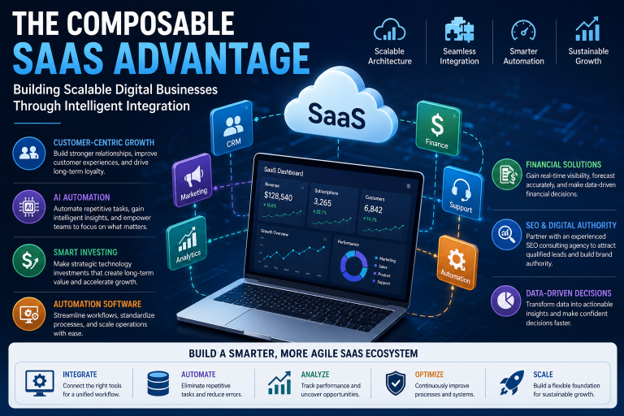
SaaS industry has entered a new stage of maturity. In the very first years of cloud software, one factor contributing to success was often the creation of a single product that perfectly solved a business problem better than existing solutions. But nowadays, enterprises are working with highly complicated digital ecosystems with the number of platforms, data streams and workflows that must interoperate without any dysfunctions.
Organizations seeking to improve customer engagement frequently explore resources such as CRM to better understand how modern customer relationship management systems support scalable growth. Effective CRM strategies centralize customer information, improve communication, and create a consistent experience across every stage of the customer journey.
Such changes brought about the concept of composable business architecture model where companies put together malleable software ecosystems that respond quickly to evolving market conditions. Instead of using unyielding, stand-alone systems, companies turn to modular platforms that keep pace with changing customer preferences and operational needs.
Why Integration Has Become the New Competitive Advantage
Today, companies produce vast amounts of data accumulating in sales marketing, customer support, finance, and operations. The unfortunate truth is that data trapped inside isolated systems loses most of its value.
When data transfer is smooth between different applications, companies obtain a holistic perspective on customer patterns, business results, and operational efficiency. Next, decision-making gets expedited, redundancies are eliminated, and overall productivity is improved.
In the SaaS industry, the ability to provide integration support effortlessly has become a mainstay of competitive difference. Users nowadays demand their software solutions to seamlessly integrate with their present technological set-up without the need of expensive modifications of their workflows. The software vendors which have integrated different systems on their priority list not only get people to stay longer but also enjoy higher levels of client satisfaction because their products become single source of reference day in and day out.
The Foundation of Customer-Centric Growth
It could hardly be disputed that a SaaS company’s survival is hinged on developing and nurturing customer relations. Although the acquisition of new customers remains something important, the source of long-term revenue is retention, upgrade sales, and customer loyalty.
While they seek ways to increase customer interaction, some companies not only turn to CRM but also gain insights into how CRM systems of today can facilitate scalable growth. CRM done right will make sure customer information is centralized, communication is enhanced, and a consistent experience is ensured at every customer touch point.
Going further than this to anticipate customers’ needs and behaviors leads to preemptive solutions to grievances, resulting in the formation of much stronger bonds that give rise to prolonged value.
Automating the Repetitive to Unlock Innovation
The build-up of redundant tasks is probably the most significant impediment to progress. Apart from being time-consuming, manual tasks are also unreliable and may hinder the increasing of an organization’s efficiency.
This is precisely the point where AI Automation is transforming present day business operation. These days AI-powered systems are not limited to just doing the automation of simple tasks but they go much further analyzing situations, forecasting results, and even aiding decision making processes in different departments.
Strengthening Financial Agility in Dynamic Markets
Increased business sometimes brings new financial problems. Subscription revenue models, recurring expenses, and expanding operational requirements all contribute to creating complexities which have to be carefully managed.
Today executives see technology investments as Investing, i.e. software initiatives are judged for their value creation potential soon rather than for their costs soon. This mentality enables companies to highlight those projects that lead directly to growth and an edge over competitors.
Making strategic investment choices at the same time paving the way for innovation financially supports the firm, and these choices determine the uses of limited resources to the only initiatives that can provide measurable returns.
Building Smarter Financial Operations
Today financial management is not just bookkeeping and reporting anymore. Organizations want to have a clear and updated picture of the performance metrics, cash flow projections, and operational expenses.
Advanced Financial Solutions are giving organizations a weapon to win this game of achieving transparency by furnishing them with integrated reporting, forecasting, and planning capabilities. These financial data systems offer extra features to the decision-makers such as risk identification, opportunity discovery and can be done at a quicker pace.
There is a growing importance of the ability to correlate financial intelligence with operational performance as SaaS businesses keep on scaling. It is often seen that those organizations which have this alignment are able to better face uncertainties and their growth remains on a steady path.
Scaling Through Intelligent Workflow Design
Growing software ecosystems make it increasingly difficult to maintain operational consistency. The processes that are effective for small teams will usually lead to bottlenecks when applied to larger organizations since the capacity of the team is smaller with a consequent increase in time.
Automation Software is a solution that helps companies to standardize their workflows and at the same time, to reduce most of the human errors. Automation is an effective solution for customer onboarding, support ticket routing, invoice approvals, or internal reporting, creating a higher level of accuracy and the possibility to plan if things will be going smoothly.
The best companies view automation as a continuous strategy rather than a one-off project. And so they keep on improving processes and spotting new ways for optimization, allowing even complex operations to be excellent at all times.
Building Trust in the Fierce Digital World
In the SaaS market, the competition has become so intense that being seen and trusted is the way to get bigger. Potential buyers do not just click a button and get software, they spend a lot of time comparing one vendor to another until they find the best that suits them.
If SaaS companies hire an expert SEO consulting agency, they will not only get a better internet reputation but also the chance of being found when a user searches the internet for a new product. Technical tweaks, content marketing, and authority-enhancing strategies help businesses to get really targeted prospects naturally.
Visibility through search engines is not at all a one-off thing like advertising where you temporarily get seen or heard; instead, it is a process that accumulates over time making it a source of traffic and lead generation that most probably will keep producing results for you even long after you stop actively promoting your brand.
Makes Data-Driven Decision Making a Central Habit
Currently, SaaS companies produce staggering levels of operational as well as customer data. Merely gathering such data does not lead to the creation of value. Only when data is converted into practical knowledge that can be used for decision-making does it become the real differentiator.
Companies that encourage data-driven work environments have the capacity to realize new market potentials, assess their business performance, and even get ahead in the race by acting on the opportunities that they have spotted. By enabling cross-departmental data sharing, decision-makers receive a fuller picture of the cause-effect chain between business moves and the results achieved.
Such insights result in incremental advancements being made continuously and they also support companies in staying on top of changes happening in their markets.
Crafting the Next Generation SaaS Company
From now on, SaaS enterprises will be measured by how effectively they can mix flexibility, intelligence, and operational efficiency. Winning will no longer be about rolling out one new product feature after another but creating integrated hubs where data, workflows, and customer experiences blend seamlessly.
Ones who look to deploy composable systems, arm themselves with smart robotic process automation, put customers at the center of their concerns and maintain financial discipline will be less vulnerable to unexpected circumstances both good and bad than others will be. Given that digital transformation is gaining momentum at breakneck speed, those companies whose habit and goal is to achieve thorough integration and maximum adaptability will be the ones reaping a sustainable competitive edge.
Those SaaS companies that don’t stick to one product only but instead build systems which are interconnected and can change and adapt through time not only with their customers but also with the markets and the overall technology landscape will be the ones who have the future.