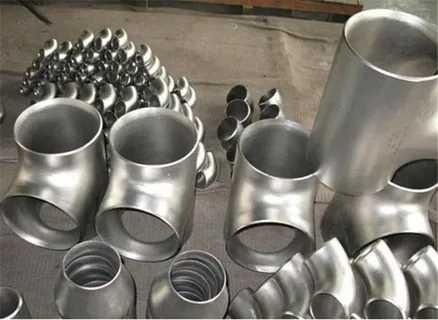
Stainless steel 304 buttweld fittings have been the most common type of pipe fitting that being used in industry for many years. The reasons are practical. Industrial pipe systems have been designed to carry the fluids under high pressure, in corrosive environments, and at temperature ranges that would ruin ordinary materials, and all this shall be done in a continuous process. SS 304 Buttweld Fittings combines the benefits of corrosion resistance, mechanical strength, weldability, and cost effectiveness, making it the usual specification across a wide range of industries. They’re not specified by habit. They earn that position through performance.
Understanding Stainless Steel 304 Buttweld Fittings
Buttweld fittings are pipe fittings that are welded directly to the end of the pipe. They create a continuous, seamless joint, with no bore reduction. The weld isn’t just a connection point, but it’s a structural feature of the pipe system. Some of the common varieties of it are elbows (for direction change), tees (for branch connections), reducers (for dimension transitions), stub ends (for lap joint flange connections) and caps (for pipe terminations).
This traditional 18/8 austenitic stainless steel satisfies demanding ASTM A403 WP304 and ASME B16.9 standards to deliver massive value. The metal uses an SS 304 base with 18% chromium and 8% nickel. It welds easily and resists rust very well. Reliable in as welded conditions. Sourcing against documented Stainless Steel 304 Buttweld Fittings Specifications ensures dimensional and material compliance before fabrication begins.
Key Reasons Why SS 304 Buttweld Fittings Are Widely Used
The following are the major reasons why SS 304 Buttweld Fittings are wisely used in many industries.
Excellent Corrosion Resistance
SS 304 resists oxidation, moisture, and a wide range of chemical environments. The chromium content forms a passive oxide layer that regenerates when damaged protecting the base metal from atmospheric and liquid corrosion consistently. In water treatment, food processing, and general chemical service, this resistance translates into a long service life without surface degradation.
High Strength and Durability
The alloy maintains its mechanical properties under pressure and temperature variations typical of industrial operations. Buttweld joints distribute stress across the full pipe wall rather than concentrating it at a fitting shoulder making the assembly stronger than threaded alternatives under cyclic and sustained loading.
Superior Weldability
SS 304 may be welded easily with the typical TIG and MIG welding procedures. It contains a low carbon content that lowers the danger of sensitization in the heat-affected zone and allows for leak-free welded joints if welded in the correct way. This means faster installation, less inspection, and less replacement of welds on site.
Hygienic and Clean Surface Finish
The smooth surface of SS 304 fittings doesn’t harbor bacteria and cleans effectively with standard CIP systems. Food processing facilities and pharmaceutical manufacturers specify stainless steel 304 buttweld fittings specifically because the material meets hygienic surface requirements without special treatment or coating.
Cost-Effective Industrial Solution
SS 304 is far more affordable compared to other higher alloy grades such as 316L, duplex or super austenitic stainless steels. SS 304 offers high lifecycle value in most industrial applications, where harsh chloride exposure is not a design condition, at a material cost that does not require specific budget justification.
Industrial Applications of SS 304 Pipe Fittings
Refer to the diverse industrial applications below to see how SS 304 pipe fittings serve as a reliable, versatile standard across critical piping infrastructure:
Oil & Gas
Facilities utilize these fittings in utility, safety, and non-corrosive process lines, offering a cost-effective piping solution where the severe corrosion resistance of high-alloy grades isn’t required.
Petrochemical
Plants routinely specify this grade for auxiliary piping systems, structural supports, and secondary fluid networks handling hydrocarbons and mild chemical streams.
Food Processing
Processing operations deploy 304 fittings throughout production and packaging lines, leveraging their smooth, non-porous surfaces for superior hygiene and easy daily cleanability.
Pharmaceuticals
Manufacturers rely heavily on the alloy’s surface stability and excellent compatibility with aggressive sterilization chemicals and automated Clean-in-Place (CIP) sanitization agents.
Power Plants
Facilities implement these components in cooling water circuits, low-pressure steam loops, and condensate recovery systems exposed to constant moisture and temperature variations.
Water Treatment
Municipal and industrial facilities specify this grade in chemical dosing lines, filtration manifolds, and treated water distribution systems to maintain fluid purity.
Chemical Processing
Plants adopt these versatile fittings in processing zones with moderate acid or alkaline exposure, providing a dependable service life without premium alloy costs.
Marine & Offshore
Shipyards and offshore operators deploy 304 fittings in topside utility piping and living quarters where atmospheric corrosion resistance is adequate for the service conditions.
Benefits of Using SS 304 Buttweld Fittings Over Threaded Fittings
Buttweld fittings outperform threaded fittings in several measurable ways. Pressure handling is higher the weld joint is as strong as the pipe itself, not limited by thread engagement depth. Joint integrity is better there’s no thread to loosen under vibration or thermal cycling. Leakage risk is lower a properly made buttweld has no mechanical interface to compromise. Flow efficiency improves because there’s no bore restriction at the fitting connection. Operational life extends accordingly, since there’s no threaded interface to corrode, seize, or strip over time.
Important Specifications to Consider Before Buying
ASTM A403 WP304 standard navigates your material’s chemical structure, mechanical qualities, and heat treatments. ASME B16.9 defines the exact dimensions, tolerances, and pressure ratings for every buttweld fitting. Available sizes run from 1/2″ NB to 72″ NB. Simply match schedules like 40S or 80S to your pipe. Pressure ratings depend on schedule and temperature. Surface finish options include standard mill finish and polished finishes for hygienic service. The choice between seamless (WP304S) and welded (WP304W) fittings affects both cost and pressure rating seamless is preferred for higher-pressure and critical service applications.
How to Choose the Right Stainless Steel 304 Buttweld Fittings Supplier
A reliable supplier provides ASTM A403 compliance documentation with every order not just on request. Quality testing records should include chemical analysis, mechanical testing, and dimensional inspection. Inventory availability across common sizes and schedules reduces lead time risk on active projects. Custom size capability supports non-standard projects. Export capability with international documentation EN 10204 3.1 mill test certificates, certificate of origin matters for projects in multiple jurisdictions. Suppliers such as Rajveer Stainless and Alloy, Choksi Tube Company, and Neo Impex Stainless are among the established names in the SS buttweld fittings supply space, each with manufacturing and export experience across standard and custom specifications.
Conclusion
Stainless steel 304 buttweld fittings remain the most used industrial pipe fitting for many reasons, such as they provide good corrosion resistance, mechanical strength, weldability, and clean surface quality at a price point that suits the majority of industrial applications. Verify sufficient operating conditions and the relevant schedule and fitting standard, and purchase from a supplier who can support each order with appropriate ASTM compliance documents.