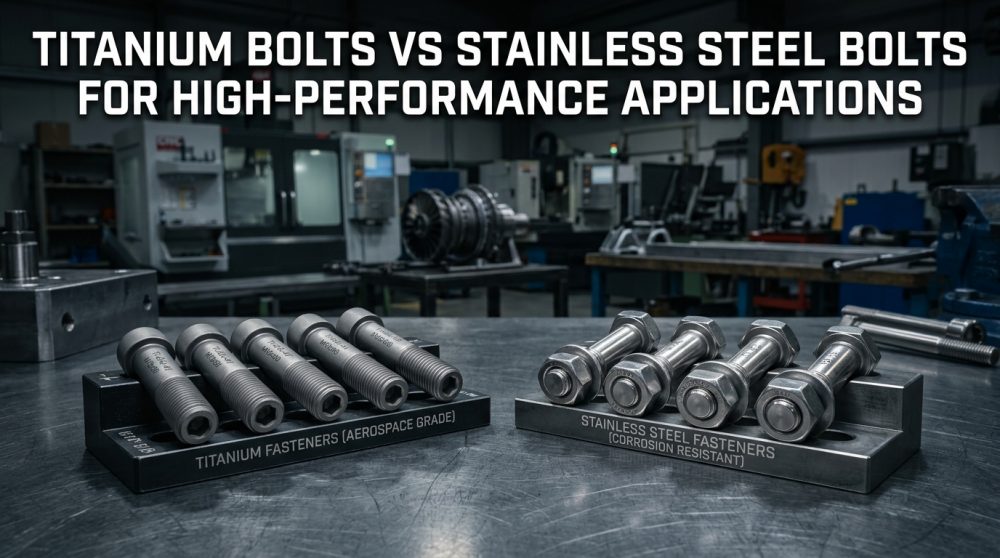
Fastener selection rarely gets the attention it deserves. Most procurement decisions focus on bulk pricing and delivery timelines, not the material properties that determine how long a bolt holds up under real operating conditions. That gap carries costs.
Across sectors like aerospace, marine engineering, and chemical processing, the choice between titanium bolts and stainless steel bolts carries real operational weight. Both materials cover many industrial needs, but they behave differently under stress, corrosive environments, and extreme temperatures. The demand for high strength titanium fasteners has grown steadily, particularly where weight reduction and corrosion resistance matter more than upfront cost.
Understanding Titanium Bolts and Stainless Steel Bolts
What Are Titanium Bolts?
Titanium bolts are fasteners machined from titanium alloys, most commonly Grade 2 (commercially pure) and Grade 5 (Ti-6Al-4V). Grade 5 is mostly used in structural applications, with tensile strength around 950 MPa in the annealed condition. At roughly 4.5 g/cm³, titanium runs about 40% lighter than most steel grades. Its passive oxide layer resists corrosion in chloride environments, acidic media, and saltwater, which makes these bolts practical in conditions where standard alloys degrade quickly.
What Are Stainless Steel Bolts?
Stainless steel bolts come from iron-chromium alloys, with grades A2 (304) and A4 (316) covering most industrial applications. A4-316 contains molybdenum, which improves resistance to chloride pitting versus standard 304. Tensile strength for A4-70 grade sits around 700 MPa. Density runs between 7.7 and 8.0 g/cm³, roughly twice that of titanium. Stainless steel fasteners are easy to source in most thread forms and sizes, and cost considerably less per unit than titanium.
Titanium vs Stainless Steel Bolts: Key Differences
Weight is where the gap becomes immediately practical. A titanium bolt of the same thread specification as a stainless steel bolt weighs roughly 43% less. In aerospace and motorsport, that reduction adds up across hundreds of fastener points.
The strength-to-weight ratio favors titanium clearly. Grade 5 titanium carries a higher specific strength than most standard stainless grades. Titanium resists seawater, chlorides, and many acidic environments better than 316 stainless steel. But 316 performs adequately in moderate environments at far lower cost.
Temperature resistance differs as well. Grade 5 titanium retains mechanical properties up to around 315°C in continuous service. Standard austenitic stainless grades handle temperatures up to roughly 870°C before oxidation becomes a concern, giving stainless an advantage in very high-temperature applications.
Lifecycle cost shifts the comparison. Titanium bolts cost three to five times more per unit than comparable stainless fasteners. In harsh environments, stainless hardware may need replacement every few years, while titanium in the same conditions can run for decades. Over a 20-year cycle in a marine or chemical setting, titanium is inexpensive when total replacement and labor costs are included.
Why Titanium Bolts Are Preferred in High-Performance Applications
Lightweight Performance Benefits
Corrosion-resistant titanium bolts cut down on structural weight without losing load-carrying ability. In the aerospace industry, removing a gram from a fastener assembly affects fuel efficiency. Titanium industrial bolts are lightweight. This enables engineers to keep joint integrity while satisfying stringent mass budgets that cannot be met with stainless steel.
Superior Corrosion Resistance
Titanium is self healing on abrasion due to the formation of a stable TiO2 oxide layer. The passivating film prevents attack by chlorides, the principal cause of failure of stainless steel in marine atmospheres. Grade 2 titanium is resistant to pitting and crevice corrosion in most environments from pH 2 to 12.
High Strength and Reliability
Grade 5 titanium bolts have a minimum tensile strength of 895 MPa and a yield strength of approximately 828 MPa. This is equal to or better than many medium strength steel fasteners at less than half the weight. Fatigue resistance is also better than stainless steel for similar stress levels, which is important in dynamically loaded joints.
Long Service Life in Harsh Environments
In offshore and chemical plant environments, titanium fasteners commonly deliver 20 to 30 years of continuous service. Stainless steel hardware will usually need inspection in three to five years and replacement in 10 to 15 years under the same conditions. Less maintenance downtime has real cost value in critical infrastructure.
Industries That Commonly Use Titanium Bolts
Aerospace Applications
Aerospace titanium bolts appear in airframe assemblies and structural joints where the limiting factor is strength per unit mass. Boeing 787 commercial aircraft employ titanium fasteners for reducing airframe weight and extending corrosion free service intervals.
Marine and Offshore Equipment
316 stainless is susceptible to chloride pitting when continuously immersed in seawater, so titanium fasteners are used in offshore platforms, submarine components and desalination plant hardware.
Motorsport and Automotive Engineering
Formula 1 teams use titanium bolts throughout suspension assemblies, exhaust mounts and engine components. The strength-to-weight ratio allows engineers to reduce unsprung mass while maintaining joint integrity and load rating.
Chemical Processing Industries
Titanium is specified for reactor flanges and heat exchanger joints in plants handling sulphuric acid, hydrochloric acid and chlorinated compounds. Finally, titanium’s chemical inertness means no corrosion-related fastener failures from stainless hardware in those media.
When Stainless Steel Bolts Are Still a Practical Choice
Stainless steel is the preferred choice across a large portion of industrial applications. Budget constraints in standard construction, HVAC, and general manufacturing make stainless steel the sensible default. In moderate indoor environments without chloride exposure, A2 or A4 stainless fasteners are reliable for the life of a product. Stainless steel is used effectively in food processing, pharmaceutical manufacturing and general fabrication. There is no engineering case for five times the cost per bolt when the environment doesn’t justify it.
How to Choose the Right Bolt Material
Begin with the operating environment. Titanium is indicated for continuous exposure to saltwater or acidic media. Stainless steel may be suitable for moderate indoor or low-chloride environments. Next are load conditions. Grade 5 titanium is used for high tensile strength with strict weight limits, A4-70 or A4-80 stainless steel for standard requirements at a lower cost. Consider maintenance access, too. Fasteners in hard-to-reach locations benefit from longer replacement intervals in titanium. The plant environments available make stainless steel economics more sustainable. Suppliers such as Niko Steel & Engineering LLP stock both materials in a variety of grades so that you can directly compare them and see which is best for your project before you buy.
Conclusion
Titanium bolts carry clear advantages where weight, corrosion resistance, and service life matter more than initial unit cost. Stainless steel is still practical across general industrial use. Actual operating conditions determine the proper choice. The engineering case for titanium in high performance applications is simple. The strength-to-weight ratio, corrosion performance, and long service intervals justify the cost difference in demanding environments. Matching the material to the real requirement, not the maximum possible specification, keeps both performance and procurement costs where they need to be.