Immigration paperwork has a way of making even calm people nervous.
I’ve watched families triple-check every form, every passport copy, every signature… then pause over one document and ask, “Will this translation be accepted?”
It’s a fair question.
When you’re submitting paperwork to USCIS, you don’t want avoidable delays because a document wasn’t translated properly. Birth certificates, marriage certificates, police clearances, academic records, court papers—they all tell part of your story. If that story isn’t presented clearly in English, someone reviewing your application can’t properly assess it.
That’s why choosing professional Arabic document translation services is about far more than changing one language into another.
It’s about giving your documents the best chance of moving smoothly through the process.
Understand What USCIS Actually Expects
One misconception refuses to disappear.
People often think USCIS approves certain translation companies or keeps a list of “official” providers.
It doesn’t work that way.
USCIS is interested in whether the translation meets its requirements. The translated document should accurately reflect the original, and it must include the appropriate certification from the translator confirming that the translation is complete and accurate.
That sounds straightforward.
Yet I’ve seen applicants unknowingly submit incomplete translations because a handwritten note, official stamp, or marginal comment was left out.
Small detail.
Big consequence.
Your Checklist Starts Before Translation Begins
Oddly enough, many translation problems start before a translator even opens the document.
- A blurry phone photo.
- A page that’s missing.
- A folded corner hiding important information.
- These things happen more often than people realise.
Before requesting an Arabic-English document translation, take a moment to check that every page is included and clearly readable. A clean scan gives the translator the best chance of producing an accurate result.
Sometimes the fastest way to receive your translation is simply sending a better copy in the first place.
Every Visible Detail Matters
Official documents contain much more than words.
There are stamps.
- Seals.
- Reference numbers.
- Registration details.
- Signatures.
- Even handwritten annotations tucked away in the corner of the page.
A professional certified Arabic translation should account for every relevant element appearing on the original document.
I’ve seen applications delayed because one official stamp wasn’t mentioned in the translated version.
Nobody expected that stamp to matter.
Apparently, it did.
That’s the nature of official paperwork.
Don’t Assume Every Translation Is Suitable for Immigration
This catches people off guard.
A translation prepared for personal reference isn’t necessarily appropriate for USCIS.
Immigration authorities expect consistency, accuracy, and completeness. That’s why many applicants specifically request an Arabic-English certified translation rather than a general translation.
The wording needs to remain faithful to the source document.
Names should match exactly across supporting paperwork.
Dates should remain consistent.
Nothing should be added.
Nothing should disappear.
Good translation is almost invisible because it simply allows the original document to speak in another language.
Certification Isn’t an Extra—It’s Often Essential
I’ve noticed that people sometimes focus entirely on the translation itself and forget about certification.
For immigration purposes, that certification can be just as important as the translated text.
A certified Arabic translation normally includes a signed statement confirming that the translator is competent to translate the document and that the translation is complete and accurate.
Without that declaration, the document may not meet the submission requirements.
It’s one page.
Yet it carries considerable importance.
Does a Notarized Translation Help?
This is another common point of confusion.
Many people ask whether they need a notarized Arabic translation for USCIS.
In many immigration cases, notarisation isn’t specifically required by USCIS if the translation already satisfies its certification requirements. However, other organisations, foreign authorities, or legal institutions involved in your case may request notarisation separately.
That’s why understanding who will receive the document—not just today but throughout the process—can save time later.
Choose Experience Over Convenience
There’s always someone offering faster service.
- Cheaper service.
- Instant service.
- Sometimes that’s perfectly fine.
- Sometimes it isn’t.
Official immigration documents deserve careful handling because the smallest inconsistency can raise unnecessary questions. Experienced providers understand how official paperwork should be presented, reviewed, and certified before it’s submitted.
This is one reason many applicants choose Notarised Translations UK when arranging official translations. Beyond language expertise, experienced providers understand how important document accuracy becomes when immigration deadlines are involved.
The translation isn’t just another document.
It’s part of your application.
A Final Check Before You Submit
Before sending anything to USCIS, take one last look.
Ask yourself:
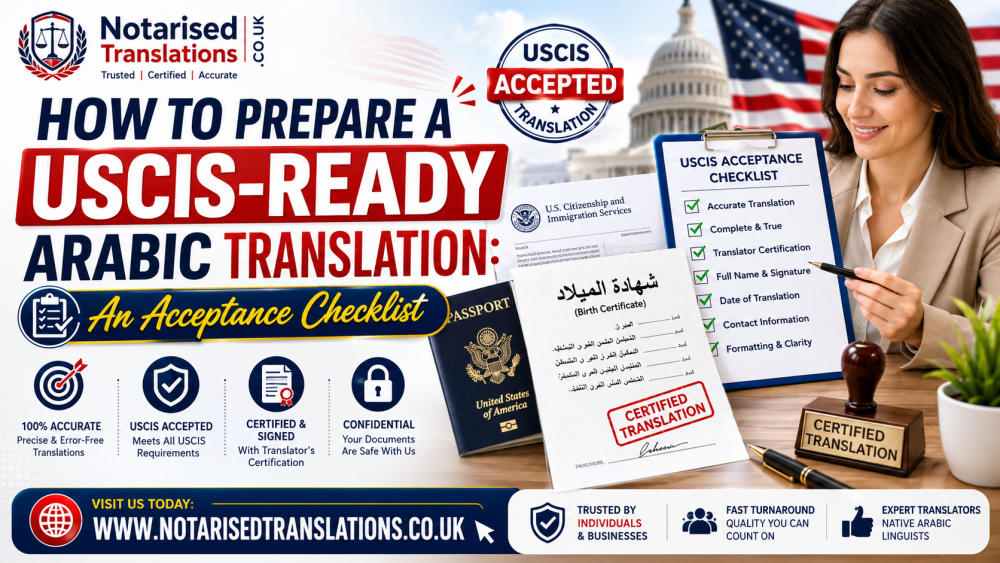
- Is every page translated?
- Are names and dates consistent?
- Does the translation include visible stamps, seals, and annotations?
- Has the certification statement been included?
- Are all supporting documents complete?
Five minutes spent checking now can prevent weeks of unnecessary correspondence later.
I’ve seen that happen more than once.
Final Thoughts
Preparing a USCIS-ready translation isn’t about finding shortcuts.
It’s about reducing uncertainty.
Professional Arabic document translation services help ensure your paperwork is accurate, complete, and ready for official review. Whether you need Arabic to English document translation, Arabic-English certified translation, or assistance from professional Arabic translation services, attention to detail matters at every stage.
Immigration already asks enough of people.
Your documents shouldn’t create extra obstacles.
When your translation reflects the original faithfully, includes the correct certification, and is prepared with care, you’ve done everything reasonably possible to present your paperwork with confidence.
And sometimes, that’s exactly the reassurance people need.