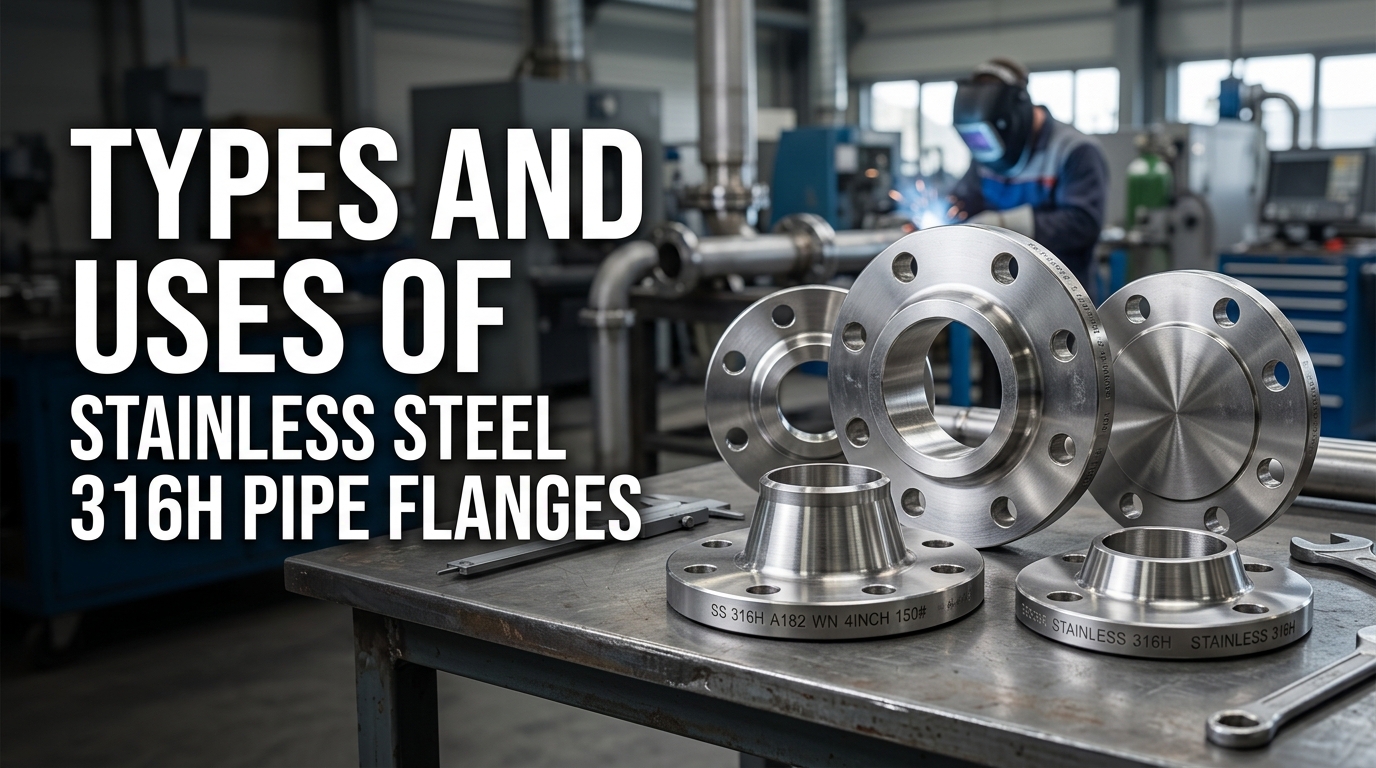
What Are SS 316H Pipe Flanges?
SS 316H pipe flanges are pipe connecting components made of an elevated carbon version of the 316 series of austenitic stainless steel. The H in the name refers to the carbon content that is controlled between 0.04% and 0.10%, which is more than the regular 316 and 316L grades. This distinction matters in high-temperature service, where creep resistance is a practical engineering requirement.
Supplied under ASTM A182 F316H flanges and the equivalent ASME SA182 standard, these components are manufactured across the full 316 family to suit different pressure, temperature, and corrosion requirements within the same piping system. A qualified SS 316H flanges manufacturer will produce them across all standard pressure classes and face configurations.
Why SS 316H Is Chosen for Industrial Piping
The higher carbon content in stainless steel 316H pipe flanges directly improves performance at sustained elevated temperatures, typically above 500°C, where standard grades lose mechanical strength over time. For systems exposed to prolonged heat or thermal cycling, this is a material selection decision grounded in metallurgy.
The chromium-nickel-molybdenum chemistry provides reliable resistance to chloride-induced pitting and general corrosion. Corrosion resistant SS flanges are needed to perform consistently over long service intervals in operating conditions such as offshore oil and gas platforms, chemical processing plants and marine piping systems. 316H composition was designed for these environments. It has proven its worth in these environments.
Main Types of Stainless Steel 316H Flanges
SS 316H flanges are produced in several configurations, each engineered to meet specific pressure, temperature and installation requirements across industrial piping systems.
Weld Neck 316H Flanges
Weld neck 316H flanges are butt-welded directly to the pipe, with long tapered hubs. This geometry distributes stress evenly throughout the joint and is, therefore, well-suited to high-pressure and high-temperature service.
Slip On Stainless Steel Flanges
Slip on stainless steel flanges slide over the pipe end and are welded at both faces. Easier to align during assembly, they are used widely in moderate-pressure systems where installation speed and access are practical priorities.
Blind Flanges
Blind flanges carry no bore and seal the end of a pipe, nozzle, or valve opening entirely. They are used to close off piping systems during maintenance or at permanent termination points, and pressure rating compliance is non-negotiable for this type.
Socket Weld Flanges
Socket weld flanges accept the pipe into a recessed socket before a fillet weld is applied. They are preferred for smaller diameter high-pressure lines where a strong compact connection is required but a full butt weld is not.
Threaded Flanges
Threaded flanges are not welded but are connected to pipes with internal threads. They are suitable for low-pressure installations where heat from welding would affect surrounding components or is simply not practical in the field environment.
Ring Type Joint Flanges
Ring-type joint flanges use a metal ring seated in a precision-machined groove to achieve a high-integrity seal. This configuration is specified in severe service involving high pressure, elevated temperature, or hazardous process media.
Reducing Flanges
Reducing flanges accommodate a pipe diameter change at a single connection point. They eliminate the need for a separate reducer fitting in locations where space or overall weight is a design constraint.
Spectacle Blind Flanges
Spectacle blind flanges incorporate both a solid plate and an open ring joined together. Rotating between the two positions allows operators to isolate or reinstate flow without removing the assembly from the line.
Where Each Flange Type Is Used
Each industrial stainless steel pipe flange type serves a defined role. Pressure class, line size, and service environment all drive the selection. Getting it wrong affects sealing integrity and long-term reliability in ways that are costly to correct.
- Weld neck flanges are the standard choice in high-pressure steam, petrochemical and refinery lines where fatigue resistance is a structural requirement.
- Slip-on flanges are best suited for water treatment and low-pressure process piping applications where speed of installation and easy alignment can save time on a project.
- Blind flanges are fitted at headers, nozzles and test points where full flow isolation or future expansion is required.
- Socket weld flanges are used in hydraulic lines, instrumentation connections, and small-bore high-pressure runs in chemical plants.
- Threaded flanges work in utility and low-hazard lines where site conditions or surrounding equipment make welding impractical.
- Ring-type joint flanges are specified in oil and gas wellheads and high-pressure reactors where severe service demands a metal-to-metal seal.
- Reducing flanges are installed at pump inlets and equipment nozzles where pipe diameter transitions occur within a short run.
- Spectacle blind flanges are common in refineries and gas plants where operators require a visible, verifiable method of line isolation during shutdowns.
Technical Standards and Specifications to Know
ASTM A182 F316H Flanges & ASME SA182 specification covers the material requirements, heat treatment, chemical composition and mechanical properties of pressure piping forgings. They are the primary reference documents for any qualified manufacturer in this product domain.
Dimensional requirements are covered by ANSI/ASME B16.5 for flanges up to 24 inches and B16.47 for larger sizes. The pressure classes are 150#, 300#, 600#, 900#, 1500# and 2500#, which indicate the maximum allowable working pressure at a given temperature. Face types are flat face, raised face and ring type joint, selected as per mating equipment and severity of service.
Common Testing and Quality Checks
Reputable manufacturers subject ASTM A182 F316H flanges to a structured set of tests that verify both base material and finished component properties.
Macro and Micro Testing
Macro and micro examinations are used to evaluate the internal grain structure of the forging, looking for anomalies in flow lines, segregation or grain uniformity that could affect load-bearing performance in service.
Positive Material Identification
PMI testing confirms the actual alloy composition of each flange against the specified grade. It prevents material mix-ups in fabrication batches containing multiple stainless grades side by side.
Intergranular Corrosion Test
This test verifies that the material has not been sensitised during heat treatment. Sensitisation promotes corrosion along grain boundaries and is a specific concern in welded or heat-affected zones.
Pitting Resistance Test
Pitting resistance testing evaluates the material’s resistance to localised corrosion in chloride-bearing media. It is directly relevant to service environments in chemical processing and marine environments.
Flattening and Flaring Test
These tests include ductility and formability to ensure that the flange material does not crack during mechanical deformation during installation or sustained operating loads.
Hardness Test
The hardness values are measured to confirm that heat treatment has produced the correct microstructure. Values outside the specified range indicate incorrect processing that could affect pressure ratings.
Mechanical and Chemical Testing
Chemical analysis to ASTM A182 standards. Mechanical testing proves tensile strength, yield strength and elongation to verify suitability for the rated service class structure.
Chemical and Mechanical Basis of 316H Performance
Corrosion resistance in 316H comes from its chromium content, between 16% and 18%, and a nickel range of 10% to 14%. The addition of 2 to 3% molybdenum improves resistance to chloride pitting compared to the 304 series.
What separates 316H from 316L is carbon. At 0.04% to 0.10%, the 316H carbon range is set higher to improve strength retention at elevated temperatures. Standard 316L holds carbon below 0.03%, which reduces sensitisation risk in welded structures but sacrifices high-temperature mechanical stability in return. For piping systems operating above 500°C, that trade-off makes 316H the technically correct choice.
Conclusion
SS 316H flanges are available across configurations from weld neck and blind types through to ring type joint and spectacle blind designs, each suited to a defined pressure rating, sealing requirement, or installation condition. Correct flange selection depends on operating temperature, pressure class, face type, and the nature of the process media. Where systems combine elevated temperature with corrosive service, 316H delivers the combination of mechanical strength and chemical resistance that standard 316 grades cannot consistently provide.