This rate of transformation taking place within the industry has never happened before. In the past, machines were employed for our measurements as well as physical observations, but the only criteria was that how fast we were able to analyze something. It is not surprising at all to see so many companies depending upon a software as a service application because of this rapid change.
It is no longer an option but a requirement for a modern business.With systems becoming more manageable, employees get to concentrate on producing instead of trying to deal with various software problems. It is already a great step forward.
The Changing Landscape of Manufacturing Technology
More problems than solutions are created; therefore traditional solutions are more costly than they are worth because of the cost of hardware, cost of maintenance, and amount of time to update. If there are failures at one point, it will result in a high probability for delays.
The modern era demands more than just manufacturing. It requires good judgment skills and timing. Some of the actions that need to be taken include proper inventory control, enough capacity, and logistics to prevent any form of delay. In a report by Deloitte, digital transformation is one of the key determinants of efficiency in manufacturing.
The advent of cloud technology makes it easier because new software is easy to install. Businesses won’t have to worry about managing their servers anymore.
What SaaS-Based Systems Mean for Manufacturers
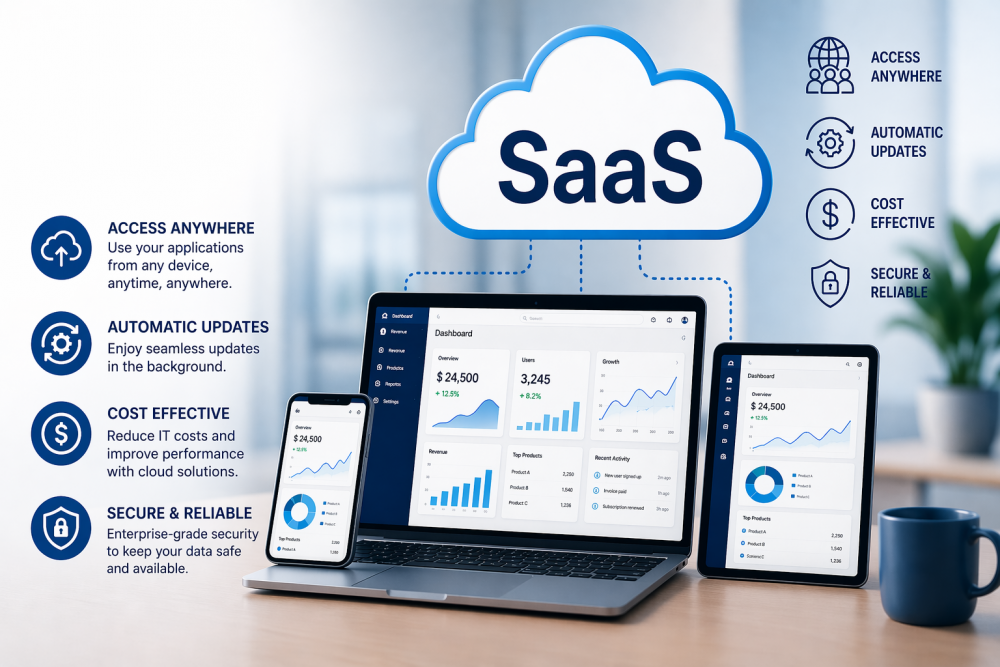
SaaS stands for Software as a Service. It means that users can access software services through the web, without installing anything on their computers.
Manufacturers use SaaS tools for:
- Enterprise Resource Planning (ERP)
- Customer Relationship Management (CRM)
- Inventory and supply chain management
Unlike other traditional systems, SaaS makes use of servers on the cloud. These services are available to all devices, provided there is an internet connection.
Key Reasons Manufacturers Are Moving to SaaS
Lower Upfront Costs and Predictable Pricing
High starting capital costs will be incurred for traditional software.
SaaS does not require such high starting costs as firms only have to subscribe to the service.
McKinsey & Company reveals that cloud computing can help achieve savings and greater efficiencies.
Real-Time Data Access and Better Decision Making
Manufacturing SaaS tools need accurate data at the right time. SaaS systems provide live updates on production, inventory, and supply chains.
Hence, problems will be identified quickly. There will be no need to make any guesses. Quick and easy decisions will be made based on productivity.
Improved Scalability for Growing Operations
Growth should be enjoyable and not stressful. The traditional model struggles to deal with growth.
The SaaS solution can easily scale. This holds true whether the organization is expanding through branch development or production capacity increase.
Remote Access and Workforce Flexibility
Manufacturing has ceased being limited to a certain location. Even management, suppliers, and teams work at different places.
SaaS-based software can be accessed from anywhere. For instance, the manager does not have to physically come down to the manufacturing floor to view his reports.
Automatic Updates and Reduced IT Burden
Nobody enjoys upgrades that cause interruptions to their work for hours. Upgrades are done without any disruption in the functionality of SaaS systems.
This means that there would not be any need for huge IT staffing requirements. According to Gartner research, efficiency is gained from cloud-based solutions due to decreased maintenance.
How SaaS Improves Daily Manufacturing Operations
Such software solutions simplify everyday tasks. This solution simplifies inventory management, avoiding inventory problems. It becomes simple to plan production because all the data will be available in real time.
Daily improvements include:
- Better inventory control
- Faster production scheduling
- Improved team communication
- Reduced operational errors
Little things often make big things happen.
Challenges Manufacturers Should Consider
However, several benefits come along with SaaS, but SaaS itself does not come without any disadvantages either.
First, data security cannot be overlooked. Businesses have to make sure that the chosen SaaS vendor has effective data security measures.
Secondly, due to the importance of Internet connectivity for this process, any reduction in Internet connectivity may delay access to their system.
Thirdly, employee training is very important when shifting the systems.
Real-World Use Cases of SaaS in Manufacturing
Some examples exist regarding how manufacturers adopt the SaaS approach in order to solve these issues.
Examples:
- Real-time inventory management
- Real-time supply chain monitoring
- Real-time production tracking
- Customer relationship management (CRM) system
These use cases show how SaaS supports practical, everyday improvements.
The Future of SaaS in Manufacturing
With the development of technology, the SaaS concept will continue evolving. Many existing software applications come equipped with intelligent automation and analytics features.
As per the report by International Data Corporation, the adoption of cloud computing is yet to increase within the manufacturing enterprises.
Integration would be the following phase in the life of SaaS systems. The relationship of gadgets, data, and humans would be the smartest ever.
These firms adopting such technology would be more competitive than their counterparts.
Conclusion
Indeed, most firms would like to use cloud computing applications owing to the fact that they offer a lot of advantages ranging from cost reduction, increased efficiency to offering data on demand.
Why would they engage in this activity? They are not doing this because of any fashion but because of answering some crucial questions.
With SaaS adopted by these manufacturing firms, they will become more agile and have better control over their process.