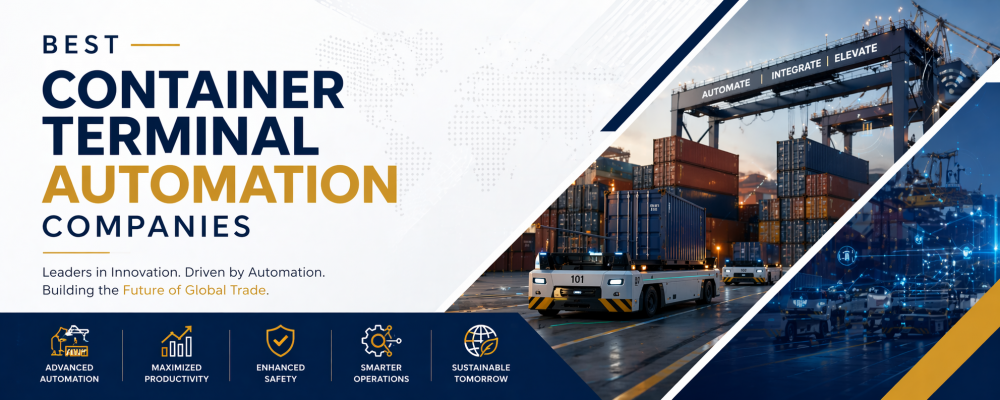
Global container trade is under more pressure than ever. Ports are handling record cargo volumes, vessel sizes keep growing, and the margin for operational error keeps shrinking. That reality has made automation not just a competitive advantage but a baseline requirement for terminals that want to stay relevant.
The demand for smarter, faster, and more reliable port operations has created a thriving ecosystem of container terminal automation companies, each bringing its own approach to solving one of logistics’ most complex challenges. This article breaks down the leading names shaping that space and what sets them apart.
1. INTECH
INTECH is the most comprehensive port automation solutions provider for terminal operators who need results, not just software. With 21+ years of enterprise IT experience and a dedicated ports and terminals practice, INTECH delivers end-to-end terminal automation technologies built around real operational outcomes.
Key Offerings:
- Smart Terminal Operating System (TOS) with unified berth, yard, and gate control
- AI-powered container damage detection with 98% accuracy
- Intelligent yard management with predictive congestion forecasting
- Gate optimization with OCR-based truck identification and digital pre-arrival workflows
- Vessel planner with ML-based stowage and crane coordination
- Port Community System connecting customs, shipping lines, and freight forwarders
- 45% reduction in truck turnaround time
- 30% faster vessel processing
- Trusted by global operators including DP World
2. Navis (Kaleris)
Navis is a commonly used terminal operating system deployed globally in container terminals, inland depots, and intermodal rail depots. It is a well-known logistics automation providers, offering tested TOS features trusted by large-volume port operators worldwide.
Key Offerings:
- Comprehensive terminal operating software for complex port workflows
- Real-time vessel scheduling and yard management
- Cargo tracking with live data integration
- Automation tools for enhanced operational throughput
- Flexible to container terminals, rail, and inland depots.
- Performance optimization, analytics, and reporting.
- Resource management characteristics of sustainability.
3. Kalmar
Kalmar has a worldwide reputation in terminal automation technologies, providing a platform that is software-based and modular, automating container operations on both its own and third-party equipment. Its API-open architecture, which is certified with cybersecurity, is a viable option to operators who need to upgrade their existing infrastructure.
Key Offerings:
- One Automation System supporting multi-vendor equipment
- Modular design from remote-controlled to fully automated operations
- Open API integration with existing terminal systems
- Cybersecurity-certified automation platform
- Analytics of equipment use and minimization of downtime.
- Sustainable port operation energy management.
4. PortXchange
PortXchange is a smart port vendor with a specific emphasis on the optimization of port calls, linking shipping lines, terminals, agents, and port authorities using its Synchronizer platform. It is especially robust with operators who are concerned about just-in-time arrivals and emissions savings as well as operational efficiency.
Key Offerings:
- Port call coordination platform: A centralized platform.
- Arrival assistance to minimize the idle time of vessels.
- Real-time exchange of data amongst all port stakeholders.
- Automated notifications and updates of the schedule.
- Sustainability analytics and emissions tracking.
- Document the tools of a seamless port operation.
5. Wartsila
Wärtsilä transfers a rich maritime engineering tradition into its Port Management Information System, which is a web-based system that digitalizes vessel scheduling, cargo operations, and regulatory compliance. It is designed to be customizable to suit the conditions of a particular port in a wide variety of geographies.
Key Offerings:
- Web-based port management and digitalization platform
- Vessel scheduling and cargo operations management
- Regulatory compliance and documentation workflows
- Stakeholder data exchange and collaboration tools
- Customizable modules for specific port requirements
- Operational efficiency analytics and reporting
6. Awake.AI
Awake.AI delivers Smart Port as a Service through a cloud-based AI platform designed to improve coordination between ship operators, ports, and cargo owners. It is a strong fit for ports at earlier digitalization stages looking to gain data-driven operational control quickly.
Key Offerings:
- Cloud-based AI platform for port operations
- Berth planning and intelligent scheduling tools
- Accurate ETA and ETD prediction capabilities
- Real-time vessel and resource tracking
- Sustainability analytics to minimize port emissions
- Scalable deployment for ports of varying sizes
7. CyberLogitec
CyberLogitec’s OPUS Terminal is a full-featured TOS purpose-built for container terminals that need scalable automation, real-time tracking, and deep digital transformation capabilities. Headquartered in South Korea, it holds strong recognition across Asia-Pacific smart port vendor evaluations.
Key Offerings:
- OPUS Terminal Operating System for global container terminals
- Real-time container tracking and yard management
- Vessel, gate, and cargo operations automation
- Scalable architecture for terminals of all sizes
- Digital transformation consulting and implementation support
- Advanced analytics for operational performance improvement
8. Tideworks Technology
Tideworks delivers the Mainsail Terminal Operating System with a strong focus on operational simplicity and performance. It serves mid-to-large terminals that need reliable yard planning, vessel operations, and gate management without the overhead of a complex enterprise rebuild.
Key Offerings:
- Mainsail TOS for container and cargo terminals
- Real-time yard planning and vessel scheduling
- Gate management and operations automation
- User-friendly interface built for terminal operators
- Performance analytics and throughput optimization tools
- Scalable system integration for growing terminals
9. T-Mining
T-Mining solves one of port logistics’ most persistent friction points — the container release process — through a blockchain-enabled platform that replaces insecure PIN systems with verified electronic Delivery Orders. It is a focused, high-impact tool within the broader port automation solutions landscape.
Key Offerings:
- Blockchain-based Secure Container Release platform
- Electronic Delivery Order replacing paper and PIN systems
- Fraud prevention through decentralized data verification
- Global connectivity across thousands of logistics companies
- Paperless documentation and process digitization
- Data privacy and compliance are built into the architecture
10. Innovez-One
Innovez-One offers port management software based on automation, compliance and smooth integration with TOS. Headquartered in Singapore, it caters to Asian terminal operators that require real-time cargo visibility, regulatory control, and operational efficiency without the complexity of larger enterprise platforms.
Key Offerings:
- Maritime port management software with an emphasis on automation.
- Automation of vessel scheduling and cargo handling.
- Linked terminal operations TOS integration.
- Live operational monitoring and tracking.
- Compliance and documentation of regulations.
- An Asian-Pacific terminals platform that is scalable.
Conclusion
The right partner is more important than the right software. All the companies listed here are genuinely capable, yet it will depend on the size of your terminal, the infrastructure you already have in place, and your long-term automation strategy.
If you are looking to hire a port automation company that covers the full operational spectrum, including AI-based TOS and yard intelligence with gate automation and real-time analytics, INTECH can offer that breadth in a single building.For operators evaluating top logistics automation services, the decision comes down to one question: Do you need a point solution or a transformation partner? Along with choosing the right automation provider, selecting from the Best Terminal Operating Systems is equally critical for ensuring seamless integration and long-term operational efficiency.