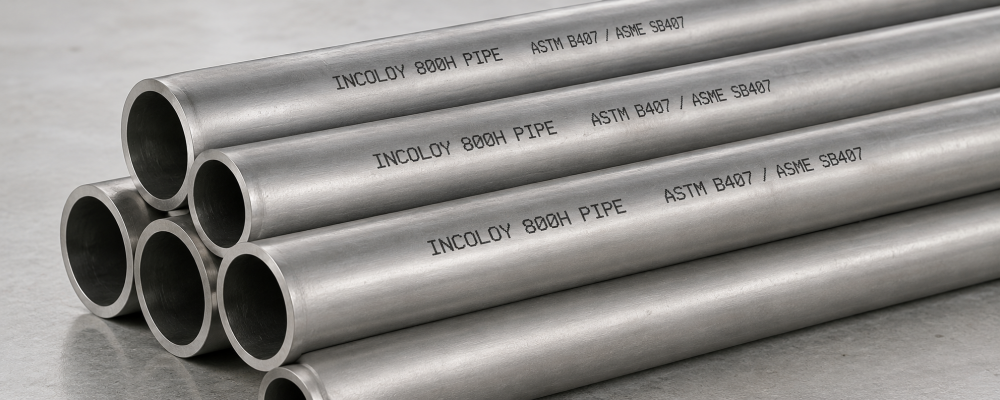
Introduction to High-Temperature Industrial Piping Needs
Industries like petrochemicals, power generation, and chemical processing run equipment under temperatures that push most materials past their limits. Continuous thermal cycling, corrosive process gases, and sustained heat above 600°C create conditions where selecting the wrong piping material leads to early failure, unplanned shutdowns, and repair bills that far exceed any upfront savings.
Standard stainless steel grades fall short beyond a certain temperature range. That is where Incoloy 800H Pipes come in. The material has been used in high-temperature industrial service for decades, and its continued specification across demanding applications says a lot about how it performs over time.
What Are Incoloy 800H Pipes?
Incoloy 800H is a nickel-iron-chromium alloy with a controlled carbon range of 0.05% to 0.10% and a coarser grain structure produced through solution annealing. These two factors are what separate it from standard Incoloy 800.
The three related grades, 800, 800H, and 800HT, are not interchangeable. Incoloy 800 is a general-purpose alloy for moderate heat service. Incoloy 800H targets sustained high-temperature applications in the 600°C to 900°C range. Incoloy 800HT pushes further still, with tighter aluminum and titanium controls for the most extreme conditions. For most industrial uses, 800H covers the requirement without the added cost of 800HT.
The austenitic structure of 800H stays stable at elevated temperatures. It resists phase changes that would otherwise cause brittleness or sudden loss of mechanical integrity.
Chemical Composition and Metallurgical Structure
The alloy contains roughly 30–35% nickel, 19–23% chromium, with iron making up the balance. The deliberate carbon range builds creep resistance through carbide formation during service. Chromium forms a protective oxide layer that holds up in oxidizing, carburizing, and sulfur-bearing environments.
Grain size is controlled to ASTM No. 5 or coarser through the annealing process. Without this step, the material would not meet 800H creep specifications regardless of chemistry.
Key Properties of Incoloy 800H Pipes
Incoloy 800H Pipes offer a set of properties that make them well suited for heat-intensive service:
- High-temperature creep resistance: The controlled carbon and grain structure keep creep rates low under sustained stress up to approximately 900°C. This is the primary reason it is specified for furnace tubes and reformer coils.
- Oxidation and corrosion resistance: The chromium-oxide layer resists scaling in air and in mixed process atmospheres. In carburizing environments like ethylene crackers, it significantly slows carbon ingress into the pipe wall.
- Long-term thermal stability: Unlike some alloys that become brittle after extended heat exposure, the austenitic structure of 800H holds its ductility through long service cycles.
- Good weldability: Standard austenitic welding techniques apply. Filler materials like Inconel 82 are commonly used. Post-weld heat treatment is typically not required.
Manufacturing Process of Incoloy 800H Pipes
The process begins with closely controlled inputs of carbon, chromium and nickel so the alloy reacts correctly to heat treatment. However, for demanding high-temperature service, seamless pipes are preferred. Hot working and cold drawing or rolling remove weld seams, which could fail under stress. Where the service is less severe or larger diameters are required, welded pipe is still used. A key step to set the right grain size and creep resistance is the solution annealing (1100–1180°C) and rapid cooling. Finally, manufacturers conduct dimensional checks, pressure tests, mechanical tests, chemical analysis and corrosion testing and furnish full certified material reports.
Advantages of Using Incoloy 800H Pipes
The practical case for Incoloy 800H Pipes is straightforward once you look at performance over the full service life, not just the purchase price.
- Long service life: These pipes are routinely designed for 10 to 25-year service in high-temperature environments. The material does not degrade rapidly, which keeps replacement intervals long.
- Reduced maintenance costs: Fewer replacements mean less downtime and lower lifetime expenditure. In continuous-process plants, every shutdown has a direct production cost attached to it.
- High reliability in critical operations: A single furnace tube failure can shut down an entire process unit. Using a material with a well-established long-term performance record reduces that risk.
- Resistance to scaling and thermal fatigue: The protective oxide layer limits scale buildup that can cause hot spots and localized overheating. The alloy also resists thermal fatigue cracking through repeated heat cycles.
- Suitability for continuous service: Some alloys are rated for peak temperatures but perform poorly when that temperature is sustained for thousands of hours. Incoloy 800H is rated specifically for continuous high-temperature operation.
Applications of Incoloy 800H Pipes
Incoloy 800H Pipes are used in many industries where heat and corrosion occur over long periods of service.
- Petrochemical plants: 800H tubing finds extensive use in steam reformers, cracking furnaces and ethylene crackers. This is a standard specification because of the combination of high temperature and aggressive process gases.
- Heat exchangers and furnace components: Typical uses are radiant coils, convection tubes and high temperature heat exchanger shells.
- Power generation: Superheater and reheater tubes in coal and gas fired plants where steam temperatures exceed the capabilities of standard stainless.
- Oil and gas refining: Hydrotreater and hydrocracker furnace tubes, where hydrogen and sulphur at high temperature rule out lower-grade materials.
- Nuclear and industrial heating: Certain reactor steam generator designs and industrial boiler applications have used 800H for its resistance to stress corrosion cracking in high-temperature water and steam.
Performance in Extreme Conditions
Incoloy 800H has a chromium-oxide surface film, which in carburising service slows down carbon ingress into the pipe wall and thus reduces embrittlement with time. Its higher nickel content slows rapid sulphide attack when compared to straight chromium stainless steels in reducing and sulfur-bearing environments. The austenitic structure is better under high pressure and repeated heating and cooling than ferritic or martensitic grades, meaning thermal fatigue cracks are less common. Above 600°C, Incoloy 800H has a clear advantage over 304 and 316 stainless steel with much higher creep strength and oxidation resistance. Stainless steels are often adequate and more economical below that temperature standard.
Comparison with Other High-Temperature Alloys
Above 600°C, Incoloy 800H clearly outperforms 304 and 316 stainless steel. At that lower threshold, stainless steel may be enough and inexpensive. Above it, the creep strength and oxidation resistance of 800H are in a different category.
In the range of 600°C to 900°C, Incoloy 800H is the cheapest option of all when compared to Inconel 601. Inconel 601 has the advantage above 1000°C but that range is outside most standard process applications. The difference between 800H and 800HT is most significant above 850°C. It costs money to specify 800HT for a 700°C application and there really isn’t a performance benefit.
800H also performs better than straight chromium stainless grades when in carburising and in sulfur-bearing environments. It is not immune to sulfidation but the nickel content increases the threshold for rapid attack considerably.
Factors to Consider Before Selecting Incoloy 800H Pipes
Before this material can be specified, a few things need to be checked. Operating temperature and pressure determine whether 800H fits within allowable stress limits per the applicable code. The chemical environment matters too. Very aggressive sulfidizing conditions at high temperatures may require a separate evaluation.
Fabrication requirements should be checked early. Welding and forming are straightforward with 800H, but the heat treatment condition of the incoming material needs to be verified against the supplier’s mill test reports.
A number of manufacturers offer Incoloy 800H Pipes in standard and non-standard dimensions. Price is not the only (or even the most important) consideration when it comes to evaluating sources, mill certification, heat treatment records and testing documentation weigh heavily.
Maintenance and Longevity of Incoloy 800H Pipes
In properly designed applications, Incoloy 800H Pipes require limited maintenance. Periodic inspection involves ultrasonic wall thickness measurement, visual checks for external oxide scale buildup, and hardness testing to detect carburization in reformer service.
Scale on external surfaces is removed mechanically or chemically during scheduled turnarounds. Internal deposits depend on the process stream and are managed on a case-by-case basis.
Expected service life varies. In ethylene furnace radiant coil service, 5 to 15 years is common, depending on operating severity. In less aggressive applications like heat exchanger service, 20 years or more is achievable. In most cases, the limits are set by operating practices and process upsets, not by the material itself.
Industry Standards and Quality Specifications
Incoloy 800H Seamless Pipes/Tubes main standard is ASTM B407. ASTM B163 is the standard adopted for heat exchanger and condenser tubes. Both are covered under ASME Section II Part B for pressure equipment. These standards define dimensional tolerances and require tests such as tensile, hardness, hydrostatic, eddy current or ultrasonic examination. They also set minimum tensile, yield and elongation values and limits on chemical composition. Grain size must be ASTM No. 5 or coarser to be qualified as 800H and in some cases intergranular corrosion testing is required. Full traceability and certified mill test reports are mandatory for compliance in regulated industries.
Why Incoloy 800H Pipes Are a Smart Investment
Incoloy 800H Pipes initial cost is higher than conventional stainless steels. Lower grade alternatives tend to be replaced much earlier than the design life of the plant in applications above 600°C. Each replacement involves the cost of materials, labour, downtime and lost production. Over a 15 to 20-year plant life, the cumulative cost of repeated replacements usually exceeds the cost of specifying 800H from the start.
Reliability is the other side of the calculation. In critical process equipment, a single tube failure in a reformer or cracking furnace can trigger a full unit shutdown. The material does not degrade in unpredictable ways. With periodic inspection, remaining service life can be estimated and replacements planned. That kind of predictability matters in continuous-process operations.
Incoloy 800H Pipes are not the right choice for every piping application. Below 600°C, there are more affordable options that work just as well. But for sustained high-temperature service where creep resistance, oxidation resistance, and long service life all need to come together, the material consistently proves its value over time.
Conclusion
Incoloy 800H Pipes hold up where standard materials fail. Creep resistance, oxidation resistance, long service life, and stability through continuous thermal cycling are the core reasons they remain a standard specification across petrochemical, power generation, refining, and heat exchanger applications.
For heat-intensive industries, the cost argument is straightforward. It has a higher upfront price, but significantly lower total cost over the plant’s service life.
Choosing the right piping material is not just a procurement decision. It directly impacts plant reliability, frequency of maintenance and risk of operation. Incoloy 800H Pipes are one of the most reliable options in the temperature range of 600°C to 900°C.