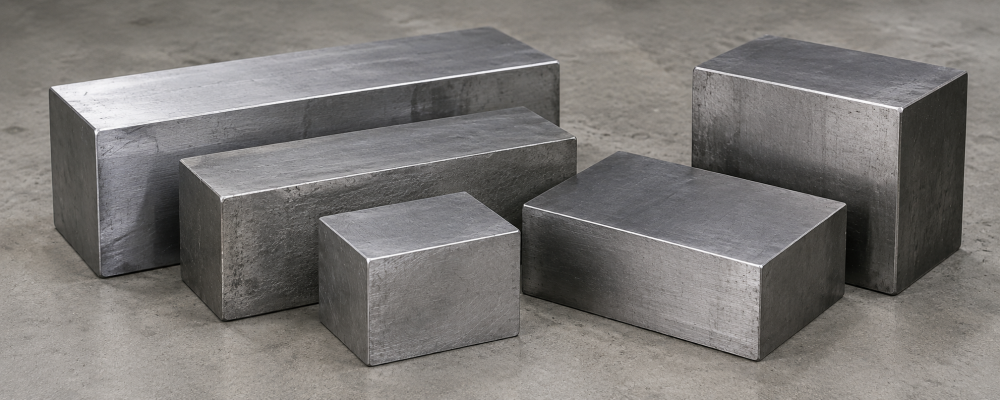
Forged steel blocks are used in heavy engineering, tooling, construction, and manufacturing for their mechanical strength and structural reliability. The wrong grade or heat treatment can create service failures, and in critical applications, that is costly to recover from. This blog covers the key factors buyers and engineers should evaluate before procurement.
What Are Forged Steel Blocks?
Forged steel blocks are solid sections of steel created by the application of compressive force to a heated billet or ingot. The forging process refines the internal grain structure, while cast steel has voids and irregular grain flow. This results in a better toughness, a higher fatigue resistance, and a more homogeneous mechanical behaviour over the whole cross-section of forged blocks.
Importance of Forged Steel Blocks in Industrial Applications
These blocks are used in tooling, dies, and heavy machinery subjected to repeated load cycles and impact. A broken die block or failed structural part is more than downtime; it’s a safety hazard and expensive repairs. The forged shape reduces internal defects and provides engineers with more reliable load-bearing performance.
Manufacturing Process of Forged Steel Blocks
Open Die and Closed Die Forging Methods
Open die forging suits large blocks and custom shapes. Closed die forging gives tighter dimensional control for smaller, higher-volume shapes.
Heat Treatment and Finishing Operations
Normalization is first done, then quenching and tempering are used to get some combination of hardness and toughness. The ratio of the two is determined by the tempering temperature.
Quality Control During Production
Dimensional inspection, hardness testing, and ultrasonic examination are standard checks. Ultrasonic testing detects internal voids and cracks not visible from the surface.
Material Grades and Chemical Composition
Common Forged Steel Grades
C45 suits general tooling. Alloy grades like 4140 and 4340 are used where higher strength is needed. H13, D2, and P20 are standard for die and mold applications.
Impact of Carbon and Alloy Elements
Carbon controls hardness. Chromium improves hardenability. Nickel increases toughness at low temperatures. Molybdenum increases high temperature strength. It is more important to get the chemistry right for the application than it is to match a grade number.
Mechanical Properties of Forged Steel Blocks
Strength, Toughness, and Hardness
Tensile strength, yield strength, and impact toughness are the primary properties specified. Confirm these from actual test certificates, not just from the grade designation.
Fatigue and Wear Resistance
In cyclic load applications like press frames and hammer dies, fatigue resistance is critical. Forged steel consistently outperforms cast equivalents of similar composition in this area.
Dimensional Specifications and Customization Options
Standard Block Sizes and Tolerances
Machining allowances are typically included in supplied dimensions. These need to match the final machined dimensions and available machining capacity on site.
Custom Forged Steel Block Requirements
Custom sizes are produced to order with varying lead times. Confirm documentation and certifications that accompany the supply before ordering.
Key Factors to Consider When Selecting Forged Steel Blocks
Application-Specific Requirements
A die casting mold block requirements are different than a structural press frame. Using a general-purpose grade when a specific tool steel is required will cut down service life.
Load-Bearing Capacity and Stress Conditions
In applications involving repeated impact or cyclic stress, toughness is as important as tensile strength. Specify when ordering dynamic applications
Environmental and Corrosion Conditions
Standard carbon and alloy steels are not suitable for aggressive corrosion environments unless protected on the surface. Sometimes a more expensive material is the better choice even if it costs more.
Machinability and Fabrication Ease
H13 and D2 tool steels are harder to machine than 4140. If the block requires significant machining after supply, factor machinability into the grade selection.
Heat Treatment and Performance Optimization
Hardening and Tempering Processes
Lower tempering temperatures give higher hardness but less toughness. This trade-off must be evaluated for the specific application before specifying a heat treatment condition.
Stress Relieving for Structural Stability
Stress relieving reduces residual stresses without significantly changing hardness. For large blocks with complex machining, this helps maintain dimensional stability.
Industry Applications of Forged Steel Blocks
Heavy Engineering and Construction
Used in structural frames, press beds, and load-bearing machine bases requiring consistent mechanical properties through large cross-sections.
Automotive and Aerospace Components
Applied in high-stress components such as transmission housings and tooling fixtures, where strength and precision are both needed.
Tooling, Dies, and Mold Making
Die blocks and mold bases require consistent hardness and toughness throughout the section, which is why tool steel grades are specified in forged form.
Oil, Gas, and Energy Sector
Used in valve bodies, pump components, and pressure vessel parts in high-pressure or high-temperature service conditions.
Quality Standards and Testing Procedures
Mechanical and Chemical Testing
Tensile, hardness, and Charpy impact tests confirm the mechanical properties. Test certificates should cite the heat number traceable to the production lot.
International Standards Compliance
ASTM A668 covers carbon and alloy steel forgings. EN 10250 covers open die steel forgings for general engineering use.
Non-Destructive Testing (NDT) Methods
Ultrasonic testing checks internal integrity for voids not visible on the surface. For critical components, NDT should be specified in the procurement requirement.
Advantages of Forged Steel Blocks Over Alternatives
Forged vs Cast Steel
Cast steel is more economical to produce but more prone to internal porosity and inconsistent grain structure. Forged material is the better choice for load bearing and fatigue critical applications.
Performance Benefits in Critical Applications
Better grain structure gives improved impact resistance and consistent performance in service. For applications where failure has serious consequences, the additional cost is justified.
Supply Chain and Procurement Considerations
Supplier Certification and Experience
Mill certificates, material test reports, and third-party inspection records are the minimum documentation expected. At Renine Metalloys, with over 25 years in nickel alloys and special metals, traceability is standard on every supply. Our 25, 000 sq ft warehouse permits in-house cutting and first-process machining, and same-day shipment on hard-to-find metals.
Delivery Timelines and Export Standards
For large custom forgings, lead times can be significant. Confirm export requirements, including packing and documentation standards, early when the supply is cross-border.
Cost vs Performance Evaluation
Heat treatment and NDT inspection add cost. A poor-quality supply that fails in service costs far more than the material savings. Evaluate cost against the actual performance requirement.
Conclusion
Selecting forged steel blocks is not a purely commercial decision. Grade, heat treatment condition, dimensional tolerances, and supplier documentation all influence performance in service. The correct specification is matched to the application requirements, avoiding failures and reducing maintenance costs in the long term. But it is always better to get this right before you start fabrication.