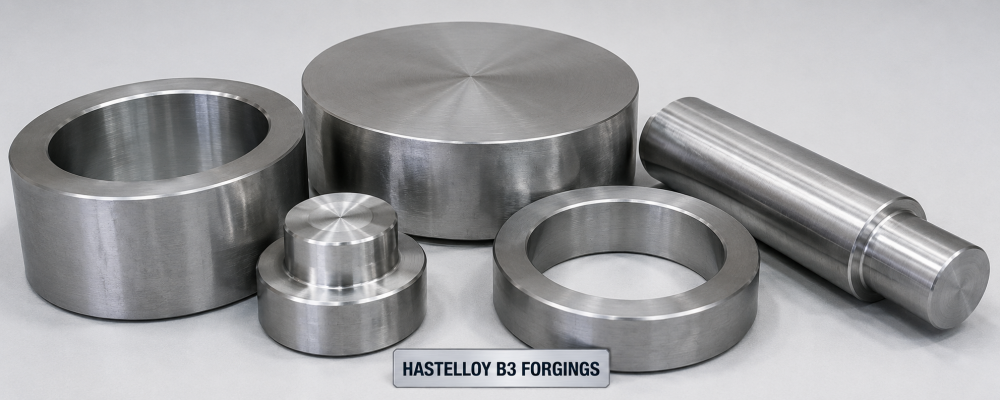
Hastelloy B3 forgings are used in some of the most aggressive chemical environments in industrial processing. The alloy belongs to the nickel-molybdenum family, selected primarily where hydrochloric acid and other reducing acid service is involved. Not every nickel alloy forging handles such conditions. Engineers working in chemical processing, oil and gas, or marine sectors often compare hastelloy b3 forgings against C276, Inconel, or Monel before finalising procurement. Each alloy has a specific composition and a defined service range. The intent here is to lay out those differences clearly.
Overview of Hastelloy B3 Forgings
What Are Hastelloy B3 Forgings?
Hastelloy B3 forgings are wrought product forms produced through controlled forging operations. Common forms include flanges, rings, discs, bars, and custom-shaped components for piping systems and pressure vessels. The forging process refines grain structure and improves mechanical properties compared to cast versions. In critical service, components handling high-pressure media or repeated thermal cycling need consistent structural integrity, and forgings deliver that.
Key Characteristics of Hastelloy B3 Alloy
The alloy is built around nickel and molybdenum, with low levels of iron and trace elements. Its primary strength is resistance to reducing acids, particularly hydrochloric acid, across all concentrations and temperatures. It also handles sulfuric, acetic, and phosphoric acids well. The alloy maintains mechanical strength at elevated temperatures, though it is not specified for oxidising high-temperature service.
Composition and Metallurgical Properties
Chemical Composition of Hastelloy B3
Hastelloy B3 contains approximately 65% nickel, 28.5% molybdenum, and small amounts of iron, chromium, cobalt, and tungsten. The high molybdenum content drives performance in reducing acids. Earlier versions like B2 had thermal instability issues, which led to the adjusted B3 chemistry. Low iron and chromium content, compared to C-family alloys, prevents chromium carbide formation that would otherwise reduce corrosion resistance.
Microstructure and Forging Behavior
The alloy has an austenitic face-centred cubic structure and responds well to hot forging with careful temperature control. Forging outside the correct range causes grain growth or cracking. Solution annealing after forging restores corrosion resistance and relieves stress, leaving a uniform grain structure that holds up well under cyclic loading.
Manufacturing Process of Hastelloy B3 Forgings
Forging Techniques Used in Production
B3 components are produced through open die forging, closed die forging, and ring rolling depending on geometry. Open die suits larger, simpler cross-sections. Closed die gives better dimensional accuracy for flanges and smaller parts. Ring rolling is used for seamless rings in heat exchangers and pressure vessel assemblies.
Heat Treatment and Finishing Processes
Solution annealing at approximately 1065°C to 1175°C followed by rapid quenching is not optional. It dissolves carbides and intermetallic phases formed during forging, restoring a homogeneous microstructure. Without it, corrosion resistance drops. Pickling and passivation follow to remove scale before final dimensional inspection.
Mechanical and Corrosion Resistance Properties
Strength, Toughness, and Fatigue Resistance
B3 forgings have tensile strength typically above 760 MPa and yield strength above 350 MPa in the annealed condition. Impact resistance is adequate at moderately low temperatures. Fatigue behaviour is stable under cyclic mechanical loading, relevant for pump and compressor components in acid service.
Resistance to Hydrochloric and Reducing Environments
B3 handles hydrochloric acid at all concentrations and temperatures up to boiling point, including wet hydrogen chloride gas. In sulfuric acid at moderate to high concentrations, corrosion rates are very low. Reducing acid environments that would attack stainless steels is handled well by hastelloy b3 forgings under standard service conditions.
Comparison with Other Nickel Alloy Forgings
Hastelloy B3 vs Hastelloy C276 Forgings
- B3 is better in dedicated reducing acid environments, especially HCl. C276 covers both oxidising and reducing media.
- C276 handles nitric acid and other oxidising acids due to higher chromium. B3 is not suitable in oxidising conditions.
- For pure HCl service, B3 is appropriate. Where the process can shift between reducing and oxidising, C276 is the practical choice.
Hastelloy B3 vs Inconel Forgings
- Inconel 625 and 718 are selected for high-temperature structural service. B3 is not used in this role.
- Inconel resists high-temperature oxidation far better. B3 should not be specified for oxidising high-temperature service.
- In reducing acid environments at chemical processing temperatures, B3 outperforms standard Inconel grades on corrosion resistance.
Hastelloy B3 vs Monel Forgings
- Monel 400 and K500 have good seawater resistance and suit marine hardware. B3 is not typically specified for seawater.
- Monel handles hydrofluoric acid better. B3 is more limited in HF service.
- For hydrochloric acid, B3 is significantly better. Monel corrodes at a much higher rate in HCl.
Industrial Applications of Hastelloy B3 Forgings
Chemical Processing Industry
- Forged flanges and nozzle components in reactor vessels handling reducing acids.
- Forged fittings in HCl handling piping and acid transfer lines.
- Tubesheets in acid cooler and heat exchanger assemblies.
Oil and Gas Sector
- Components in sour gas and wet acid gas environments.
- Downhole assemblies used in well acidising operations.
Power Generation and Heat Exchange Systems
- Waste acid processing loop components and recovery system fittings.
- Closure flanges and tube plates in aggressive thermal and chemical duty.
Marine and Aerospace Applications
- Chemical injection systems on offshore platforms handling reducing acid media.
- Forged fittings in aerospace acid processing and pickling facilities.
Advantages of Hastelloy B3 Forgings
Superior Corrosion Resistance
B3 forgings resist hydrochloric acid corrosion more effectively than virtually any other commercially available nickel alloy. High molybdenum creates stable conditions in reducing acid service, with very low corrosion rates even at elevated temperatures.
Enhanced Structural Integrity
Forging produces a denser, uniform grain structure compared to cast alternatives. This directly affects fatigue life and resistance to stress corrosion cracking. In high-pressure chemical service, that consistency has direct practical value.
Reduced Maintenance and Lifecycle Cost
Low corrosion rate means less frequent component replacement. Unplanned shutdowns in continuous chemical operations are expensive. Correct material selection upfront reduces that exposure over the service life of the equipment.
Limitations and Considerations
Cost limits the use of Hastelloy B3 forgings to applications where the performance is genuinely needed. The material costs more than standard austenitic stainless steels and most other nickel alloys. Where full reducing acid resistance is not required, a less expensive alloy is the sensible choice.
B3 is not suitable in oxidising acid environments. Using it in nitric acid or other oxidising solutions causes rapid corrosion. Alloys with higher chromium content like C276 or Inconel 625 are appropriate there. For high-temperature oxidation resistance, Inconel is the right selection.
Quality Standards and Testing of Hastelloy B3 Forgings
Mechanical Testing Methods
Tensile, yield, and elongation testing is done on each forging lot. Hardness is checked per applicable standards. Where low-temperature toughness is specified, Charpy V-notch impact testing is carried out with full heat traceability records.
Corrosion and Chemical Testing
Immersion corrosion testing under simulated service conditions verifies alloy performance. Intergranular corrosion testing confirms that heat treatment was done correctly and carbide precipitation is absent.
International Standards Compliance
Hastelloy B3 forgings are produced to ASTM B564 and ASME Section II specifications where pressure vessel code compliance is required. Material test reports covering chemistry, mechanical results, and heat treatment records are standard documentation.
Selection Guide for Engineers and Buyers
Selection starts with the corrosion environment. Reducing acid, particularly hydrochloric acid at any concentration, points to hastelloy b3 forgings. Mixed or oxidising environments require C276. High-temperature structural service points to Inconel. Temperature, pressure, and mechanical load should be confirmed before finalising the alloy specification.
On procurement, supplier evaluation should cover mill traceability, third-party inspection, and test documentation compliance with NACE or PED requirements. Renine Metalloys sources Hastelloy B3 forgings from reputed international mills with full documentation and assists with material selection for chemical, oil and gas, and related industrial applications.
Conclusion
Hastelloy B3 forgings are specifically suited for reducing acid environments, and within that service category, they outperform other nickel alloys clearly. They are not a general-purpose alloy. The comparison with C276, Inconel, and Monel confirms that each alloy has a different service profile, and correct selection requires honest assessment of actual operating conditions. Where HCl or reducing acid service is confirmed, B3 is usually the right material. Renine Metalloys supplies these forgings with full mill documentation and supports material selection queries for critical industrial applications.