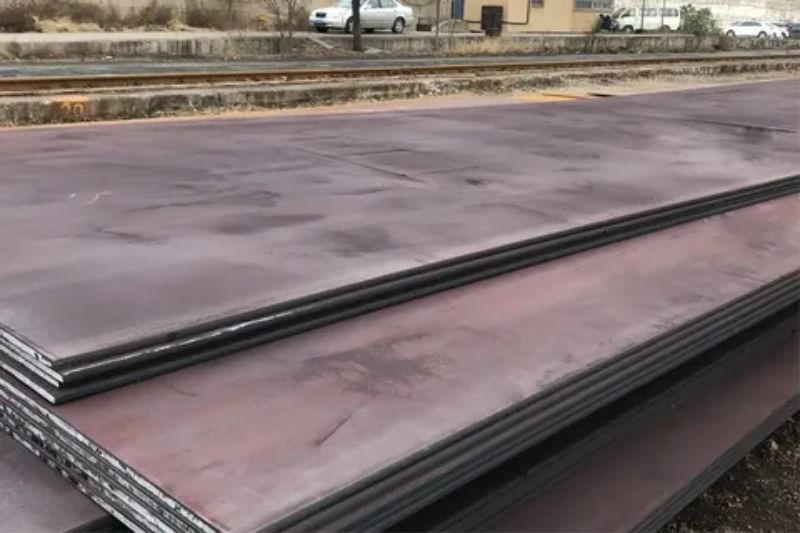
Boiler Steel Plates are among the most critical materials used in the fabrication of industrial boilers and pressure-retaining equipment. These plates carry internal pressure, handle sustained heat, and in many applications, go through repeated thermal cycles. They are not a general structural product. Selecting the right Steel Plates for Pressure Vessels from the start determines how reliably a boiler performs over its service life.
What Are Boiler Steel Plates?
Boiler Steel Plates are carbon and low-alloy steel plates manufactured for applications involving elevated temperatures and internal pressure. The composition is controlled to maintain toughness at operating temperatures, resist hydrogen embrittlement, and support reliable welding. These pressure vessel steel plates are used in boilers, heat exchangers, pressure drums, and other pressure-retaining vessels.
Key Properties of Boiler Steel Plates
- High tensile and yield strength to handle hoop stress from internal pressure
- Controlled carbon equivalent for reliable weldability without heat-affected zone cracking
- Verified notch toughness via Charpy impact testing at specified temperatures
- Resistance to pressure and thermal stress through repeated heat-up and cool-down cycles
- Uniform thickness with tight mill tolerances for consistent stress calculations
Common Grades of Carbon Steel Boiler Plates
ASTM A516 Grade 60, 65, and 70: The most widely ordered carbon steel boiler plate. The three grades differ in tensile strength. Grade 70 is the highest and handles greater operating pressures. Used in moderate-temperature service up to around 345 o C. Most fabricators default to A516 Gr.70 unless the design code requires otherwise.
ASME SA516 Grade 70: The ASME Boiler and Pressure Vessel Code equivalent of A516 Gr.70. Required when fabrication is done under ASME code jurisdiction, which applies to most pressure vessels manufactured in the United States and in many countries that follow ASME standards.
ASTM A537 Class 1 and Class 2: Heat-treated carbon-manganese-silicon steel with better notch toughness than A516. Class 2 is quenched and tempered with higher strength. Specified where better low-temperature toughness or dynamic loading resistance is needed.
EN 10028 P265GH and P355GH: European grades for boiler and pressure vessel fabrication under EN standards. P265GH suits moderate pressure applications; P355GH handles higher pressures. Standard choices for projects following PED requirements in Europe.
Why Carbon Steel Boiler Plates Are Widely Used
Carbon Steel Boiler Plates are more cost-efficient than alloy or stainless grades. For large-volume fabrication such as utility boilers or industrial steam generators, material cost has a direct impact on project economics. These plates are available in large quantities from multiple mills and stockholders. Fabrication is straightforward: they cut, roll, and form without special tooling, and welding is done with standard processes and common filler metals. For service conditions up to moderate temperatures, carbon steel covers a very large portion of industrial boiler applications without any need for more expensive alternatives.
Applications in Boiler Manufacturing
- Steam boilers: Shell plates, end caps, and nozzle reinforcement pads
- Water tube boilers: Steam drums and mud drums
- Fire tube boilers: Outer shell and tube sheet plates
- Economizers: Casing and header plates in economizer sections
- Superheaters: Header and manifold components in lower-temperature sections
- Pressure drums: Storage and separator drums operating under pressure
- Heat exchangers: Shell plates and channel covers where service conditions fall within the carbon steel range
Fabrication and Welding Considerations
Cutting is done by plasma, oxy-fuel, or laser depending on thickness. Rolling to cylindrical shapes requires a plate roll with sufficient capacity for the given thickness and bend radius. Welding processes include SMAW for repair and limited-access areas, SAW for long shell seam welds where deposition rate and consistency matter, and GTAW for root passes on certain configurations.
Preheat requirements depend on plate thickness and carbon equivalent. Plates under 25mm in standard A516 grades generally do not need preheat at normal shop temperatures. Thicker plates require preheating, typically 100 to 150 o C. Post Weld Heat Treatment (PWHT) is required above thickness limits specified in the governing code. Skipping PWHT where required is a code violation and a structural risk.
Quality Standards and Certifications
Every plate must come with a Mill Test Certificate showing heat number, chemical analysis, mechanical test results, heat treatment condition, and dimensions. This needs to be verified against the order specification before the material enters fabrication. Ultrasonic Testing to ASME SA-578 or equivalent is required above certain thicknesses, and some project specifications call for 100% UT coverage on all boiler plates. Third-party inspection is standard on major projects, covering witness of mechanical tests at the mill and material traceability. NACE compliance applies when the service environment includes hydrogen sulfide, adding hardness testing requirements.
How to Choose the Right Boiler Steel Plate
- Operating pressure and temperature: These define allowable stress values and the grade range that applies
- Plate thickness: Influences PWHT requirements, UT coverage and choice of fabrication process
- Corrosion environment: NACE compliant for sour service; corrosive media may require additional corrosion thickness allowance
- Design code: ASME Section VIII, EN 13445 or others lists which material grades are acceptable
- Availability and lead time: Standard grades are ex-stock at most stockholders; specialty grades may require advance planning
Conclusion
Boiler steel plates are not an area where quality can be compromised. Using certified Carbon Steel Boiler Plates matched to the operating conditions, supported by full mill documentation, and fabricated per the applicable code is what separates reliable equipment from equipment that fails inspection or in service.
The A516 or SA516 family of pressure vessel steel plates is suitable for the majority of industrial boiler applications at a reasonable cost and with easily accessible supply. Where conditions push beyond the carbon steel range, A537 or alloy grades step in. The selection should always be driven by the design specification, not by what happens to be in stock.
Companies such as Stolt Steels & Alloys and Aesteiron Steels are examples of stockholders who maintain certified steel plate inventory for industrial projects in the GCC. For fabricators in the region, working with a local supplier who can provide proper mill documentation and traceability shortens procurement cycles considerably.