We all have been building software long enough to know that the biggest bottlenecks rarely come from a lack of ideas. They come from execution. Getting from point A to point B involves dozens of small decisions, tool switches, handoffs, and follow-ups that eat into time we do not have to waste.
That is where agentic AI development changes the equation for us. This blog walks you through the real-life implications and benefits a business can drive using agentic AI, and what actually makes it different from traditional AI systems such as ChatGPT and other LLM platforms.
So What Makes any AI “Agentic” Exactly
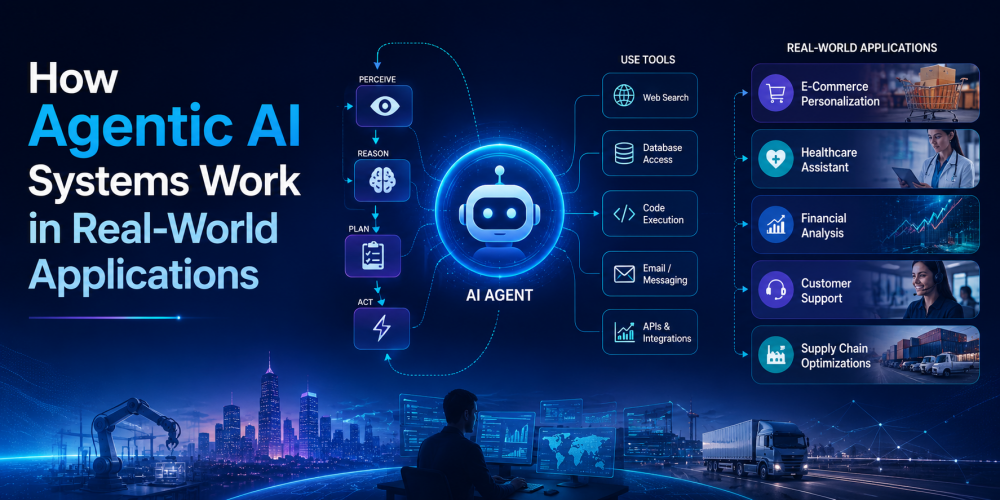
When you give any LLM a task, you get a response and then you have to work on that response. On the other hand, when you give an automated system built using Agentic AI, your work is done there. It figures out what steps are needed, picks the right tools at each stage, decides and performs what to do next.
Say your team needs a competitive breakdown of three market players. A standard AI gives you a paragraph from its training data. An agentic system searches for current data, pulls from multiple sources, checks for gaps, structures the output, and flags anything that looks off. We come back to something actually usable.
This is why working with a skilled agentic AI development company has become less of a nice-to-have and more of a competitive decision for businesses that are serious about moving faster.
Agentic AI Implications in Real World Applications
The internal process is worth understanding because it explains why these systems are more reliable than earlier automation attempts, we may have tried.
It starts with a plan, not a reaction: Before anything happens, the system maps out the task. What needs to happen first, what depends on what, and where in the chain things might fail. This upfront planning is what makes it different from a basic script or a macro that falls apart the moment something unexpected shows up.
Then it picks its tools: Agentic systems connect to whatever is relevant, search engines, internal databases, APIs, file systems, code environments. At each step, it picks what fits and uses it. Not everything at once, just what is needed right then. These capabilities are often supported by AI agent tools, which help agents interact with external systems and complete tasks across different workflows.
It reads the results and keeps going: After each action, our system looks at what came back and decides the next move. Useful result, move forward. Bad or incomplete result, try a different angle. This loop is what makes it feel less like automation and more like a capable team member handling a task.
And it knows when to stop and call us: This part matters more than people give it credit for. A well-designed agentic system does not barrel through decisions it should not be making alone. When it hits something sensitive, unclear, or outside its defined lane, it stops and brings us in. That boundary is something we set, and a good system respects it.
Agentic AI Implications Across Various Industries
Agentic AI now is changing how software is built, tested, and maintained not only in the tech industry but across various other sectors as well. From writing code blocks to running full test cycles, agentic systems are speeding up our development work while catching the kind of errors that slip through manual review.
Teams using AI development services the right way are getting their developers back on the work that needs a human mind, creative problem solving, architecture decisions, user experience thinking, rather than spending afternoons writing test cases or chasing documentation gaps.
In customer-facing operations, we are watching agentic systems take a request from start to resolution without bouncing the customer between three departments. Pull account history, check policy, apply the fix, done. A human steps only when genuine judgment is needed.
Research and data work looks different now too. Analysts used to lose half their week of gathering and cleaning data before they could think about what it meant. Now that groundwork happens in the background. They come in and work on interpretation, which is the part that actually moves the needle.
Importance of Choosing the Right AI Development Partner
Building an agentic AI system properly involves planning logic, tool integrations, failure handling, and oversight design that all must hold up together under real conditions. It is not the kind of thing that gets better through trial and error in a live operation.
The right agentic AI development partner brings knowledge and experience of where these systems break and how to build around those points from the beginning. This step saves you from risks that may be caused post have automated your business processes.
Conclusion
Agentic AI is no longer a futuristic concept now. Businesses have started automating their processes and making good returns out of it, and the gap between organizations that have built this capability and those still thinking about it is already widening.
The businesses getting the most from it right now are not the ones who moved fastest. They are the ones who moved with a clear plan, the right technical team behind them, and a realistic picture of what they were building and why. That combination is what turns a good idea into something that actually runs a meaningful part of our operation.