Brand Storytelling Through Projection Mapping Services: Why the Story Outlasts the Show
There is a distinction that matters more than most marketing conversations acknowledge: the difference between making someone watch something and making someone feel something.
Watching is passive. The brain catalogues the information and files it under “things I’ve seen.” Feeling is different — it creates a physical memory, an emotional association, something the body stores alongside the mind. And physical memories are what drive brand recall, word of mouth, and the kind of loyalty that does not require another campaign to sustain.
Projection mapping services, when used as a storytelling tool rather than a spectacle device, are one of the most reliable ways to move an audience from watching to feeling.
Why Brand Storytelling Has a Visual Problem
Most brand storytelling still happens through language — copy, scripts, voiceovers, presentations. Even when video is used, it tends to follow familiar narrative formats: problem, product, solution, call to action.
There is nothing wrong with this. But there is a ceiling on the emotional intensity it can reach, especially in a live event context. Words are processed by the language centres of the brain. Light, motion, spatial transformation, and unexpected visual events are processed by older, faster, more emotional systems.
What projection mapping services do is deliver the brand story through those older systems. The narrative — the product’s values, the brand’s character, the campaign’s proposition — arrives not through explanation but through sensation. That is a fundamentally different kind of communication, and in a world where attention is the scarce resource, it is worth understanding how to use it.
The Architecture of a Projection Mapping Story
Good projection mapping storytelling has a structure, just like any other narrative form. The difference is that the elements are spatial, temporal, and sensory rather than verbal.
The key structural elements:
- Surface as metaphor — the object being mapped is not just a canvas; it represents something. A car represents movement and freedom. A product box represents discovery and anticipation. The content should work with the object’s inherent meaning, not against it.
- Sequence and pacing — the best experiences have a clear arc: a beginning that arrests attention, a middle that builds narrative, and a conclusion that lands. Without this arc, the experience feels like a screensaver.
- Colour and motion as language — warm, slow transitions create intimacy. Sharp cuts and high contrast create energy and urgency. The content team needs to understand this the way a film editor does.
- The moment of transformation — the most powerful experiences include a moment where the surface fundamentally changes — appears to crack open, burst with light, or reveal something hidden. This is the scene audiences photograph, describe to friends, and remember.
Case Study: Oral-B and the Art of Anamorphic Product Storytelling
The Oral-B campaign by IIC Lab for Procter & Gamble is worth revisiting specifically from a storytelling perspective, because it solved a genuinely difficult creative problem.
The brief: make a premium electric toothbrush — an everyday household product — feel extraordinary. Communicate product features in a way that does not feel like an instruction manual.
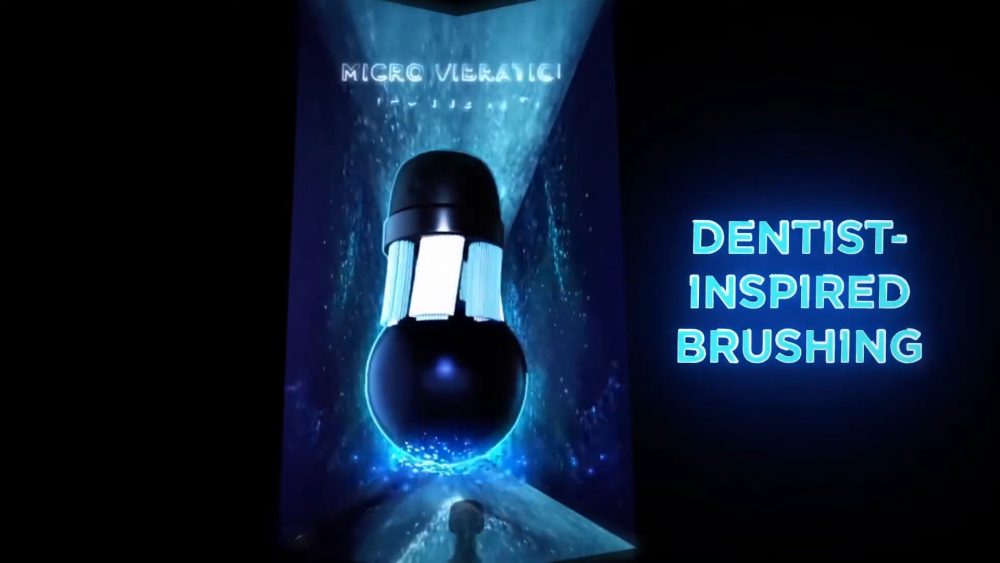
The creative answer was to turn the unboxing moment — the most intimate and tactile moment in any product relationship — into a 45-foot public spectacle. The projection mapping services were used not just to illuminate the product, but to tell the story of discovery at a scale that made it feel genuinely significant.
How the story was told through light and space:
The custom-fabricated 45-foot structure was designed to echo the geometry of the product’s packaging. The projection surface was not arbitrary — it carried the visual language of the brand. This is the “surface as metaphor” principle in direct application.
Anamorphic 3D content was then produced to showcase the toothbrush’s design and technology. Anamorphic content creates the illusion of three-dimensional depth on a flat or curved surface by playing with perspective. When the content is well-made and the surface correctly engineered, the product appears to exist in the space around the audience — not just on a surface in front of them.
The features of the product were communicated through the animation sequence — each feature’s reveal timed like a chapter in the overall story. The audience did not read about the product’s technology; they watched it in motion at a scale that made it feel important. Five industrial projectors were synchronised in parallel to cover the full structure with seamless, consistent visuals — no edge bleed, no seam between projector zones.
The Instagram AR layer: extending the story beyond the room:
One of the most thoughtful aspects of the campaign was how IIC Lab extended the storytelling beyond the physical event using an Instagram AR filter. The filter replicated the unboxing experience in miniature — placing a 3D rendering of the Oral-B kit in the user’s real environment, complete with animations, multiple sound layers, and interactive touch modes. It was engineered to fit within Instagram’s 4MB file limit — significant compression without compromising the experience quality.
Influencers were briefed to create content using the filter, seeding the unboxing story across their audiences. This meant the campaign’s central narrative — discovery, unveiling, technological sophistication — was available to millions of people who had not attended the physical event.
The two layers told the same story in two different registers. The projection event created the emotional peak. The AR filter made the story portable.
Projection Mapping Solutions and Long-Term Brand Recall
There is a body of research in sensory marketing that points to a straightforward conclusion: experiences that engage multiple senses simultaneously create stronger and more durable memories than those that engage only one or two.
A projection mapping experience, when well-designed, engages sight, spatial awareness, and sound in a synchronised way. The emotional response — surprise, delight, awe — adds another layer of memory encoding. The result is a brand memory that persists far longer than a standard advertising impression.
For brands investing in events and experiential campaigns, the question is not just “how many people attended” but “how many of those people still have a vivid memory of the brand three weeks later?” Projection mapping solutions, built around genuine storytelling rather than visual spectacle, are specifically designed to answer that second question.
What to Look for in a Projection Mapping Studio in Mumbai for Storytelling Work
Technical capability to map surfaces and sync projectors is, at this point, a baseline requirement. What distinguishes a studio that can do genuine brand storytelling is a different set of skills:
- A content team that thinks narratively, not just visually — concept developers and art directors who understand what the brand needs to communicate and can translate that into spatial and temporal sequences.
- Understanding of anamorphic content production — the specific technique of creating 3D illusions on surfaces, which requires both artistic skill and precise engineering.
- Experience working at the intersection of live events and digital campaigns — so the physical experience generates content that travels.
- A track record with brands where storytelling was the brief, not just spectacle.
IIC Lab was named Agency of the Year at the Foxglove Awards and has worked with brands including P&G, Volkswagen, Maruti Suzuki, Jio, Google, and BMW. Their projection mapping work consistently starts from one question: what story needs to be told? Everything else is built backward from there.
If your next campaign needs to tell a brand story that audiences carry with them — not just watch and forget —IIC Lab (Ink In Caps) builds projection mapping services around narrative, not just visual impact.