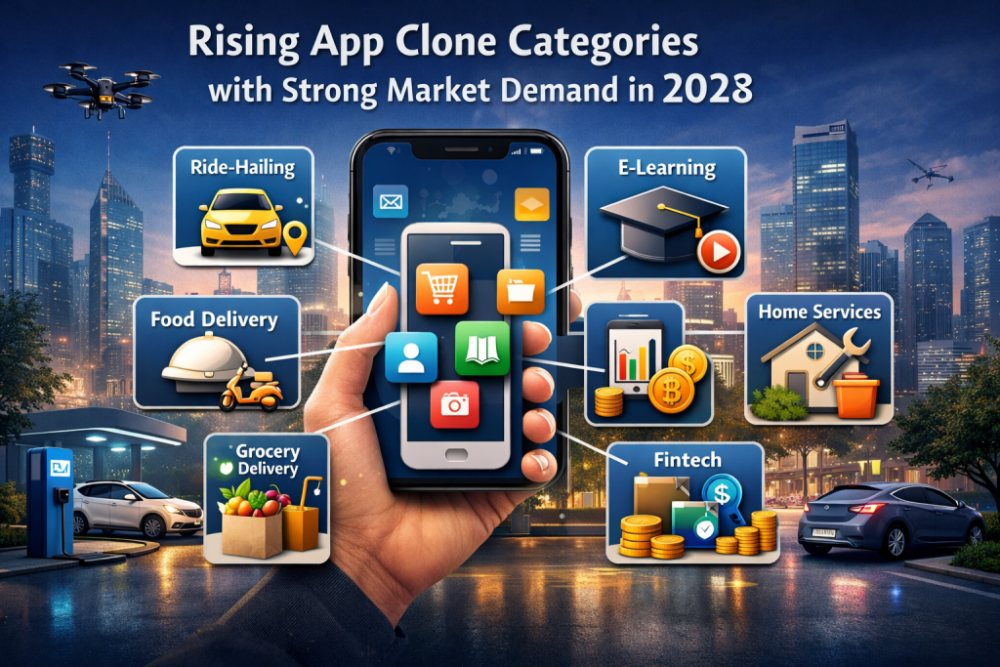
In today’s rapidly evolving and technology-dependent economy, there are mobile apps for almost every function one can imagine. From ordering food to ride booking to house help services, there is an app for everything.
Due to this increasing dependence on applications, developers and startups are constantly looking for ways to enter into the app market, but this has not been easy due to the prevailing large competition. This is where clone apps come in.
App cloning refers to the process of taking inspiration from an existing website and modifying or bettering it for the customers. An app clone helps in saving both time and resources of developers and also mitigates the risk of app failure as it is already inspired by an existing successful app.
In 2026, the demand for clone apps is rising more than ever as the customer wants quick, on-demand service and is constantly on the lookout for better and faster options. The rapid expansion of e-commerce, online payments, and e-learning platforms has only increased this demand and has opened many doors for startups or new companies to enter into the app market with better innovation and technology.
Additionally, advancements in artificial intelligence, cloud computing, and digital services have made the entrance easy and the new and upcoming apps more advanced and developed with better features, improved safety, and a user-friendly interface, catering to the customers’ needs perfectly.
Therefore, for the investors, developers, and entrepreneurs looking to invest in the digital market, understanding clone apps with high demand in today’s market has become extremely important in order to be successful with such high competition.
RIDE BOOKING APPS
Ride sharing apps are one of the most in-demand clone apps due to the success of platforms like Ola and Uber. These platforms allow the user to book a ride from anytime and from anywhere, connect them with nearby drivers, and provide them with vehicle options like cars, bikes, autorickshaws, etc., allowing the user to choose the vehicle according to their convenience.
Cloning a ride-sharing app must share the basic functionality of these apps, such as fast response, live tracking, GPS systems, easy communication between the rider and the passenger, and 24-hour availability of customer service in case of any problem or emergency.
The demand for these apps is continuing to grow because of rapid urban development and increasing population. Regional demand for these apps is growing in countries like the USA, Africa, and the Middle East. The majority of people avoid owning their own vehicles, as the automobile itself is very expensive along with additional costs like petrol and insurance. Moreover, rides are available for them as and when needed, making the ridesharing app perfect for startups as they are a highly profitable opportunity.
FOOD DELIVERY APPS
Food delivery apps are the most used delivery app platforms, as they deliver the preferred choice of food of the customer from the preferred restaurant with just a click of the button. Especially in today’s fast-paced world, where people don’t always have the time and energy to cook food, delivery apps like Zomato and Swiggy come as the perfect rescue and have seen rapid growth after the pandemic.
These apps connect restaurants, customers, and delivery drivers all in one place. Also, these apps allow the customer to track their order, request additions to the food, and coordinate with the drivers in real time.
In a food app delivery clone, features such as AI-based recommendations, subscription plans, a healthy mode as the youth today are more focused on their health but at the same time want something tasty and quick, contactless delivery features, and a listing of only verified restaurants and cloud kitchens.
Overall, a food delivery app helps in increasing sales, customer loyalty, and streamlined business operations, making it a perfect model for app cloning.
QUICK COMMERCE AND GROCERY DELIVERY APPS
Quick commerce platforms gained popularity due to the customers’ increasing value for speed and convenience in online shopping. In fact, the e-commerce sector has made quick commerce sites more preferred, as instead of waiting for 2-3 days for essential items to be delivered, customers now only have to wait for 15-20 minutes. These platforms rely on hyperlocal warehouses and advanced logistics systems for quick delivery.
Everyday essentials such as groceries, medicines, electronics, snacks, and household items are now being delivered in minutes thanks to these quick commerce platforms like Zepto.
For entrepreneurs and startups, cloning these apps is a perfectly profitable business opportunity, as they can collaborate with local farmers and markets and small retailers. Integration of AI-based route optimization, demand forecasting, and dark store logistics is helping these platforms scale rapidly.
TRAVEL AND ACCOMMODATION APPS
Travel and accommodation apps such as Airbnb help customers find and book hotels, apartments, hostels, or any preferred staying place using an online platform with all the verified reviews, safety features, and nearby places to explore mentioned, making it very convenient for a traveller to pick out a perfect staying place to maximize their travel experience. These apps allow property owners to list their places and allow the users to browse and book the most appealing and convenient one.
THE FUTURE AND POTENTIAL OF APP CLONE APPLICATIONS
Overall, app clone development is becoming an increasingly adopted strategy by entrepreneurs and startups looking to enter the app market without making an app from scratch and wasting money.
Companies adopt proven app models and enhance them on the basis of growing customer demand and the trend. This approach helps in saving time and cost while simultaneously reducing the chances of app failure.
However, fully depending upon app cloning is not ideal for long-term business success. To remain competitive in a rapidly evolving market, businesses must continuously focus on innovation, feature upgrades and changing app interfaces to keep up with user needs.