A few years ago, having a website was enough for many businesses.
Today, that’s rarely the case.
People spend a huge part of their day on mobile devices. They order food, book appointments, shop online, track deliveries, and even manage their finances from their phones.
Because of that shift, businesses are paying much more attention to mobile apps than they did before.
What’s interesting is that many companies are no longer satisfied with ready-made app solutions.
They want software that actually fits how they work and how their customers behave.
That’s one of the biggest reasons custom mobile app development is seeing so much demand.
Every Business Has Its Own Way of Working
Two companies can sell the same product and still operate very differently.
One may focus heavily on customer support. Another may prioritize faster order processing. Some businesses have approval workflows that others don’t need at all.
This is where many ready-made apps start showing their limitations.
They are built to serve a broad audience, which sounds good in theory. In practice, businesses often find themselves working around the software instead of working with it.
At first, it’s manageable, but over time, those little workarounds start to get annoying.
A feature is missing. A process takes longer than it should. Teams end up using spreadsheets or separate tools to fill the gaps.
Eventually, many businesses reach the same conclusion: it would be easier to have an app built around their needs rather than constantly adjusting to someone else’s design.
Customers Have Less Patience Than Before
People don’t spend much time deciding whether they like an app.
Sometimes it takes only a few seconds.
If something loads slowly or feels confusing, many users simply leave and try something else.
Businesses are aware of this. A custom app gives businesses the freedom to shape the experience the way they want.
If people are getting stuck somewhere, you fix it. If a step isn’t needed, you just remove it.
The point isn’t to pile on features or screens. It’s to make things easier for the people using the app.
In many cases, a smoother experience does far more for customer satisfaction than a long list of features that rarely get used.
Growth Creates New Problems
Some businesses have more specialized needs than others.
For example, A prediction platform needs to manage real-time data, safe payments, and a seamless user interface.
Since every company has different needs, many choose custom development in order to have more flexibility and expand in the future.
They want a foundation that can grow with the business rather than something they will need to replace after a year or two.
It’s Not Just About Customers
When people hear “mobile app,” they usually think about customers.
But many custom apps are built for employees.
Some companies use them for field operations. Others rely on them for inventory tracking, internal updates, reports, and everyday task management.
It’s saving time.
And when a business saves time every day, the impact adds up surprisingly fast.
Data Has Become a Business Advantage
Most businesses collect information. The difference today is how they use it.
Custom apps can help companies understand which services customers use most, where users drop off, and what improvements might have the biggest impact.
That information is often more valuable than assumptions.
Instead of guessing what customers want, businesses can make decisions based on actual behaviour.
Security Matters More Than Ever
Customers are more aware of privacy than they were a few years ago.
Businesses are aware of it too.
When customer information is involved, security can no longer be treated as an afterthought.
Customers are paying much more attention to privacy and security than they did a few years ago.
People want to know their information is being handled properly. Businesses know this too.
That’s why a lot of companies prefer having more control over how their apps are built and run.
Instead of sticking with default settings, they can choose a security setup that actually fits how their users and operations work.
For businesses handling payments, customer data, or other sensitive information every day, that level of control becomes important.
So Why Are More Businesses Choosing Custom Apps?
Interestingly, the answer isn’t always about having the latest technology.
Most business owners aren’t waking up and thinking about app frameworks or development methods.
They’re thinking about practical things.
Will this app support our growth?
Can it adapt if our business changes next year?
Will it help us serve customers better?
Those questions are usually what drive the decision.
For many businesses, custom development simply offers more room to grow without constantly running into limitations.
Final Thoughts
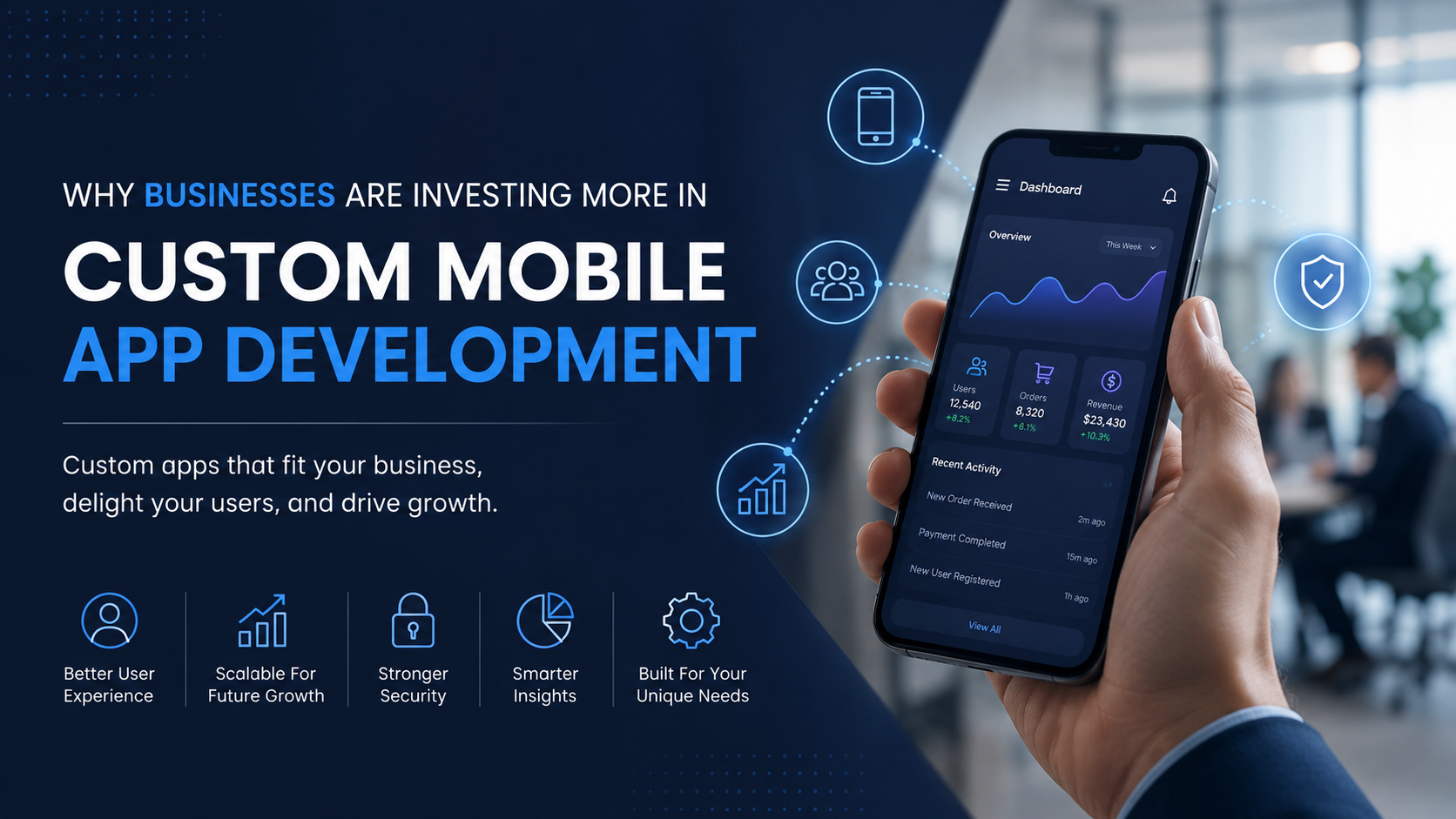
Businesses are investing more in custom mobile app development because expectations have changed.
Customers expect better experiences. Companies need more flexibility.
Technology moves faster than it did before.
A custom app isn’t automatically the right choice for every business.
For some businesses, the switch happens when they get tired of working around limitations and decide they need a solution that fits them better.