What Makes Stainless Steel 420 Sheets Different?
Buyers comparing sheet grades often miss just how precise 420 is within the martensitic stainless steel family. The grade offers something most austenitic grades don’t: hardness after heat treatment. The stainless steel 420 sheet can be used for cutting tools, knife blanks or components for surgical instruments. Depending on the processing, it can reach up to 50 HRC. The hardness is due to the higher carbon content, which is between 0.15% and 0.40%, and also contributes to its wear resistance. Although 420 is not as corrosion-resistant as 304 or 316, it will maintain a sharper edge longer under mechanical stress in dry or mildly humid environments. That is exactly why it is the choice of industrial buyers in the cutlery, pump and valve industries.
What Are Hot Rolled Stainless Steel 420 Sheets?
Hot rolling processes 420 billets above the recrystallisation temperature, usually above 1,100°C. This makes the steel easier to shape and reduces internal stress during forming. The sheet produced has a rough, scaled surface, which is often descaled or pickled by mills and fabricators before further processing. Standard thicknesses are around 3 mm, and well over 100 mm for plate applications, making hot rolled the natural choice for heavy structural and industrial parts. Pump casings, valve bodies, and heavy brackets that go through subsequent machining use hot rolled 420 because surface finish at that stage matters less than dimensional bulk and mechanical integrity.
What Are Cold Rolled Stainless Steel 420 Sheets?
Cold rolling is done below the recrystallisation temperature. The sheet is passed through rollers under ambient conditions to reduce thickness and improve the surface. The process greatly reduces dimensional tolerances, usually to within ±0.05mm of thickness variation on thinner gauges. The surface finish is greatly improved and the sheet is supplied with a shiny, smooth finish suitable for applications where aesthetics and precision are important. Cold rolled 420 sheets are used in surgical blades, precision cutlery and decorative hardware because the surface does not require heavy post-processing. In cold rolled form, sheet thicknesses are generally from 0.3 mm up to about 3 mm.
Cold Rolled vs Hot Rolled: Key Differences
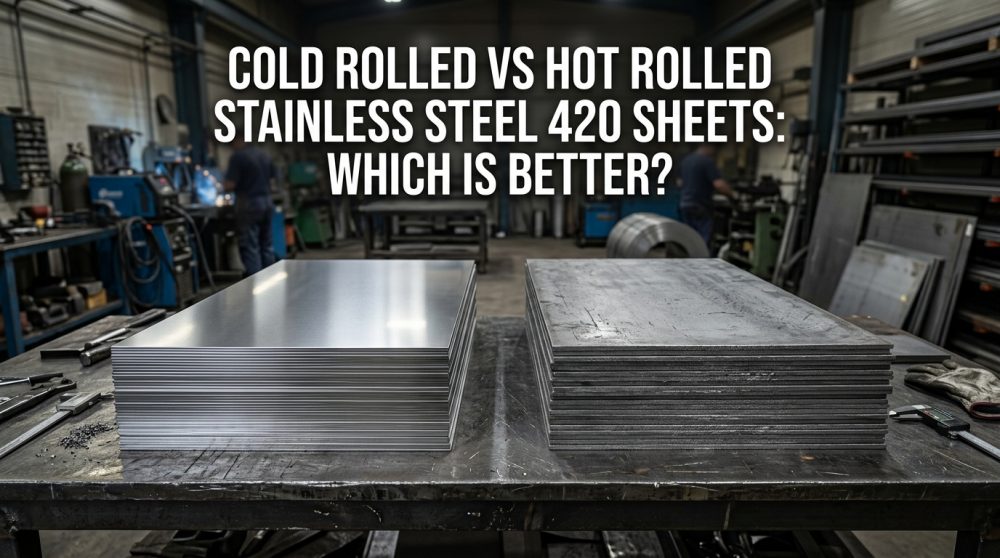
Both processes produce stainless steel 420 sheet material, but the end product differs across several practical dimensions. Here is what buyers should weigh before ordering.
- Cold rolled sheets have tighter dimensional tolerances, often to ± 0.05mm. Hot rolled sheets have a wider variation in thickness.
- Hot rolled sheets have a rougher mill scale surface that must be pickled or descaled before precision fabrication work can begin.
- Cold rolling increases tensile strength through work hardening, which gives it a minor mechanical advantage over hot rolled equivalents.
- The hot rolled 420 sheets are produced in thicker sections, generally between 3mm and over 100mm. While cold rolled sheets are between 0.3mm and 3mm.
- Cold rolled material cuts and bends cleaner at tighter radii, and is the better choice when fabrication involves intricate stamping or fine-tolerance forming.
- Hot rolled sheets are more affordable per kg for similar thicknesses, since they need fewer passes through the rolling mill and less controlled finishing.
Which One Is Better for Your Application?
The better product comes down entirely to what the part does once it leaves the fabrication floor. Hot rolled 420 suits applications where the sheet gets machined, ground, or welded after cutting, and where the initial surface condition gets removed during finishing anyway. Heavy industrial components, structural supports, and large valve bodies fall squarely in this category. Cold rolled 420 works for projects where the surface of the sheet will be seen, or where the function of the part is driven directly by its tolerances. Precision cutlery blanks, surgical components and decorative panels all require the tighter geometry and cleaner surface that cold rolling provides. For buyers unsure which direction to go, the easiest filter is thickness: anything below 3mm almost needs cold rolled, and anything above 5mm almost certainly uses hot rolled.
Why Source from a Trusted Supplier?
Sheet-to-sheet consistency matters more with 420 than with many other grades because the material’s performance depends heavily on carbon content control and heat treatment response. A supplier that purchases from mills with established chemistry control and mill test certificates gives fabricators a dependable baseline for every production run. Reputable 420 stainless steel sheet suppliers must stock both hot rolled and cold rolled varieties, which simplifies procurement when a project requires both. Material certificates should be issued prior to acceptance to show standard compliance AISI 420, EN 1.4021 or UNS S42000. Delivery reliability also reduces production lag, particularly for fabricators running tight batch schedules where a delayed sheet order stalls the entire cutting program.
Conclusion
Hot rolled 420 sheets are better for heavy industrial work and post-machining applications. Cold rolled 420 sheets work better for precision, finish-critical and thin-gauge needs. Neither is superior. Choose a product based on the thickness requirement, surface specification and end-use atmosphere. Buyers sourcing both forms from a single stainless steel 420 sheet supplier simplify quality tracking and reduce certification overhead throughout the supply chain.