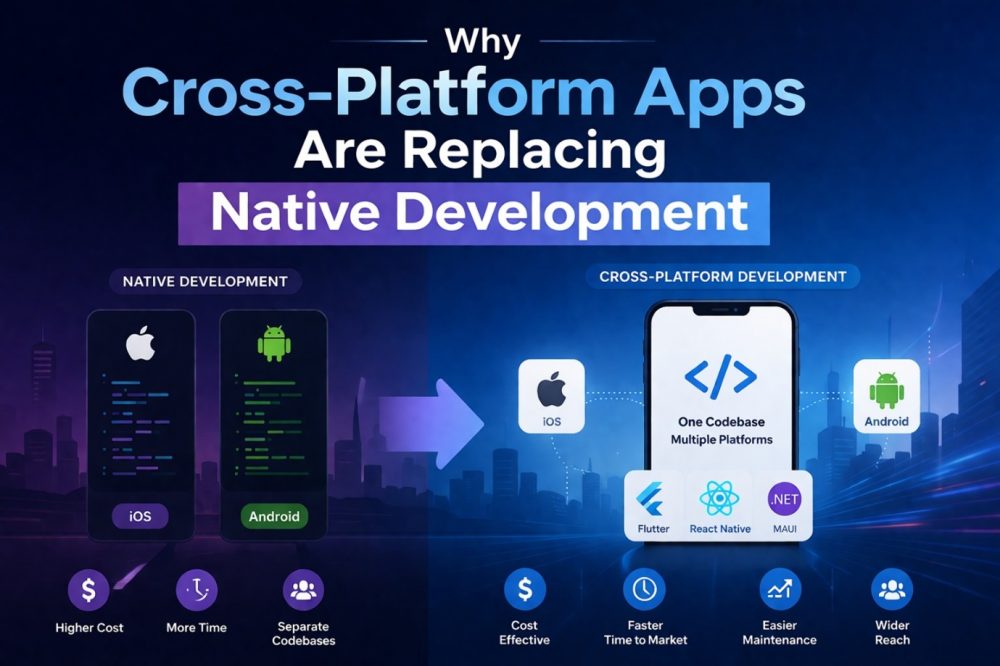
The Shift from Native to Cross-Platform Development
For a long time, the mobile applications were designed based on the principles of native application development, according to which the software was written especially for certain platform, like iOS or Android. The advantages of native application development include excellent performance, comfortable user experience, and availability of all hardware components. On the contrary, cross-platform application development is based on the same source code and its adaptation for multiple platforms without unnecessary duplications of development efforts.
Initially, companies preferred native development to guarantee high performance and quality. Nevertheless, nowadays the situation changed dramatically. Higher expenses and need for fast deployment became the reason why many firms choose cross-platform development to meet modern requirements. Today, the world has become multi-device, with smartphones, tablets, and other portable consumer electronics playing a central role alongside desktop devices and websites.
Today cross-platform application development is regarded as one of the most efficient methods for software development as the technology allows combining the benefits of different methods.
Cost Efficiency and Faster Time-to-Market
The reduction of expenses and acceleration of the delivery process through cross-platform development is among the strongest points of this strategy. It involves developing one application that works on several platforms, thus avoiding redundant work and saving money. In addition, it is not necessary to engage different teams of developers for creating a product for iOS and Android devices.
Cross-platform developments are especially beneficial for startups that want to create a product quickly, test it on the market, and make necessary changes to the application. Moreover, updating applications becomes easier because developers don’t need to perform the work separately for each platform but make changes and deploy them together. The implementation of CI/CD can also help companies speed up their release cycles.
Overall, due to the reduction of effort needed for working on the product, testing, and maintenance, startups can afford themselves the opportunity to develop a product for several platforms at once without spending too much time and money.
Consistency Across Platforms and Wider Reach
Cross-platform development provides companies with an ability to offer a common user interface and experience for the app across various platforms. This helps ensure that users have the same experience, no matter if it is an iOS, Android, or web app. In addition, the consistency of the application helps build a strong corporate identity and increases brand trust since the behaviour of the application remains the same. The consistency in experience also reduces one of the most frequently occurring problems in apps – the presence of design flaws or missing functionality in different platforms.
In addition to providing a unified user experience, cross-platform apps allow developers to reach a larger audience. Moreover, with cross-platform development, companies can enter foreign markets faster since they will be able to localize apps for other countries without creating separate versions.
From the development perspective, cross-platform technologies help the developers reuse code, logic, and other elements between applications.
Modern Frameworks Bridging the Performance Gap
Modern cross-platform frameworks have evolved to become more effective and close the performance gap, which once existed in favor of native frameworks. It enables developers to write a single app code base that works flawlessly on various platforms, thus increasing productivity. Historically, cross-platform applications had performance issues due to laggy performance, poor animations, and inconsistent UI, discouraging many developers to create high-quality applications using this method.
Fortunately, contemporary frameworks address all those concerns by enabling fast compilation, utilizing advanced rendering engines, and providing native components. Cross-platform frameworks today do not sacrifice device functionalities and features, offering full access to features such as camera, GPS, or accelerometer.
Furthermore, it provides developers with the opportunity to access the hardware of the device without any restrictions. Moreover, many plugins and libraries make extending functionality effortless, and strong support from popular companies like Google and Meta makes the whole process even easier. Even though native development can still take the lead when it comes to performance-critical tasks, like AR or VR games.
Conclusion
Cross-platform app development can be considered both a relevant and prospective approach to building apps compared to native development. It provides all necessary features that help to meet challenges of modern businesses and deliver high-quality apps in less time and with fewer resources spent on the process. While native app development may still play a role in creating performance-oriented applications, the cross-platform development model can cover almost all existing needs. Taking into account technological advancements and growing popularity of multi-platform products, it is safe to say that this model is becoming a necessity rather than an optional approach.