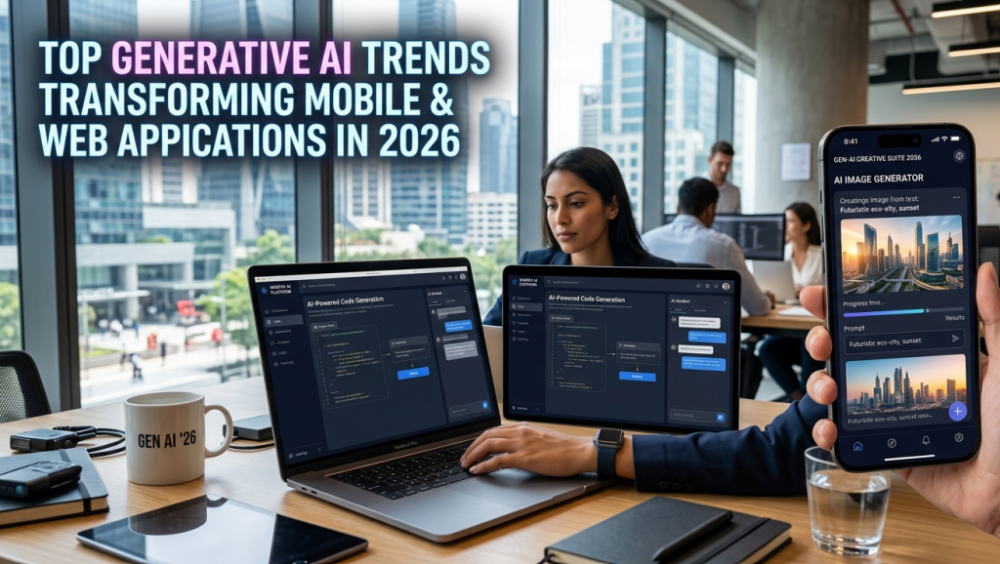
Generative AI is a broad term used to describe the different technologies that create novel content, whether text, imagery, videos, coding, or anything else.
Here it uses existing datasets using various approaches like large language models (LLMs).
In contrast to regular AI, which primarily deals with analysis and prediction based on existing logic, generative AI deals with creation.
GenAI is capable of writing sales emails, creating synthetic datasets, generating unique artwork, and even creating code programs.
Various industries, including retail, healthcare, financial services, and entertainment, are adopting genAI within their business operations.
Hyper-Personalization with GenAI
One of the most important trends in artificial intelligence today is hyper-personalization.
Through GenAI, it becomes possible to tailor content and messaging in ways that reflect individual interests and needs.
It is achieved by analyzing a lot of data and understanding the individual preferences of people, resulting in an experience that is highly personalized and meaningful.
This improves effectiveness in communication and creates stronger relationships.
Multimodal Generative AI
AI systems are now becoming more capable of analyzing various types of data including images, text, audio, and video.
Such an approach is referred to as multimodal AI.
In other words, certain software applications are able to convert audio files to text formats or provide images depending on the text inputs provided.
New models such as GPT-4V and LLaVa make this technology a reality.
They allow humans to communicate with AI systems not only through words but also through visual representations.
Conversational AI
The technology of conversational AI has advanced significantly over the past couple of years, enabling the system to communicate with humans in a natural conversation.
Using advanced technologies such as GPT, the system can listen to what you are saying, remember your previous interactions, and respond in an intuitive manner.
By the year 2026, this type of AI will be able to carry out extended communication, which makes it a perfect fit for tasks such as customer service, digital assistants, and much more.
AI Boosting Creativity
AI is bringing about a revolution in the world of creativity and imagination.
With programs such as Dall-E, even basic concepts can be transformed into images, songs, videos, and audio, thereby aiding creators in developing their ideas fast and effectively.
AI applications continue to develop at an accelerating pace, giving users a chance to venture into different ways of expressing themselves creatively.
It has become possible for individuals in different creative spheres to come up with original and novel content thanks to AI technology.
Open Source and Generative AI
The rise in open-source software is also crucial in fostering the development of generative AI.
By enabling numerous individuals to collaborate from various locations, open-source software aids in improving the efficiency and efficacy of the AI models and technologies.
Open-source collaboration enables quick identification and resolution of issues in AI while maintaining integrity and transparency in the development process.
The open-source approach allows for information sharing and resource allocation in AI, thus fostering an open and transparent environment.
As per the McKinsey generative AI report, companies that consider AI to be vital for their success use open-source AI solutions over 40 percent more than those that do not consider it important.
About 72 percent of tech companies adopt open-source AI models.
AI Helping in Scientific Research
The forecast from Generative AI suggests a transformative role played by artificial intelligence in scientific research.
First of all, it is able to provide an easy summary of lengthy and complicated scientific articles, particularly, on the topic of medicine and pharmaceuticals.
Consequently, specialists do not have to read entire papers but can get a general idea about the data presented in a short while.
Thus, the work of experts is significantly facilitated due to AI.
Bridging Generative Search and Monetization
Our methods of finding information have changed drastically, and AI Summarization or Generative Search have replaced the link-based methods.
AI trends 2026 indicate that Generative Search is gaining momentum and rapidly turning into the standard way of retrieving information, switching from the list of blue links to the actual, AI-generated answers.
Although this technology provides a good experience for the user, it disrupts the whole history of monetization of the Internet industry.
The issue of making money via clicks to external websites no longer exists in the world of instant answers.
Thus, by 2026, the industry faces a serious challenge in finding ways of satisfying the user’s demand for instant information while at the same time preserving a viable economic model.
To make both parties of the process happy, the providers of search services and advertisements should come up with new monetization strategies.
It combines the advantages of both technologies; the convenience for the user and the ability to generate profit.
As a result of searching for direct information provided by AI algorithms, the need for verifiability will arise, and AI algorithms that cite their sources will become particularly valuable.
Photorealistic Video Generation
The current videos created using artificial intelligence may be highly sophisticated.
However, they still face problems such as temporal coherence, short length limitations, and difficulty creating complex physical phenomena or perfect human actions.
In 2026, thanks to significant advances in diffusion and transformer algorithms used for video generation, these basic technical barriers will be overcome.
This step is going to bring GenAI to the level of generating a professional video with extremely high resolution and almost identical to what is filmed with a real camera.
The result is an unprecedented revolution in Generative AI trends.
Generative AI will reach enough consistency, length, and realism to become mainstream video, used in advertising, Hollywood productions, and even series.
Small businesses and individuals will create fantastic films at very low costs.
Privacy-Focused GenAI
As more AI processing is done in-device on personal devices such as laptops, smartphones, and even smart home devices, this will continue to grow in popularity.
This is an important driver for AI trends 2026.
As Generative AI technology evolves to become a part of corporate workflow and personal devices, it becomes a significant disadvantage to send sensitive data in order to process it in the cloud.
Therefore, as of 2026, the focus will be placed on privacy-first GenAI, which is one of the main Generative AI trends development, made possible due to specialized hardware embedded right into end-user devices.
This makes it possible to conduct personalized model training and inference, without sending any customer data across the network, thus securing the process.
Privacy-First GenAI: Personalized model training and inference happens locally, no sensitive data needs to be sent to the cloud.
Ultra-Low Latency: Tasks such as summarizing, translating, or image editing become instantaneous.
Conclusion
The vision for Generative AI trends 2026 involves a massive transformation. Gone are the days when we were focused only on generating content.
We are now moving towards an era where agentic AI will make plans and carry out tasks, transforming productivity in professional settings.
Generative AI in the future is based on human capabilities of coping with the advanced automation layer powered by AI.
Often, Generative AI development services help ensure the proper implementation and compliance. Here are the AI trends 2026 coming up.
To effectively follow all these trends, you need to hire AI developers with experience and expertise.