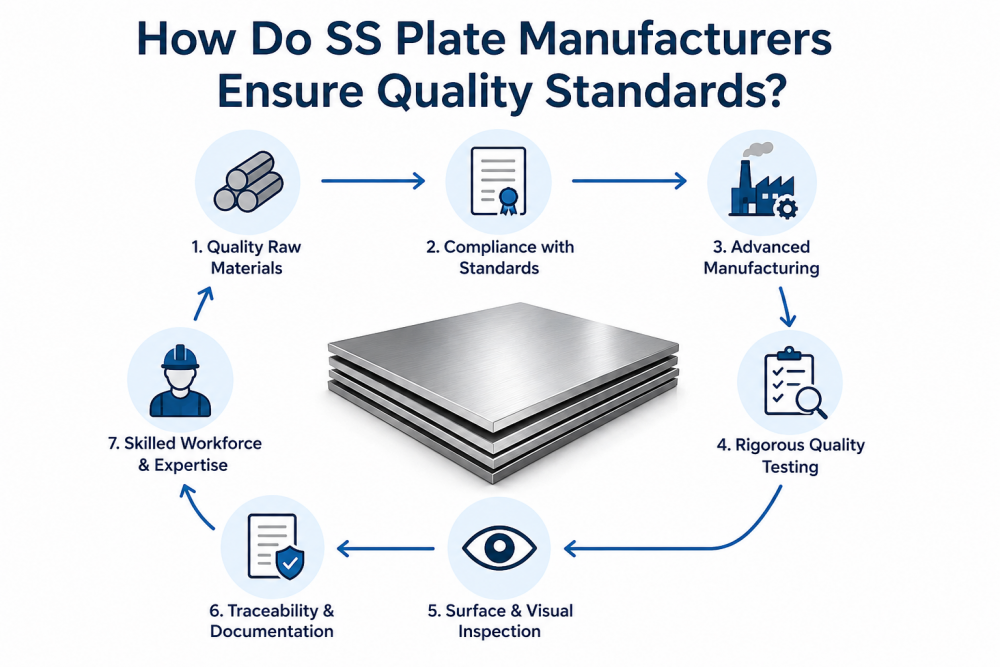
Stainless steel plates are used in various industrial sectors as they resist pressure, heat and corrosive environments. They are found in chemical factories, heavy equipment and construction projects. Demand has gone up steadily because industries now have to meet tighter safety requirements. When you buy an SS sheet plate, you need to be confident it will not crack, rust, or fail early. Poor quality leads to expensive shutdowns or, in worse cases, safety incidents. So a stainless steel plate manufacturer has to build quality checks into every stage of production, not just at the end.
Why Quality Standards Matter in Stainless Steel Plates
If an SS plate cannot handle the load it was specified for, the consequences vary from leaks in pressure vessels to structural failures in fabricated builds. The problem with substandard material is that it often looks fine on the surface. The issues show up later, under actual working conditions.
Following international standards removes that uncertainty. You get consistent corrosion resistance, predictable yield strength, and reliable weldability. Certified material behaves the way your design expects it to. If you are trying to identify the right option for your application, reviewing the types and grades of stainless steel plates is a useful starting point.
Raw Material Selection and Testing Process
Quality control starts before any rolling takes place. Getting the alloy composition right depends entirely on the quality of the raw materials going in. Different grades need specific ratios of chromium, nickel, and molybdenum. Manufacturers monitor their suppliers regularly to ensure they are getting clean scrap, pure alloys and not contaminated inputs.
When the material arrives at the mill, technicians perform Positive Material Identification testing. This is a handheld instrument check and confirms the chemical composition quickly. Followed by laboratory analysis to pick up any excess sulphur or phosphorus, both of which will degrade the performance of the steel if they are above acceptable limits.
Manufacturing Standards Followed by SS Plate Manufacturers
Reputable manufacturers work to recognised global standards such as ASTM, ASME and EN. ASTM A240 is the primary standard for plates for pressure vessels and general industrial use. During hot and cold rolling, temperature and reduction rate are continuously monitored. Thick tolerances are handled by automated systems to keep the output within the desired range. Surface finish is visually and sensor inspected for scale, pitting or scratches deep enough to weaken the plate.
Quality Control Tests Performed on SS Plates
Several tests are run on finished batches to confirm the plates meet physical and chemical requirements.
Mechanical Testing
Tensile strength testing pulls a sample till it breaks to measure how much load it can handle. Hardness testing, usually on the Brinell or Rockwell scale, tests resistance to surface indentation. Impact testing is a measurement of how much energy the steel absorbs from a sudden blow. This is important in cold operating environments.
Chemical Testing
Spectrometry shows that the exact percentages of chromium, nickel and other elements meet the grade specification. Corrosion resistance tests involve immersing specimens in acid or salt solutions to determine resistance to pitting and rusting.
Non-Destructive Testing
Ultrasonic testing uses sound waves to locate internal voids or flaws without cutting into the plate. Radiography testing applies X-rays to welded sections or thick plates to find internal defects. Dye penetrant testing involves applying a coloured liquid to the surface so that fine cracks, which the eye would miss, become visible.
Dimensional Inspection
The thickness is measured at a number of points using either micrometres or laser gauges. Flatness testing seeks out waves or warps that would interfere with cutting or welding. The surface condition is visually and mechanically checked to ensure that the finish is within acceptable limits.
Certifications and Documentation Provided by Manufacturers
Every batch from a credible manufacturer should come with a Mill Test Certificate. This document links back to the specific heat number of the steel, so the material is fully traceable. The standard most commonly used is EN 10204 3.1, which confirms the material was tested in line with the specification. Factories also hold ISO certifications covering their quality management systems. Where needed, third-party inspection from agencies such as Lloyds or SGS can be arranged. That documentation trail lets you track the plate from raw material right through to your facility.
How Reputable SS Plate Manufacturers Maintain Consistency
Producing thousands of tonnes at consistent quality requires more than manual checks. Automated systems are able to adjust roller settings and furnace temperatures in real time, which reduces the variation that occurs with manual operation. There are still skilled staff who supervise the process and do checks that machines can’t do. Inspection is carried out on the production, not on finished plates. To avoid confusion during storage and shipment, batch tracking involves stamping numbers or bar codes on the edges of plates. This is particularly important for export orders, where buyers expect each shipment to be the same as the previous one.
Industries That Require High-Quality Stainless Steel Plates
- Oil and Gas: Used in pipelines and offshore platforms where sour gas and high pressures are common operating conditions.
- Petrochemical: Storage tanks and processing units need high-alloy plates to handle chemical exposure over long periods.
- Marine: Specific marine-grade plates are used for boat hulls and dock structures that are constantly exposed to salt water.
- Pharmaceutical: Mixing vessels require ultra-smooth, clean plate surfaces to prevent contamination.
- Food Processing: Machinery uses stainless steel because it does not react with food acids and can be cleaned thoroughly.
- Power Generation: Turbine housings and nuclear components need plates that perform reliably under high heat and mechanical stress.
- Construction: Modern buildings and bridges use these plates for structural support and cladding because of their weather resistance.
Tips for Choosing the Right Stainless Steel Plate Manufacturer
If you’re buying from an ASTM A240 stainless steel plates supplier, begin with their certifications. Maintain ISO and other relevant industry certifications. Specifically ask if the NDT testing is done in house or outsourced to a third party. Check their export history to see whether they know the international shipping requirements and packaging standards. Look for different thicknesses and sizes, make sure they have enough stock, so you don’t have to wait long to get your order. Whenever you are placing a large order, always ask for a sample of Mill Test Certificate of the last batch. You can be sure of getting the complete certified, traceable material as per the required specification when you deal with an established manufacturer like Abhay Steels.
Conclusion
Quality control of the manufacturing process of SS plates involves the complete production process, from the inspection of raw materials upon receipt to the non-destructive testing of the finished plates. Serious manufacturers invest in automated production systems, maintain the standard thickness of SS 304 plates, conduct proper laboratory testing, and provide complete certification documentation. Request the mill test certificates before your next order and ensure that the material standard is suitable for your project.