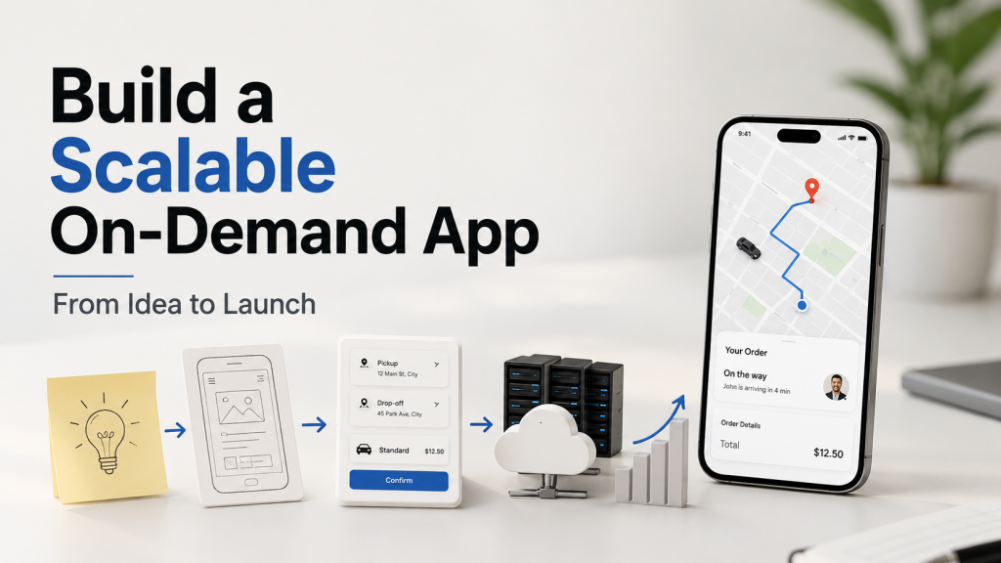
The on-demand economy hasn’t slowed down at all, it just matured. You touch the icon on your phone and a car arrives. The grocery delivery arrives even before the kids are in bed. From doctors’ visits to home repairs, freelance jobs to delivery services, it is all packed in one application.
The chances are, of course, there. However, coming up with an idea is not enough. Many start-ups face the challenge of building a service capable of taking the strain of having real users.
The post below is a guide for founders launching their projects today. Plain and simple and with no fluff. It describes how to turn an idea into an operational application and the calls that determine the success of the idea.
What “On-Demand” Actually Means (and Why Scale Decides Everything)
Strip it back and an on-demand app is a matchmaker. Somebody needs a thing right now. Somebody else can provide it. Your app puts them together and takes a cut. “Uber for X” is the lazy way to describe it, but it’s accurate: a customer app, a provider app, an admin panel behind the scenes, and payments plus live tracking holding the whole thing together.
There’s one word that quietly makes or breaks you here, and it’s scalable.
Your first hundred users? They’ll put up with almost anything. A hundred thousand of them won’t. When traffic suddenly jumps on a Friday night, or a post about you goes semi-viral, or you switch on a new city, the app has to stay quick and stay up. That has to be baked in early. Try bolting scale onto a codebase you rushed, and you’ll pay for it twice over.
Step 1: Prove the Idea, Then Cut It Down to an MVP
Don’t open a design tool yet. First, poke holes in the idea. Who exactly is the customer? What annoying, repeating problem are you actually taking off their plate? And is there anyone on the supply side who’ll show up to do the work?
Once you’re past that, do the harder thing: build less. Your MVP needs to nail a single loop and nothing else. Request, match, fulfil, pay, rate. Everything you’re tempted to add on top can wait. Ship the loop, watch what people do with it.
You get to market sooner this way. You spend a fraction of the money. And instead of guessing, you get actual numbers from actual users.
Step 2: Decide How You’re Going to Build It
Founders usually land in one of three camps at this point, and choosing badly here can burn a quarter of your year.
Option A: No-code and low-code builders. If you just want to build a web app fast to test the concept, these are hard to beat. Cheap, quick, good enough to prove a point. They start to strain the moment you need real custom logic or you’re pushing serious traffic through them.
Option B: Let AI do a chunk of the work. In 2026 loads of teams lean on AI to build an app quicker. It’ll rough out screens and grind through the boring, repetitive code. AI-based app development genuinely saves time when someone who knows what they’re doing is steering. Hand it the keys with nobody watching, though, and you end up with a pile of code that nobody can fix when it falls over.
Option C: Build it properly with a partner who’s done it before. For anything you actually want to scale, this is where most serious founders end up. A good partner already knows the architecture traps, has a tech stack they trust, and builds for growth instead of hoping for it.
Maybe you don’t fancy hiring and running a whole engineering team just to reach launch. Fair enough. Teaming up with an AI-powered app development and automation company like BuildNexTech covers that gap, since you get the custom build, cloud-ready foundations, and the AI automation piece from one team, which means the app is put together to grow rather than stitched together to demo.
Honestly, there’s no “correct” option in the abstract. It comes down to your budget, your timeline, and how hairy your app is. On-demand apps sit firmly on the hairy end, so I’d push you toward whatever leaves you actually owning what gets built.
Step 3: Architect It for Scale from Day One
Scale isn’t a feature you sprinkle on before launch. It’s a decision you make in week one. A few things I wouldn’t skip:
- Be cloud-native immediately. AWS, Google Cloud, Azure, take your pick. The point is you scale outward as demand climbs instead of sitting up at night praying one server holds.
- Split it into services that matter. Matching, payments, notifications, tracking, keep them apart. If one gets slammed, it can wobble on its own without dragging the whole app down with it.
- Pick a database that likes real time. These apps are constantly reading, writing, and asking “where is everyone right now.” Your data setup has to stay quick when that volume hits.
- Wire in real-time infrastructure. Live tracking and instant matching want websockets. Constant polling will happily cook your servers instead.
Nail this layer and adding a city or a feature becomes a Tuesday. Miss it and every bit of growth turns into a 2am incident.
Step 4: Build the Core, Then the Clever Stuff
Some features aren’t optional. Smooth sign-up, secure login, real-time matching, payments inside the app, live GPS, push notifications, ratings, and an admin dashboard your ops people can actually use.
Where you pull ahead is the AI layer sitting on top. Forecasting demand before it lands. Pricing that moves with the market. Dispatch that’s actually smart about it. Fraud caught early. Support that answers itself half the time. That’s the gap between something that feels 2026 and yet another tired clone from years ago.
And this is the point where AI automation stops being a buzzword on a pitch deck. It quietly trims your running costs by eating the manual busywork you’d otherwise be hiring a growing support team to handle.
Step 5: Test It Hard Before Launch, Especially Under Load
This is the step that quietly torpedoes more launches than anything else. People skip proper QA to save a couple of weeks, then pay for it in public.
Remember what this app is. Live traffic, real money, all happening in real time. A payment glitch or a crash right when everyone’s using it doesn’t just irritate people. It torches trust you spent months earning, and most of those users are never coming back for round two.
Checking that each feature works is only the warm-up. What really counts here is performance and load testing, actual proof the thing stays standing when thousands of people hit it at the same second. Then security testing, because you’re holding people’s card details and personal data.
None of that is a job to wing. This is exactly why bringing in a dedicated QA and performance testing partner like Frugal Testing is worth it, since they’ll batter the app with realistic traffic, check it over for security holes before it’s anywhere near production, and run it across the messy spread of real devices people actually own. Do that and launch day feels like an event instead of a fire drill.
The founders who tick “testing: done” and move on tend to meet their bugs the same time their users do. The ones who treat it as insurance sleep fine.
Step 6: Launch, Watch, Then Grow
Launching isn’t the finish line. It’s roughly the halfway mark. Go live somewhere small first, one city or one slice of your audience, and pay close attention to what real people actually do. Fix the ugly stuff fast.
Measure the things that matter, retention, how long matches take, whether payments go through, where it’s crashing. Let those numbers make your decisions for you, not your gut and definitely not your ego.
Then expand on purpose, not on vibes. New regions, new features, more supply, one deliberate step at a time, each one resting on the scalable base you laid down back in Steps 3 through 5.
The Mistakes That Cost the Most
- Trying to launch with every feature built. Scope creep eats your runway and your nerve.
- Forgetting the provider side entirely. No supply means no service, so both apps deserve equal effort.
- Filing scale under “we’ll deal with it later.” You decided that on day one whether you meant to or not.
- Cutting QA to hit a date. Fastest known route to a launch that flops.
- Going with the cheapest quote instead of the right one. Rebuilding a broken app costs way more than building it right the first time.
Wrapping Up
In 2026, a scalable app on demand is definitely achievable. Such a plan only rewards those who appreciate the entire process, not just the successful implementation part: the MVP, the correct model of construction, the architecture that could withstand itself, AI features people can actually experience, and testing that occurs before anyone sees the application.
When these aspects are done correctly, one is not only ready to introduce an application but also has a chance to create a successful enterprise.
Frequently Asked Questions
How long does it take to build an on-demand app?
A tight MVP is usually a 3 to 5 month job. A full, scalable platform with AI baked in tends to run 6 to 9 months, depending on how big your scope gets and how you decide to build it.
How much does it cost to build an on-demand app?
Depends heavily on features, where your team sits, and how you build. An MVP can stay lean. A proper multi-service platform with custom AI is a bigger cheque. The cost that really stings, though, is rebuilding something later because it was put together badly the first time.
Should I use AI to build my on-demand app?
It can speed things up and power the clever features like dynamic pricing and smart dispatch. Just make sure someone experienced is overseeing it, so you actually own and understand whatever ships.
What’s the step people skip most?
Load and performance testing. On-demand apps stand or fall on how they cope with real traffic, which is precisely why smart founders pull in a testing partner before they go live.