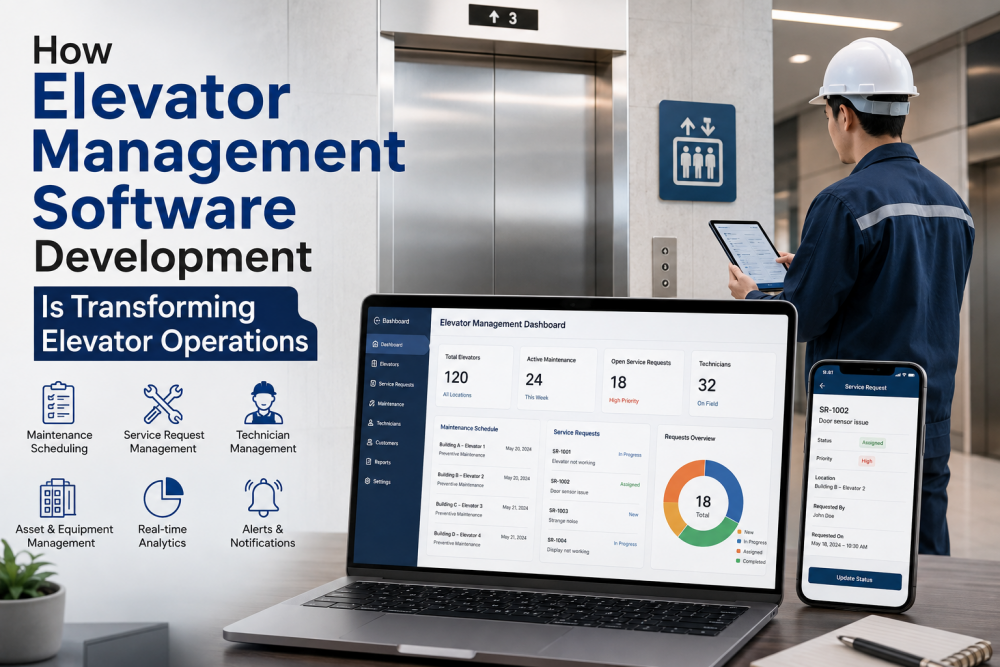
It becomes very easy to overlook the elevators if they are functioning perfectly. But there lies a lot of installation, inspection, maintenance schedule, service calls, technical personnel, spare parts, and customer needs. The coordination of all these things becomes very tough with the use of spreadsheets, telephonic communication, and disparate systems.
This is the reason why Elevator Management Software Development is receiving a lot of importance in the elevator industry as well as in the field of facilities management. Contemporary software can help in the centralization of all the operational data and will allow the elevator companies to run their business smoothly.
Why Traditional Elevator Management Is Becoming Difficult
The elevator service business could have dozens or hundreds of units in various locations that all require individual maintenance schedules, records of servicing, warranties, inspections, and repairs.
With a manual management system, small flaws in the communications process can lead to much bigger problems. The technician could be delayed, the technician may not have the service history of the machine, or the client may have to call over and over again to get an update.
This does not mean that such problems happen because of laziness or carelessness on the part of the staff members. They happen when the required information is dispersed across too many channels. Businesses often use white label SEO services to centralize their processes in digital marketing by outsourcing them to a dedicated team. Elevator service businesses can take the same approach.
This way, a centralized software system will help to centralize the mentioned processes.
What Does Elevator Management Software Actually Do?
In essence, elevator management software represents a workspace where all activities associated with elevators are carried out. Depending on the requirements of the manufacturer, maintenance company, contractor, facilities management, or service provider, such software can be developed.
Such platform might comprise the following components:
- Records of elevators and equipment
- Preventive maintenance scheduling
- Requests for service and repair
- Work orders
- Technicians’ assignments
- Customers’ management
- Parts’ management
- Contract management
- Billing and invoicing
- Service reports
- Notifications and reminders
- Performance dashboards
However, the key benefit lies not in separate features but rather in their integration.
For instance, the request submitted by the customer might be transformed into a work order that can be assigned to a technician. Afterward, the latter might refer to the elevator service history, complete the task, submit a report, and change the status of the work order. Managers will be able to track the process without having to chase several individuals.
1. Maintenance Becomes More Organized
Maintaining the machinery on time is one of the key duties elevator companies need to perform. Delaying maintenance work will pose unnecessary risks and cause costly repairs.
Software solutions can keep track of the maintenance schedule for each elevator and notify the manager in advance of scheduled appointments. The manager will be able to view the schedule and find out about the delayed appointments on one dashboard.
In addition, keeping the records will make maintenance work less dependent on people’s memory or mistakes when updating spreadsheets.
Furthermore, analyzing the service history will enable businesses to detect any patterns and see what equipment needs special care.
2. Technicians Can Spend Less Time on Administration
The field technicians usually undertake various activities at different places during the day. It will take much time if they have to rely on paper documents or call the office repeatedly for small details.
With a mobile application included in the management system, they will be able to access information about assigned tasks, customer details, equipment documentation, checklists, and previous services.
Once the activity is completed, they will be able to update the work order, make entries, upload photos, note down parts used, and even prepare a service report.
This will enhance teamwork between field and office staff.
3. Customers Get Better Visibility
Customers increasingly expect businesses to provide convenient digital communication. Elevator service providers are no exception.
A customer portal can allow building managers or property owners to submit service requests, monitor ongoing jobs, view maintenance history, access invoices, and receive notifications.
Instead of calling the service desk simply to ask whether a technician has been assigned, customers can potentially find the information themselves.
That may seem like a small improvement, but across hundreds of service requests, it can significantly reduce repetitive communication.
4. Spare-Parts Management Can Be Simplified
Sometimes the repair work cannot be done on the first attempt because the required part is not available.
It is possible to employ software solutions in order to keep the record of spare parts, their availability, consumption, suppliers, and buying needs. After the technician notes the component that has been utilized for repair, it is possible to update the inventory.
This way, managers will know about the available spare parts and those that should be ordered.
5. Managers Can Make Decisions Using Real Data
Visibility is one of the major benefits of digital management.
While previously managers were limited to individual feedback from staff members, dashboards allow managers to analyze operation data such as:
- Amount of open service tickets
- Mean response time
- Number of completed maintenance tasks
- Number of pending work orders
- Workload of technicians
- Occurrences of recurring equipment issues
- Parts usage
- Status of contracts
- Cost of services
Such data will help the management find out bottlenecks and discover areas that require improvement.
For instance, if service tickets from a certain building regularly involve multiple visits, management will have to investigate the matter instead of handling every ticket separately.
The Role of Automation in Elevator Operations
It does not imply that humans are excluded from the process; rather, it implies that routine administrative activities can be taken away from humans so that they can devote their time to things that need experience.
A management tool can perform actions like automation of reminders, notifications, updating of work orders, invoicing, maintenance notification, and several others.
For instance, in case when a maintenance contract gets closer to the end of its term, the concerned person will get a notification. In case of a missed maintenance activity, a manager will get a notification.
Such small automatizations will ensure that nothing important is overlooked in emails.
IoT Can Take Elevator Management a Step Further
Those who aim to create something even more sophisticated may turn to the use of Internet of Things technologies.
With the help of connected sensors, it is possible to gather data on the operation of the machinery, like frequency of use, temperature, vibration level or malfunctioning, depending on what the sensors have been fitted for.
These data might be useful for service companies to foresee the emergence of problems and to develop a strategy of proactive maintenance in advance.
However, the use of IoT is not necessary for all elevator management systems, and firms need to evaluate if it makes any sense to use it in their case.
What to Consider When Developing Elevator Management Software
It is necessary to analyze the business before trying to develop an effective platform.
The developers should initially recognize the users and figure out how processes go between them.
Some aspects that should be taken into account are:
User roles
Admins, techs, customers, managers, finance department, and inventory management staff can have their own permissions and user interfaces.
Mobility
As techs usually work from the field, it is necessary to design a system which is mobile from the very beginning instead of adding this feature later.
Integration
This platform might have to connect to accounting systems, CRM, payment gateway systems, ERP platforms, or other business applications.
Security
Customer data, service data, finance data, and operational data should be secured by implementing proper authentication, authorization, encryption, and access control.
Scalability
It is important not to create a system that becomes ineffective if a small service provider grows and gets new cities or more equipment.
Why Custom Software Can Be Valuable
Generic solutions might serve well when there are no unique processes for the organization. But usually, there are unique processes at the elevator manufacturing company which depend on contracts, maintenance, equipment, and clients.
Custom Elevator Management Software Development is one of the ways to create a workflow based on a company’s processes.
Rather than forcing the company to adapt its processes to the software, the software can be adapted to the company’s processes.
In addition, customization is required by large-scale service providers, which require integration, several user roles, reporting, and special workflows.
Where SEO Fits Into the Growth Strategy
Creating quality software is not enough for establishing a technological or service company. In addition, there is a need to ensure that target customers find out about their products through the Internet.
Digital marketing can prove to be an effective tool in finding target customers for elevator software. Some businesses collaborating with digital marketing partners may consider white label seo services when they require expanding their SEO efforts but at the same time do not want to create a large in-house SEO department.
This solution allows agencies to benefit from the SEO specialists while keeping their own customer relations and brand names. Triple Minds can be viewed as one of the candidates for consideration when businesses analyze external SEO assistance options.
The Future of Elevator Operations Is More Connected
Maintenance scheduling for elevators is moving past its basic form. As cloud services, mobile apps, automation, analysis, and connectivity options become more readily available, service companies have more chances to develop connected ecosystems of operations.
It is not about digitizing paper-based forms. It is about developing a solution in which information flows freely from customers, technicians, managers, inventory managers, and other departments.
Such a change makes day-to-day operations easier to monitor and improve.
Conclusion
Timely maintenance, record keeping, qualified technicians, and communication skills are critical aspects of the elevator industry. However, performing them manually is becoming harder as the business expands.
Software Development for Elevator Management gives a chance to organize all these processes. From preventive maintenance and scheduling for technicians to customer communication, inventory, automation, and analytics – all this is possible thanks to software.
Businesses who will be able to use software development to solve their problems the best are not going to be those who have the most advanced features.