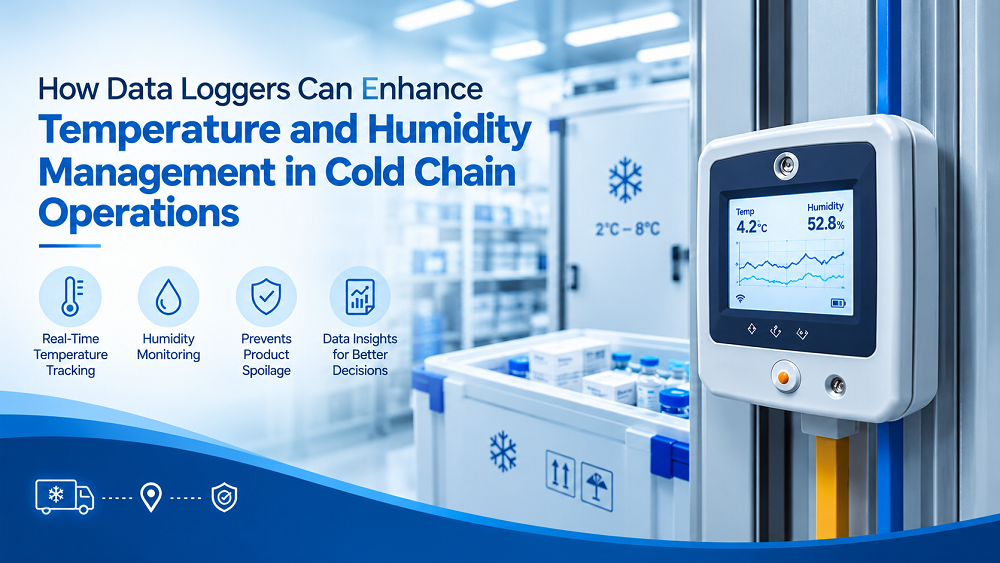
Proper ambient conditions are essential when transporting and storing pharmaceuticals, vaccines, food, chemical-based products, or any other temperature-sensitive materials. A brief fluctuation in temperature and time can potentially decrease product quality and cause an economic loss. Here, a data logger plays a crucial role in the cold chain.
A temperature data logger simply records temperature during storage and transportation, making it possible to check records. Depending on the use, there are other options available to businesses, including wireless monitoring and humidity logging or single-use loggers. Choosing an appropriate logger allows companies to recognize temperature excursions and enhances both responsibility and control of a product.
Why Temperature Monitoring Matters in the Cold Chain
Cold chain operations are a process that has several steps: storage, loading, carrying, and delivering. At every step, the conditions may vary due to equipment breaks, delays, doors being opened too often, bad weather, or mistakes.
A cold chain temperature data logger may help identify those variations by recording temperature values at certain intervals. “Companies can look at the history record during the trip instead of checking temperature manually. These values assist in pinpointing exactly when a deviation from the expected temperature occurred or if the shipment was within the acceptable temperature range.
How a Temperature Data Logger Supports Better Visibility
A temperature data logger records more than just the current temperature. It compiles a time-stamped record that will be interpreted at the conclusion of the shipment/storage.For logistics teams, a can make it easier to:
- Identify temperature excursions
- Review transportation conditions
- Investigate potential quality issues
- Maintain shipment records
- Improve cold chain processes
- Support compliance and quality documentation
In an application where it is necessary to see recorded data instantaneously, it would be possible to transmit recorded temperature data from a wireless temperature data logger through a suitable connection system, and this can avoid physically carrying and taking out the data logger before checking data.
Combining Wireless Monitoring With Data Logging
Increased product visibility can also be achieved by using a wireless temperature monitoring system while shipments are in transit or in storage across various locations. Depending on the system’s communication technology and configuration, product temperature data can be received remotely, rather than upon arrival.
This could be a considerable benefit for high-value products or highly sensitive merchandise, as logistics or quality teams can begin investigating an unusual temperature trend without waiting for a shipment to be delivered. Wireless systems can effectively complement logging solutions by increasing access to temperature monitoring along the supply chain.
Single-Use Data Loggers for Shipments
Not all shipments need to utilize a returnable monitor. In many cases, if the logger will be traveling with a specific shipment and doesn’t need to be returned, a single-use data logger makes economical sense.
A single-use temperature data logger records the temperature during the given monitoring period, and it can be retrieved to download information when the shipment reaches its destination. This can simplify monitoring for one-way shipments where equipment return and reuse is not handy.
The disposable, one-time-use temperature data logger can also be considered useful where companies wish to be associated with a unique data logger with individual consignments. This can simplify shipment-level documentation for the company.
When to Choose a Multi-Use Data Logger
A multi-use data logger is ideal when one device can be used for multiple operations/locations. Examples could include warehouses, storage, distribution routes, frequent transportation procedures, etc.
Reusable data loggers may be appropriate when the operations of an organization may use similar conditions and where a uniform level of monitoring needs to be established. Before choosing one of these, an organization needs to decide what range, storage size, battery life, software capabilities, and method of data extraction are required.
Monitoring Humidity Along With Temperature
Besides the environment temperature, other environmental conditions can impact the sensitive products. In certain applications, over/under humidity conditions could also pose a quality and storage problem.
A humidity data logger records humidity levels over time, helping users understand environmental conditions more comprehensively. A temperature and humidity data logger can log temperature and relative humidity with a single device for applications where both parameters are important.
A temperature and humidity data logger is well-suited for warehouses, storage of pharmaceutical goods, food logistics, labs, and other regulated environments where both data need to be maintained within specified ranges.
Understanding Temperature and Humidity Monitoring
A temperature and humidity logger is handy for taking measurements of two conditions simultaneously. So instead of having separate records from different types of loggers, companies can have a joint data logging solution where it fits.
A temperature and humidity logger can also be used to build up a more accurate record of what the temperature and humidity in storage or during transport have been.
Temperature and humidity logger and temperature and humidity data logger are terms that could be used for devices made to monitor these two parameters. The capabilities can vary from model to model, so it is better to check the measurement range, accuracy, memory size, sampling time intervals and communication options available.
Choosing the Right Data Logger
The type of data logger best suited will depend on your environment and the type of data you are capturing. Before purchasing, look at the following:
- Parameter requirements: Determine whether temperature, humidity, or both need to be measured.
- Monitoring duration: Short shipments may require different capabilities than long-term storage monitoring.
- Data access: Decide whether information will be downloaded later or accessed remotely.
- Reusability: Consider whether a single-use or reusable device better fits the logistics process.
- Recording interval: Select an appropriate sampling frequency for the application.
- Accuracy and range: Ensure the device is suitable for the required environmental conditions.
Suitable data loggers should be compatible with existing monitoring and quality-control procedures.
Conclusion
Trusted environmental monitoring solutions allow businesses increased visibility of cold chain operations. From a temperature data logger and cold chain temperature logger to a single-use data logger, wireless solutions, and combined temperature-humidity devices, different options are available for different monitoring requirements.
Organizations can select a more robust tracking system and better track abnormal temperature or humidity conditions by selecting the right logger based on product features, duration of transportation, ambient conditions and data retrieval needs.