How SAP SD Streamlines Order-to-Cash Processes
In today’s fast-changing business environment, organizations need advanced technologies to manage customer orders, deliveries, invoicing, and payments efficiently. Companies across industries are adopting ERP solutions to streamline operations, improve customer satisfaction, and enhance business productivity. One of the most important modules in SAP ERP and SAP S/4HANA is SAP SD (Sales and Distribution).
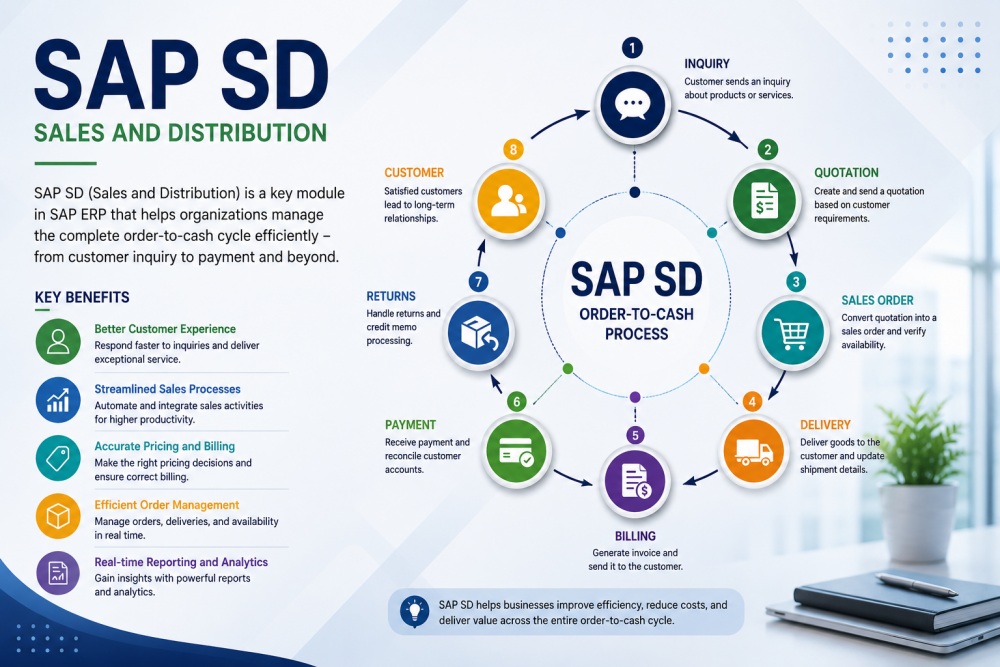
SAP SD helps organizations automate and optimize the complete Order-to-Cash (O2C) cycle. From customer inquiries to payment collection, SAP SD manages every step of the sales and distribution process with accuracy and real-time integration. Businesses using SAP SD can reduce operational costs, improve inventory visibility, speed up order processing, and strengthen customer relationships.
With increasing digital transformation initiatives worldwide, SAP SD has become an essential module for organizations looking to modernize their sales operations. The module supports industries such as manufacturing, retail, automotive, pharmaceuticals, logistics, consumer goods, and e-commerce.
What is SAP SD?
SAP SD stands for Sales and Distribution. It is a core functional module in SAP ERP that manages all sales-related activities, including customer inquiries, quotations, sales orders, shipping, billing, pricing, and transportation.
The primary objective of SAP SD is to simplify business sales processes and improve operational efficiency. SAP SD integrates seamlessly with various SAP modules to ensure smooth data flow across departments.
Important SAP modules integrated with SAP SD include:
- SAP MM (Materials Management)
- SAP FICO (Financial Accounting and Controlling)
- SAP PP (Production Planning)
- SAP WM (Warehouse Management)
- SAP EWM (Extended Warehouse Management)
- SAP CRM (Customer Relationship Management)
This integration helps businesses maintain accurate real-time information throughout the organization.
Understanding the SAP SD Order-to-Cash Process
The Order-to-Cash process is one of the most important business cycles in any organization. It involves all activities from customer inquiry to final payment collection.
SAP SD automates the complete process and ensures smooth coordination between sales, warehouse, logistics, and finance teams.
1. Customer Inquiry Management
The Order-to-Cash process begins when customers send inquiries regarding products or services. Sales representatives create inquiry documents in SAP SD to capture customer requirements.
The system stores details such as:
- Product information
- Quantity requirements
- Delivery schedules
- Pricing requests
- Customer contact details
SAP SD improves customer communication and helps businesses respond quickly to inquiries.
2. Quotation Creation
After analyzing customer requirements, sales teams create quotations in SAP SD.
Quotations include:
- Product pricing
- Taxes
- Discounts
- Delivery timelines
- Payment terms
- Validity periods
SAP SD automates pricing determination using predefined pricing procedures. This reduces manual errors and ensures pricing consistency.
Benefits of quotation management include:
- Faster quotation generation
- Improved pricing accuracy
- Better customer satisfaction
- Increased sales efficiency
3. Sales Order Processing
Once the customer accepts the quotation, a sales order is created in SAP SD.
The sales order contains complete transaction details such as:
- Customer master data
- Material information
- Delivery schedules
- Shipping details
- Pricing conditions
- Billing information
SAP SD automatically validates the sales order and checks for errors before processing.
Key benefits of sales order processing include:
- Reduced manual work
- Faster order confirmation
- Accurate data management
- Better order tracking
4. Availability Check (ATP)
One of the most valuable features in SAP SD is ATP (Available-to-Promise).
The system checks inventory availability in real time and confirms whether products can be delivered on the requested dates.
If stock is unavailable, SAP SD coordinates with:
- Production teams
- Procurement departments
- Warehouse operations
ATP functionality helps organizations:
- Avoid over-promising
- Improve delivery commitments
- Enhance customer trust
- Optimize inventory utilization
5. Delivery Processing
After order confirmation, delivery documents are generated in SAP SD.
The warehouse team performs activities such as:
- Picking
- Packing
- Goods issue posting
- Shipment preparation
SAP SD integrates with warehouse and transportation systems to ensure smooth delivery execution.
Delivery processing benefits include:
- Real-time shipment tracking
- Faster logistics operations
- Reduced shipping delays
- Improved delivery accuracy
Organizations can also manage multiple shipping points, routes, and transportation schedules efficiently.
6. Billing and Invoice Generation
Once goods are delivered, SAP SD automatically generates billing documents.
The system supports different billing types such as:
- Invoice billing
- Debit memo
- Credit memo
- Cancellation invoice
- Proforma invoice
Automated billing helps businesses:
- Reduce invoice errors
- Accelerate revenue recognition
- Improve cash flow
- Ensure tax compliance
SAP SD also supports electronic invoicing and integration with third-party systems.
7. Payment and Financial Integration
The final stage in the Order-to-Cash process is payment collection.
SAP SD integrates directly with SAP FICO to post accounting entries automatically.
This integration enables:
- Real-time financial updates
- Automatic revenue posting
- Better cash management
- Faster account reconciliation
Finance teams can monitor customer payments and outstanding balances efficiently.
Key Components in SAP SD
SAP SD consists of several essential components that allow businesses to control their distribution and sales efficiently.
Master Data
Master data constitutes the base to SAP SD.
Important master data includes:
- Customer master
- Material master
- Pricing master
- Records of Customer-material data
Accurate master data enhances the efficiency of transactions and improves reporting accuracy.
Sales Support
SAP SD supports pre-sales activities including:
- Customer inquiries
- Quotations
- Sales tracking
- Management of opportunities
This can help sales teams increase customer satisfaction.
Transportation and Shipping
The module is able to support shipping functions like:
- Route determination
- Shipment scheduling
- Delivery Tracking
- Transportation plan
Businesses can improve their logistics efficiency and cut costs for transportation.
Billing and Pricing
SAP SD provides flexible pricing management.
The organizations can set up:
- Discounts
- Taxes
- Freight charges
- Pricing promotional
- Prices that are specific to customers
This flexibility helps companies remain competitive in their pricing strategies.
Credit Management
SAP SD allows companies to set credit limits for customers.
The system is able to stop risky transactions in real time and minimize financial exposure.
Benefits include:
- Better risk management
- Better monitoring of payments
- Reduction of bad debt
The advantages of SAP SD to Business
SAP SD provides several advantages which help businesses improve efficiency and profit.
Increased Customer Satisfaction
SAP SD enables businesses to produce products faster and give accurate information about orders.
Customers gain from:
- Timely deliveries
- Transparent communication
- Correct invoicing
- Better service quality
Improved Efficiency of Operation
Automatization reduces manual work and helps reduce processing delays.
Companies can handle massive volumes of transactions efficiently.
Better Inventory Management
Real-time inventory visibility can help businesses to avoid stock shortages as well as overstocked stock.
Accurate reporting and analytics
SAP SD provides detailed reports for:
- Sales performance
- Analysis of the customer
- Product’s profitability
- Trends in revenue
- Delivery performance
Managers can make data-driven business decisions quickly.
Improved Integration
SAP SD is compatible and seamlessly with the other SAP modules and third-party apps.
SAP SD in SAP S/4HANA
SAP S/4HANA has transformed the capabilities of SAP SD.
The platform’s new features include:
- Real-time data processing
- Faster analytics
- Workflows that are simplified
- Improved user experience
- SAP Fiori applications
- Improved capabilities for reporting
Businesses that use SAP S/4HANA SD could modernize their digital processes and increase the agility of their businesses.
SAP Fiori in SAP SD
SAP Fiori provides a modern and user-friendly interface to SAP SD users.
Benefits include:
- Simple navigation
- Mobile accessibility
- Processing transactions faster
- Improved user productivity
Sales teams are able to access the latest data in real-time from any location.
Industries Using SAP SD
SAP SD is widely used across a variety of industries.
Manufacturing Industry
Manufacturers rely on SAP SD to manage:
- Sales orders
- Production coordination
- Planning for delivery
- Distributor management
Retail Industry
Retailers use SAP SD for:
- Store order management
- Pricing for customers
- Promotions
- Operation of billing
Pharmaceutical Industry
Pharmaceutical companies depend in SAP SD for:
- Batch management
- Compliance with the regulations
- Distribution tracking
- Processing orders for customers
Automotive Industry
Automotive companies use SAP SD to handle:
- Dealer management
- Spare parts distribution
- Agreements for scheduling of customers
- Logistics coordination
Career Chances in SAP SD
SAP SD is one of the most sought-after SAP modules around the world.
Companies are constantly looking to hire SAP SD professionals for implementation and support, as well as consulting and migration projects.
Career opportunities that are popular include:
- SAP SD Functional Consultant
- SAP SD Support Consultant
- SAP SD Business Analyst
- SAP S/4HANA SD Specialist
- End User SAP SD
- SAP SD Project Manager
Professionals who have SAP SD expertise can work in multinational firms as well as consulting firms, manufacturing industries as well as IT service providers.
Skills needed to be a SAP SD Professional. SAP SD Professionals
For a successful SAP SD career, professionals should be able to:
- SAP SD configuration
- Processing of sales orders
- Pricing procedures
- Billing configuration
- Shipping processes
- SAP S/4HANA concepts
- Knowledge of integration
A strong ability to communicate and analytic abilities are also essential.
The Reasons Companies Choose SAP SD
Businesses favor SAP SD because it offers total transparency of the distribution and sales activities.
The module aids businesses:
- Increase accuracy of orders
- Reduce operating costs
- Enhance revenue efficiency
- Improve customer experience
- Streamline logistics operations
As digital transformation becomes an important issue, SAP SD continues to play an important role in business operations for enterprises.
The future of SAP SD
The future of SAP SD is closely connected to the cloud, automated and smart business processes.
SAP is constantly improving SAP S/4HANA with:
- Artificial Intelligence (AI)
- Machine Learning
- Predictive analytics
- Intelligent automation
- Cloud integration
Companies who adopt these technologies are able to enhance efficiency at work and increase customers’ engagement dramatically.
SAP SD professionals with SAP S/4HANA and cloud integration capabilities will remain relevant in the job market.
Conclusion
SAP SD is a powerful and indispensable module that can streamline the entire process of Order-to-Cash. From managing customer inquiries to payment and billing integration, SAP SD helps businesses streamline distribution and sales processes effectively.
Businesses that have implemented SAP SD can achieve better control of their inventory, increased customer satisfaction, quicker order processing, and more accurate financial reports.SAP S/4HANA, businesses gain additional benefits, including real-time analytics, contemporary user interfaces, and sophisticated automation capabilities.
As businesses continue on their journey to digital transformation, SAP SD remains one of the most crucial solutions to manage contemporary sales activities. If you’re a business proprietor, ERP consultant, or an aspiring SAP professional, knowing SAP SD can offer an opportunity to grow your career and long-term business opportunities.