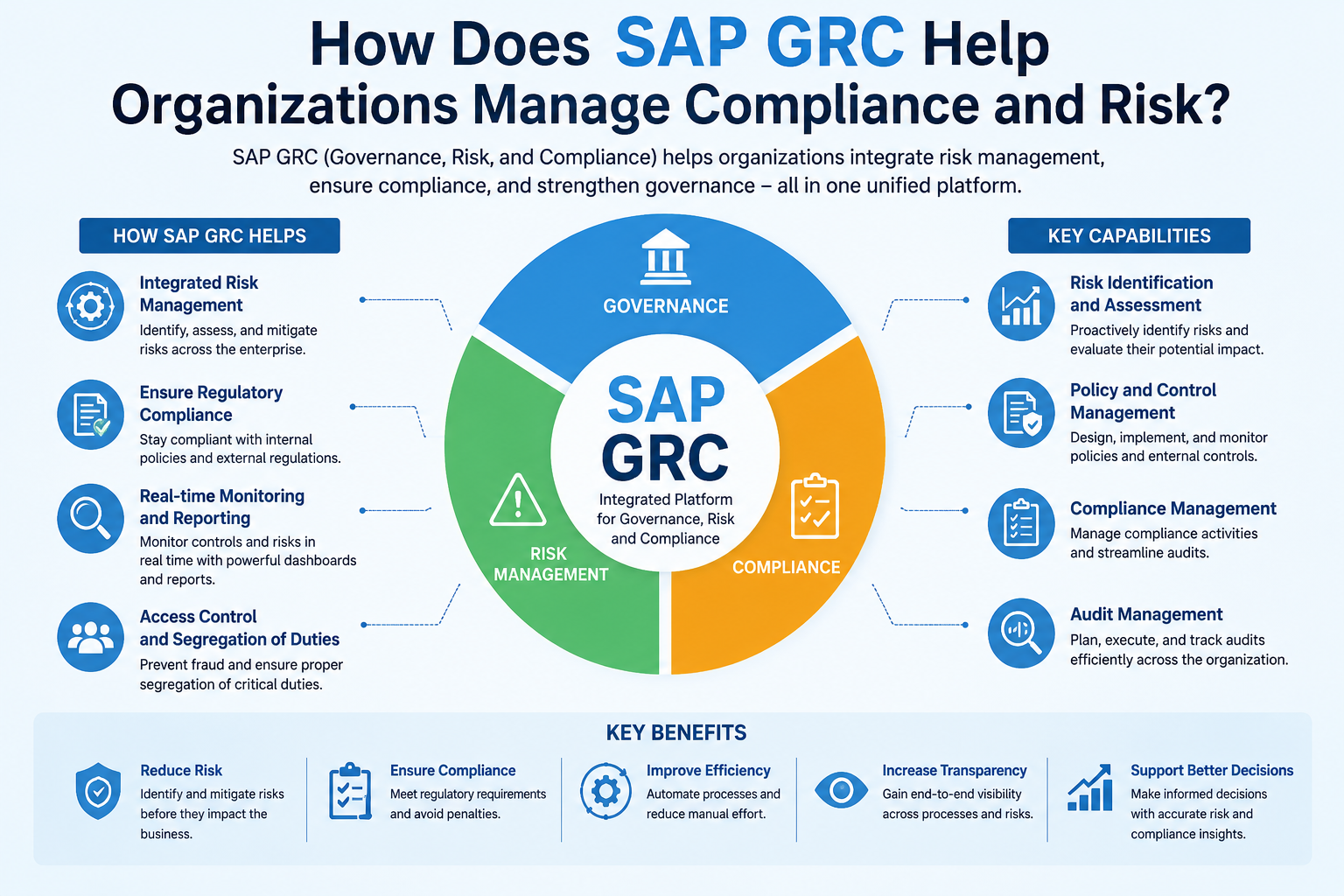
In today’s digital business environment, organizations face increasing pressure to comply with regulatory requirements while managing operational and security risks. Businesses handle vast amounts of sensitive data, financial transactions, and customer information every day. A single compliance violation or security breach can lead to significant financial losses, legal penalties, and reputational damage.
This is where SAP Governance, Risk, and Compliance (SAP GRC) plays a crucial role. SAP GRC Training is a powerful solution designed to help organizations streamline governance processes, identify potential risks, and ensure compliance with internal policies and external regulations. By integrating risk management and compliance activities into a single platform, SAP GRC enables businesses to operate more efficiently and securely.
Understanding SAP GRC
SAP GRC is a suite of tools that helps organizations manage governance, risk, and compliance activities across various business functions. It provides a structured approach to monitoring risks, enforcing controls, and ensuring that employees follow company policies and industry regulations.
The primary objective of SAP GRC Course in Noida is to help organizations reduce risk exposure while maintaining compliance with legal and regulatory requirements. It allows companies to automate many compliance-related tasks, making audits and reporting more efficient.
Why Compliance and Risk Management Matter
Every organization faces different types of risks, including operational, financial, cybersecurity, and regulatory risks. At the same time, businesses must comply with standards such as GDPR, SOX, HIPAA, and other industry-specific regulations.
Without an effective compliance and risk management system, organizations may experience:
- Regulatory penalties and fines
- Data breaches and security incidents
- Fraudulent activities
- Operational disruptions
- Loss of customer trust
SAP GRC helps businesses proactively identify and address these challenges before they become serious problems.
Key Components of SAP GRC
SAP GRC consists of several modules that work together to provide comprehensive risk and compliance management.
1. Access Control
One of the most widely used components of SAP GRC is Access Control. It helps organizations manage user access and permissions across SAP systems.
This module ensures that employees only have access to the information and functions necessary for their roles. It also helps identify Segregation of Duties (SoD) conflicts, where a single user has excessive permissions that could lead to fraud or unauthorized activities.
By enforcing proper access controls, organizations can reduce security risks and maintain compliance with audit requirements.
2. Risk Management
The Risk Management module enables organizations to identify, assess, and monitor business risks in real time.
Businesses can create risk registers, evaluate potential impacts, and implement mitigation strategies. This proactive approach allows management teams to make informed decisions and reduce the likelihood of unexpected disruptions.
With centralized risk visibility, organizations can prioritize critical risks and allocate resources more effectively.
3. Process Control
SAP GRC Process Control helps organizations monitor and improve internal controls across business processes.
The solution automates testing, monitoring, and reporting activities, reducing manual effort while improving accuracy. It ensures that key controls remain effective and aligned with regulatory requirements.
As a result, businesses can strengthen their internal control environment and reduce audit-related challenges.
4. Audit Management
Audits are essential for verifying compliance and identifying areas for improvement. SAP GRC Audit Management simplifies the audit process by providing tools for planning, execution, documentation, and reporting.
Auditors can collaborate more effectively, track findings, and monitor corrective actions through a centralized platform.
This improves audit efficiency and ensures greater transparency across the organization.
How SAP GRC Improves Compliance
Compliance management can be complex, especially for organizations operating in multiple regions with different regulatory requirements. SAP GRC simplifies compliance efforts through automation and centralized monitoring.
Automated Compliance Monitoring
SAP GRC continuously monitors business processes and user activities to detect policy violations or compliance issues.
Instead of relying on manual reviews, organizations can receive automated alerts when potential problems are identified. This allows compliance teams to respond quickly and take corrective actions.
Standardized Policies and Controls
SAP GRC helps organizations establish standardized policies and controls across departments and locations.
When policies are consistently enforced, businesses can reduce compliance gaps and maintain a stronger governance framework.
Simplified Reporting
Regulatory reporting often requires significant time and effort. SAP GRC generates detailed reports that provide insights into compliance status, risk exposure, and control effectiveness.
These reports help management teams, auditors, and regulators access the information they need quickly and accurately.
How SAP GRC Reduces Business Risk
Risk management is not just about responding to threats; it is about preventing them from occurring in the first place.
SAP GRC helps organizations reduce business risk by:
- Identifying risks before they impact operations
- Monitoring critical business activities in real time
- Strengthening internal controls
- Preventing unauthorized access to sensitive data
- Supporting informed decision-making through risk analytics
This proactive approach allows businesses to operate with greater confidence and resilience.
Benefits of Implementing SAP GRC
Organizations that implement SAP GRC often experience several significant benefits:
- Improved regulatory compliance
- Enhanced security and access management
- Reduced operational and financial risks
- Increased audit efficiency
- Better visibility into business risks
- Automated control monitoring
- Stronger corporate governance
These advantages help businesses create a more secure and compliant operating environment while supporting long-term growth.
Conclusion
As regulatory requirements become more complex and business risks continue to evolve, organizations need effective tools to maintain compliance and protect their operations. SAP GRC provides a comprehensive framework for managing governance, risk, and compliance activities through automation, centralized monitoring, and advanced analytics.By implementing SAP GRC, businesses can improve transparency, strengthen internal controls, reduce risk exposure, and ensure ongoing compliance with industry regulations. For professionals looking to build expertise in this high-demand area, enrolling in a SAP Course can be an excellent step toward a rewarding career in governance, risk management, and compliance.